商小虎正式履职总经理!融通基金如何走出业绩规模双降困境?

RongTong Fund announced on October 25, 2024 that Xiao Hu has officially taken over as the general manager, replacing Zhang Fan who resigned due to family reasons. Despite being backed by the state-owned enterprise China Chengtong, RongTong Fund has seen a continuous decline in performance in recent years, with serious product homogenization. Xiao Hu's appointment is highly anticipated to see if he can lead the company out of its predicament. Since 2017, Zhang Fan's departure has raised concerns in the market about management stability, while Xiao Hu is an experienced veteran who has accumulated rich investment management experience in RongTong Fund and the private equity field
On October 25, 2024, Rongtong Fund officially announced that Shang Xiaohu has taken office as the general manager, once again putting this long-established fund company in the spotlight. Since the previous general manager Zhang Fan left due to family reasons in April, Shang Xiaohu has been acting as the helm for nearly half a year, and now officially assumes the position.
Backed by the central state-owned enterprise China Chengtong, Rongtong Fund has a strong resource background. However, in recent years, its performance has been continuously lagging behind, with highly homogenized products severely affecting the company's image. The ability of the new leader to lead Rongtong Fund to break through under heavy pressure is worth looking forward to.
Frequent key personnel changes affecting investment decision continuity
Established in 2001, Rongtong Fund, as one of the second batch of domestic fund management companies, initially stood out in the industry with innovative products and rapid expansion of its management scale. In 2022, China Chengtong Group took over, and Rongtong Fund officially joined the "central enterprise system" public fund camp. This change of shareholders was seen as an important transformation for the company in terms of strategic positioning and governance structure. However, despite having a central enterprise background, Rongtong Fund's internal management did not achieve the expected stability as a result, but instead exposed issues such as high-level turbulence and increased team mobility during the transformation process.
Since 2017, Zhang Fan has served as the general manager of Rongtong Fund, leading the company through multiple changes in shareholders and reorganization of the management team, including the introduction of new deputy general managers, head of research, and several fund managers, aiming to enhance the company's research capabilities and market competitiveness. Under Zhang Fan's leadership, Rongtong Fund's management scale has grown. However, after nearly seven years in office, Zhang Fan suddenly resigned in April 2024 due to personal family reasons, causing concerns in the market about the stability of Rongtong Fund's management. Especially against the backdrop of frequent personnel changes in the company, Zhang Fan's departure further intensified external doubts about the quality of Rongtong Fund's management team.
Shang Xiaohu, who took over as acting general manager after Zhang Fan, is a seasoned veteran with rich research experience. Shang Xiaohu first joined Rongtong Fund in 2015 as the investment director, managing multiple fund products with outstanding performance and industry recognition. In 2017, Shang Xiaohu left Rongtong Fund and moved to the private equity field, serving as the general manager and investment director of Shanghai Xihong Private Equity, accumulating more extensive investment management experience. In 2023, after China Chengtong took over Rongtong Fund, the company recalled Shang Xiaohu to strengthen its research capabilities, appointing him as the deputy general manager in charge of research management. In April 2024, following Zhang Fan's resignation, Shang Xiaohu was appointed as the acting general manager and officially took office as the general manager in October of the same year, fully responsible for the company's management work.
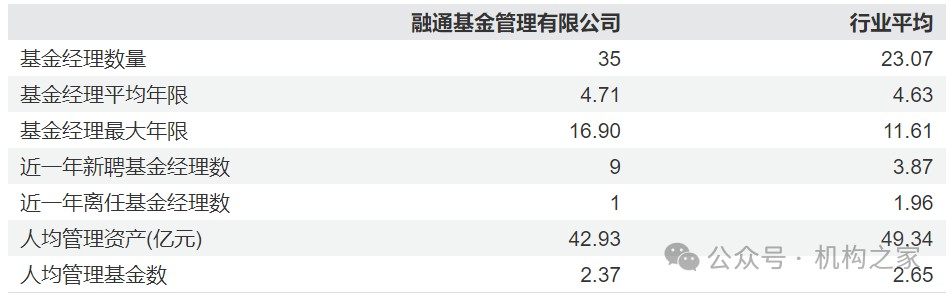
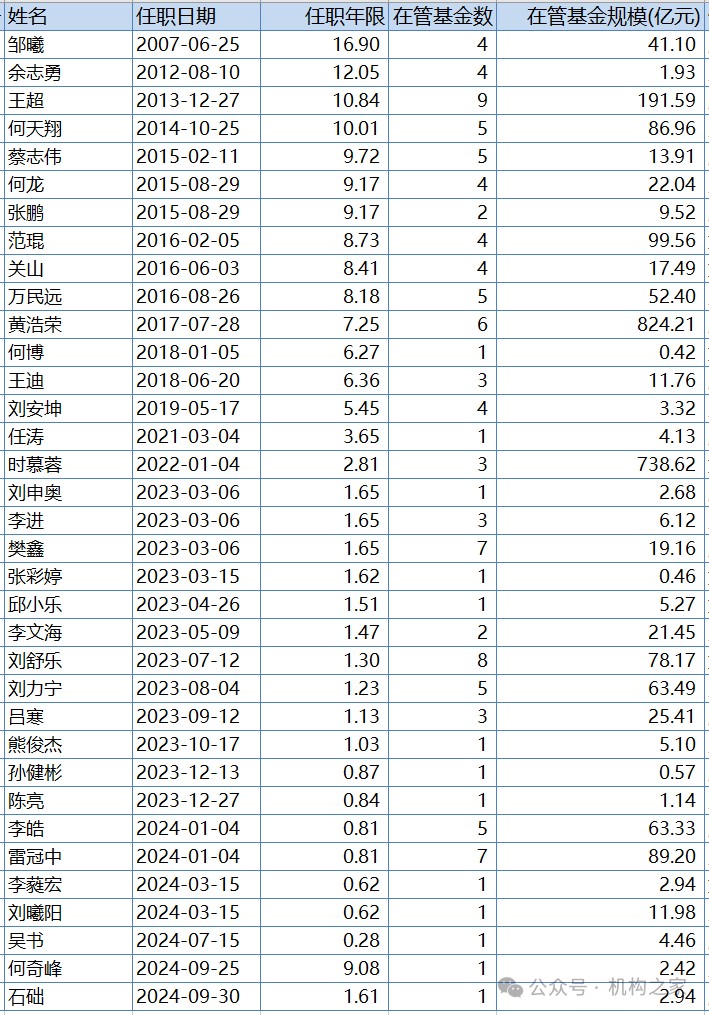
In the past two years, Rongtong Fund has introduced more than 9 new fund managers, far exceeding the industry average of 3.87, and appointed 19 new fund managers, accounting for over half of the total number of fund managers in the company. While the frequent personnel adjustments have brought fresh blood to the team, they have also highlighted the issues of personnel mobility and management stability at Rongtong Fund. Such a high frequency of personnel changes has affected the continuity and professional accumulation of the research team, posing significant challenges to the company's management structure

Chart Statistical analysis of Rongtong Fund Managers.
Data source: Wind.

Chart Rongtong Fund's fund managers.
Data source: Wind.
Long-term returns fall short of expectations, equity fund management scale shrinks
In recent years, the performance of Rongtong Fund's equity products has been continuously poor, failing to achieve the expected market returns. For example, products like Rongtong Innovation Drive A, Rongtong Internet Media, and Rongtong Core Value Hybrid A have all experienced significant cumulative net asset value declines since their inception. Among them, Rongtong Innovation Drive A has a cumulative decline of 38.94%, Rongtong Internet Media has accumulated losses of over 25% after 9 years of establishment, and Rongtong Core Value Hybrid A has also accumulated losses of over 25% since its inception. These products have been in a negative return state for a long time, far from meeting investors' expectations.

Chart Performance of Rongtong Innovation Drive A.
Data source: Wind.

Chart Performance of Rongtong Internet Media.
Data source: Wind.

Chart Performance of Rongtong Core Value Hybrid A.
Data source: Wind.
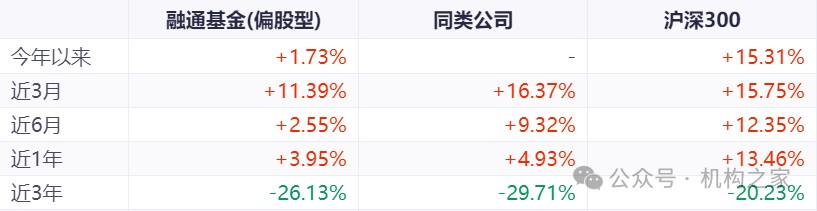
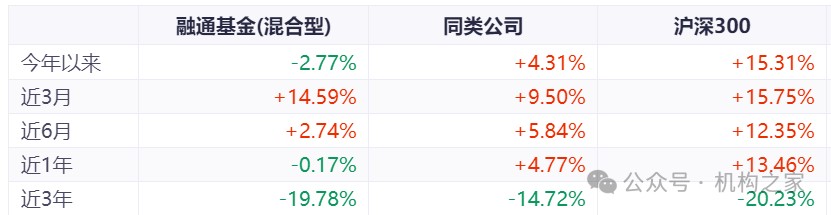
In addition, many of Rongtong Fund's funds have long-term underperformed similar products. Data shows that the average return rate of its equity funds this year is 1.73%, significantly lower than the 15.31% return rate of the CSI 300; the average return rate of the company's mixed funds in the past three years is -19.7%, also showing less than ideal performance within the industry. This significant lag reflects a conservative investment strategy by fund managers, and may also be affected by the lack of decision-making continuity due to frequent changes in senior management.

Chart Performance of Rongtong Fund's equity funds.
Data source: iFinD.
Performance of Rongtong Fund's Mixed Fund.
Data source: iFinD.
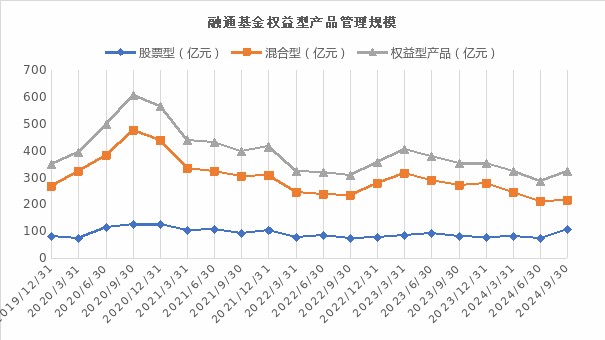
Affected by poor performance, the scale of Rongtong Fund's equity products has been continuously shrinking since 2020, dropping from the peak of 605.97 billion yuan to 323.04 billion yuan in 2024, a decrease of nearly 50%. The significant decline in scale indicates that the attractiveness and trust of investors in Rongtong Fund's equity products are gradually decreasing.

Homogenization of Holdings and "Copying Homework" Phenomenon
The problem of homogenization of product holdings in Rongtong Fund is particularly prominent, especially in several funds managed by Zou Xi. The holdings structure of the four funds he manages is highly similar, with almost identical holding proportions. This "copying homework" style of holding strategy, although it may bring short-term excess returns in individual market environments, when the market enters a downturn cycle, homogenized holdings instead exacerbate the synchronous fluctuations of the fund's net asset value, increasing investment risks.
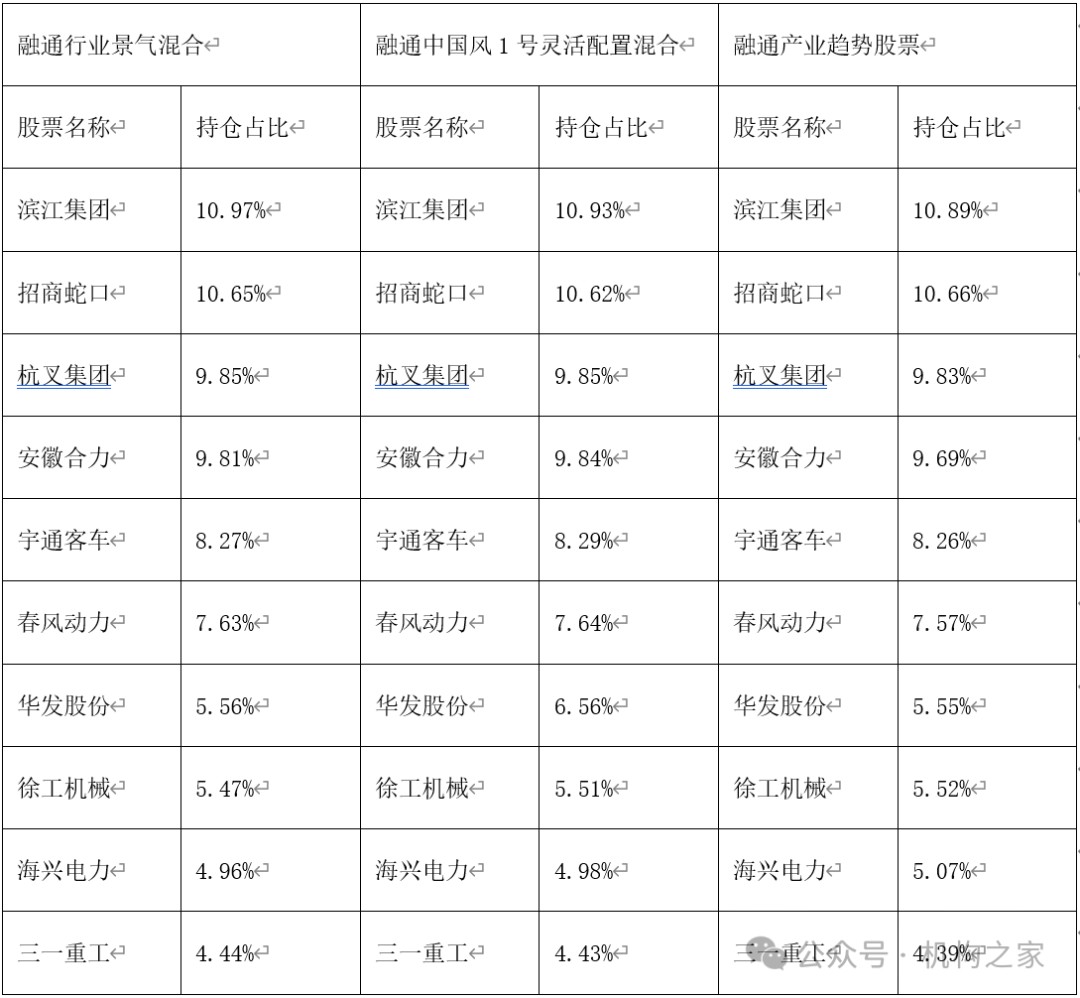
Taking the third quarter of 2024 as an example, the top ten heavy-weighted stocks of Rongtong Industry Prosperity Hybrid, Rongtong China Wind 1 Flexible Allocation Hybrid, and Rongtong Industry Trend Stock, all managed by Zou Xi, were almost identical, covering stocks such as Binjiang Group, China Merchants Shekou, and Hangcha Group. This concentrated stock holding strategy can indeed bring excess returns when individual stocks perform well, but in times of increased market volatility or stock downturns, it can lead to synchronous drawdowns in the fund's net asset value. This type of concentrated holding strategy increases the systematic risks brought by individual industries and stocks, failing to effectively diversify the fund's investment risks.

Chart showing the top ten heavy-weighted stocks of Rongtong Industry Prosperity Hybrid, Rongtong China Wind 1 Flexible Allocation Hybrid, and Rongtong Industry Trend Stock.
Data source: Wind
Furthermore, the high overlap in holdings of multiple funds not only affects the differentiated positioning of Rongtong Fund products but also amplifies the impact of market fluctuations on investment portfolios. For investors, funds with overlapping holdings are equivalent to duplicate investments, making it difficult to achieve the expected risk-return ratio. The company has not yet proposed effective differentiated management strategies to alleviate this issue, further weakening investor confidence and leading to a continuous increase in redemption intentions.
As an established fund company, Rongtong Fund is facing multiple challenges, with internal and external pressures intensifying. Frequent changes in core personnel have led to poor management stability, affecting team cohesion and the continuity of investment decisions. As Shang Xiaohu officially takes office as the general manager, the market's first expectation of him is whether he can maintain the stability of the research team, which is essential for laying a solid foundation for performance improvement