


Track Hyper | Who is the biggest beneficiary of the shortage of automotive CIS?

What is a leader?
Author: Zhou Yuan / Wall Street News
Domestic high-end vehicle-mounted CIS (CMOS Image Sensor) products are facing a serious shortage dilemma. The situation has worsened after BYD released the Aito Tian Shen Zhi Yan.
Wall Street News has learned that the most severely shorted vehicle-mounted CIS product is the 8M (i.e., 8 million pixels) vehicle-mounted camera. Currently, 8M is the highest-end vehicle-mounted CIS category in China.
Vehicle-mounted CIS, or vehicle-mounted CMOS Image Sensor (CIS: CMOS Image Sensor), is a core component of the camera module, playing a key role in light perception and image quality.
The camera is a complete system composed of multiple parts, including lens group, focus motor, infrared filter, image sensor (CIS), PCB board, etc.
CIS is an indispensable key component located inside the camera, working in conjunction with other parts to complete the tasks of image capture and transmission.
Currently, the industry is rapidly advancing the research and mass production of high-end vehicle-mounted cameras with 8 million pixels. Products of this specification have already achieved a maximum detection distance of 250m.
According to statistics from ChaoDian Research Institute, Chinese automotive brands such as BYD, Nio, Li Auto, XPeng, ZEEKR, IM Motors, as well as Aito and Extreme Fox from the Huawei system, have basically made the 8M ADAS camera a standard configuration; the Xiaomi SU7, set to be released at the end of March 2024, also starts with an 8M vehicle-mounted CIS.
The BYD Aito Tian Shen Zhi Yan system, in its lowest configuration C (DiPilot 100) version, uses a tri-camera system composed of dual 8 million pixel wide-angle and a single 8 million pixel telephoto camera, which is adopted by models such as the 2025 Han and the second-generation Qin PLUS intelligent driving version.
It is not difficult to infer that the higher-end Tian Shen Zhi Yan A and Tian Shen Zhi Yan B will also inevitably use the 8 million pixel vehicle-mounted CIS specification.
"The majority of the new vehicle-mounted cameras added to BYD's Aito Tian Shen Zhi Yan are high-end 8M (8 million) pixel CMOS," a core department head from a leading domestic manufacturer told Wall Street News.
According to statistics from ZuoSi Automotive Research, from January to September 2024, the installation volume of autonomous driving systems (ADS: Autonomous Driving System) containing 8MP front-view cameras reached 2.752 million units, a year-on-year increase of 26%, with penetration rate rising from 10.6% to 23.8%; the installation volume of 8MP side-view cameras was 1.683 million units, a year-on-year increase of 67.2%; the installation volume of 8MP rear-view ADS also saw significant growth, reaching 297,000 units, a year-on-year increase of 116.1%.
At the same time, the 7VnR solution has become the mainstream vehicle-mounted camera configuration for ADS in China, with a significant increase in installation volume, driving the growth of camera usage per vehicle.
The so-called 7VnR solution consists of "7V," which refers to a combination of seven visual sensors, and "nR," which indicates an indefinite number of radars and other sensors, working together to provide comprehensive and precise data support for the vehicle's autonomous driving functions.
From the data of ADS sensors equipped in new cars, it is evident that the growth rate in 2024 is remarkable: "7V" had an installation volume of 389,000 units from January to September last year; the "7V3R1L" saw an astonishing year-on-year increase of 4755.1%; "7V1R1L" year-on-year growth of 101%; "7V5R1L" year-on-year growth of 173.4%, highlighting the importance and broad prospects of this solution in the field of autonomous driving in 2024.
In terms of cost, the centralized architecture of system control has made cameras lightweight sensors that "only collect data without processing."
Currently, the transformation of the vehicle E/E architecture is leading to a highly centralized iteration of ECUs (Electronic Control Units, equivalent to the central brain of the car), and the aggregation of computing power and simplification of camera hardware are also driving visual computing to the "central brain," thus making CIS and lenses core components, significantly reducing costs.
What is the current global market landscape?
In 2023, the global CMOS image sensor market, Sony and Samsung together accounted for over 64% market share.
Among them, Sony increased from 42% in 2022 to 45% in 2023, ranking first in sales globally; the second to fourth places are occupied by Samsung (19%), OmniVision (11%), and ON Semiconductor (6%).
In terms of shipment volume, according to data from ChaoDian Think Tank, OmniVision's automotive CIS shipment volume in 2023 reached 103 million units, surpassing ON Semiconductor to become the global leader, with a shipment share of up to 43%.
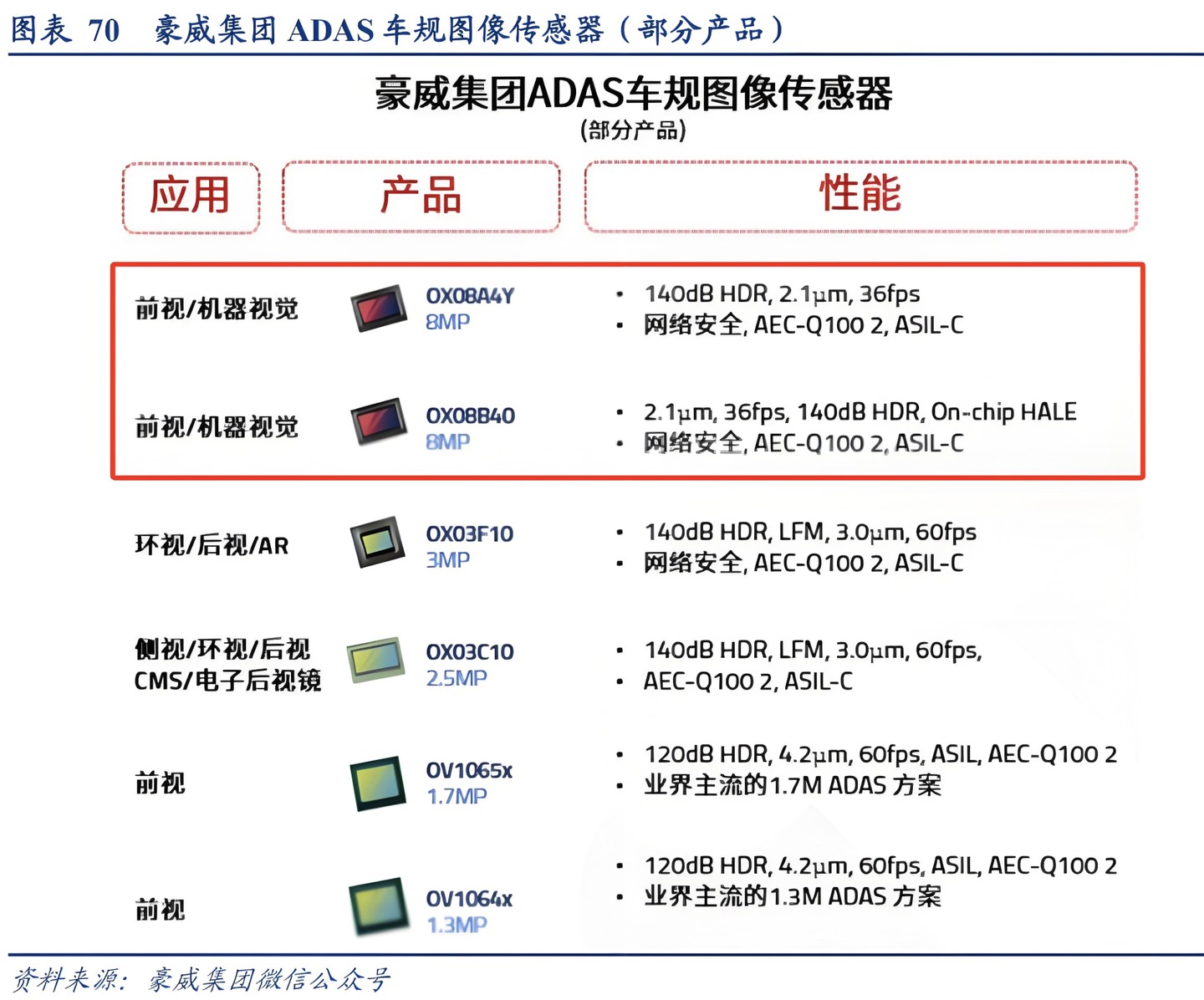
Wall Street Insights learned from authoritative supply chain channels that the current industry shortage of 8M pixel automotive CIS is indeed a product of OmniVision. This company is currently working hard to replenish orders for 8M automotive CIS. Weir Group fully controls OmniVision.
OmniVision has become a mainstream supplier of automotive-grade image sensor solutions for ADAS (Advanced Driver Assistance Systems), with clients including first-tier luxury car brands and emerging car manufacturers.
Their OX08B40 has been used in mass production models of top domestic OEMs and has achieved compatibility with major domestic and international platforms.
In addition to OmniVision, domestic suppliers also include SmartSens and GCORE.
Among them, SmartSens' automotive-grade CMOS image sensors cover resolutions from 1MP to 8MP, and ADAS products have already achieved mass production; in contrast, GCORE's front-mounted market has not yet ramped up, with main products concentrated in the automotive aftermarket. According to GCORE's 2024 semi-annual report, their front-mounted products achieved automotive-grade CMOS client sample testing in the second half of last year.
The automotive market mainly focuses on front-mounted products, so collaboration with automotive OEMs (Original Equipment Manufacturers) is crucial
