


The Japanese stock market urgently needs a "booster"! Investors are looking forward to Buffett's annual shareholder letter to boost confidence

Japanese stock market investors are looking forward to Warren Buffett's upcoming annual shareholder letter, hoping it can inject confidence into the sluggish market. Buffett's letter will be released on February 22, and investors will pay attention to his comments on the Japanese stock market. Due to global economic uncertainty and rising inflation in Japan, the Tokyo Stock Exchange Wholesale Trade Index has fallen by 12% cumulatively. Buffett's comments may provide upward momentum for the Japanese stock market, helping it break free from recent fluctuations
According to the Zhitong Finance APP, investors focusing on the Japanese stock market are holding their breath for Warren Buffett's upcoming annual shareholder letter, hoping that this global investment icon, known as the "Oracle of Omaha" and "Sage of Omaha," can inject new upward momentum into the sluggish stock prices of Japan's major general trading companies and the persistently weak Japanese stock market this year. It is understood that Buffett's Berkshire Hathaway will announce its performance on February 22nd, Eastern Time, and the highly anticipated "investment bible" from Buffett—the annual shareholder letter—will also be released on the same day.
Since the U.S. presidential election last November, the Japanese Topix Wholesale Trade Index has cumulatively dropped significantly by 12%, underperforming one of Japan's benchmark indices, the Topix Index, due to global economic uncertainties brought about by the new round of tariffs from the Trump administration, declining energy prices, rising inflation in Japan leading to reduced household spending, and the impact of Trump's pressure on oil prices. Investors focusing on Japan will carefully read Buffett's handwritten annual letter, looking for any comments he may have regarding the Japanese stock market.
The benchmark index for blue-chip stocks in the Japanese stock market—the Nikkei 225 Index—has also performed poorly this year, with a cumulative decline of over 3%, significantly underperforming the S&P 500 Index and the MSCI Global Index. The five major trading companies hold significant weight in the Nikkei 225 Index, which means that investors focusing on Japan will closely study Buffett's comments and scrutinize Berkshire Hathaway's descriptions of its positions in the Japanese stock market, searching for any signs that may support the large trading companies.
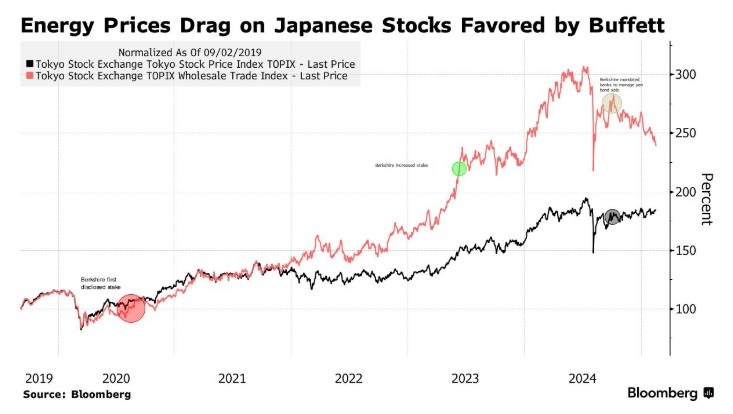
Buffett's influence in the global financial markets is immense, so any comments he makes regarding Japanese stocks, large trading companies, or other related fields are crucial. These comments are likely to provide core upward driving forces for the Japanese stock market, helping it break free from the narrow range of fluctuations it has been experiencing for the past few months.
Market observers have noted that if "Sage of Omaha" Buffett reaffirms his long-term investment outlook for the five major Japanese trading companies—Marubeni Corporation, Itochu Corporation, Sumitomo Corporation, Mitsui & Co., and Mitsubishi Corporation—in his letter, it could reverse the current downturn in the entire Japanese stock market. As an important barometer of the global capital market, any statements from Buffett in his annual shareholder letter could become a key driver in breaking the months-long sideways trading pattern of the Japanese stock market.
Kohei Onishi, chief strategist at Mitsubishi UFJ Morgan Stanley Securities, pointed out in a report: "Buffett's holdings have always been a leading indicator of foreign capital inflows. If Buffett once again affirms the investment value of Japanese stocks, the market's uplifting effect will be exponentially amplified." In last year's shareholder letter, Buffett praised the "shareholder return policies" of large Japanese companies such as Mitsui & Co. and Mitsubishi Corporation as far superior to their American counterparts, directly driving related stocks to historical highs. In the eyes of the financial market, these companies, which have strong performance and long-term attractive shareholder returns, are considered unique to the Japanese market, providing a diversified trading model across multiple core sectors from energy to retail.
After this legendary investor first disclosed his holdings in Japan's five major trading companies (with an average holding ratio of about 9%) in 2020, it triggered a global reassessment of the undervalued effect of Japanese stocks. The continuous influx of foreign capital helped the Nikkei 225 index refresh its historical peak around this time last year. However, Mineo Bito, President and CEO of Bito Financial Service Co., who has attended the Berkshire Hathaway shareholder meeting multiple times, believes that given Buffett's lack of significant adjustments to his holdings this year, the probability of him specifically mentioning the Japanese stock market in his letter is very low. He also stated that under the heavy pressure of Trump's tariffs, Buffett's investment expectations for the Japanese stock market have weakened.
It is noteworthy that Berkshire Hathaway issued the largest yen-denominated bonds since 2019 last October, which the market interpreted as a precursor to increasing investment in the Japanese stock market.
In terms of valuation, the current average price-to-earnings ratio of the five major trading companies is only around 8x, significantly lower than the average level of 12.5x for the MSCI Japan Index. The dividend yield is as high as 5%, far exceeding the benchmark dividend of the MSCI Japan Index, and cash flow has been very abundant for a long time, highlighting its value investment attributes, which align well with Buffett's long-term investment standards.
Analysts point out that if "stock god" Buffett releases a significant signal for increasing his holdings this time, it could spark a new wave of foreign capital rushing into Japan in the global capital allocation landscape. Buffett's annual letter could become an important catalyst for bullish market sentiment, especially if he expresses confidence in Japanese trading companies again. This confidence could attract more foreign capital inflow, pushing the Japanese stock market to break through its current narrow fluctuation range.
Japanese blue-chip stocks, including the five major trading companies known as "Nihon Toku" (Japanese Special Valuation), are favored by global investors in 2023-2024 due to their solid fundamentals and various measures focused on improving shareholder return rates. The Nikkei 225 index broke the levels set during Japan's bubble period in 1989, reaching a historical high in 2024, but has underperformed global indices since 2025. The concept of "Nihon Toku" mainly refers to those assets represented by the five major trading companies, which have been significantly undervalued, along with Japanese blue-chip companies that have high dividends, large stock buybacks, and continuously improve corporate governance
