


Trump's first cabinet meeting of his second term: tariffs, Ukraine, layoffs, and oil trading were all discussed, and U.S. stocks fell sharply

Elon Musk's participation in the conference became a highlight. According to CCTV News, Trump stated that most tariffs will continue to be implemented. It is expected that a 25% tariff on goods imported from the EU will be announced soon, with reciprocal tariffs implemented on April 2, and a 25% tariff on goods imported from Mexico and non-energy goods imported from Canada
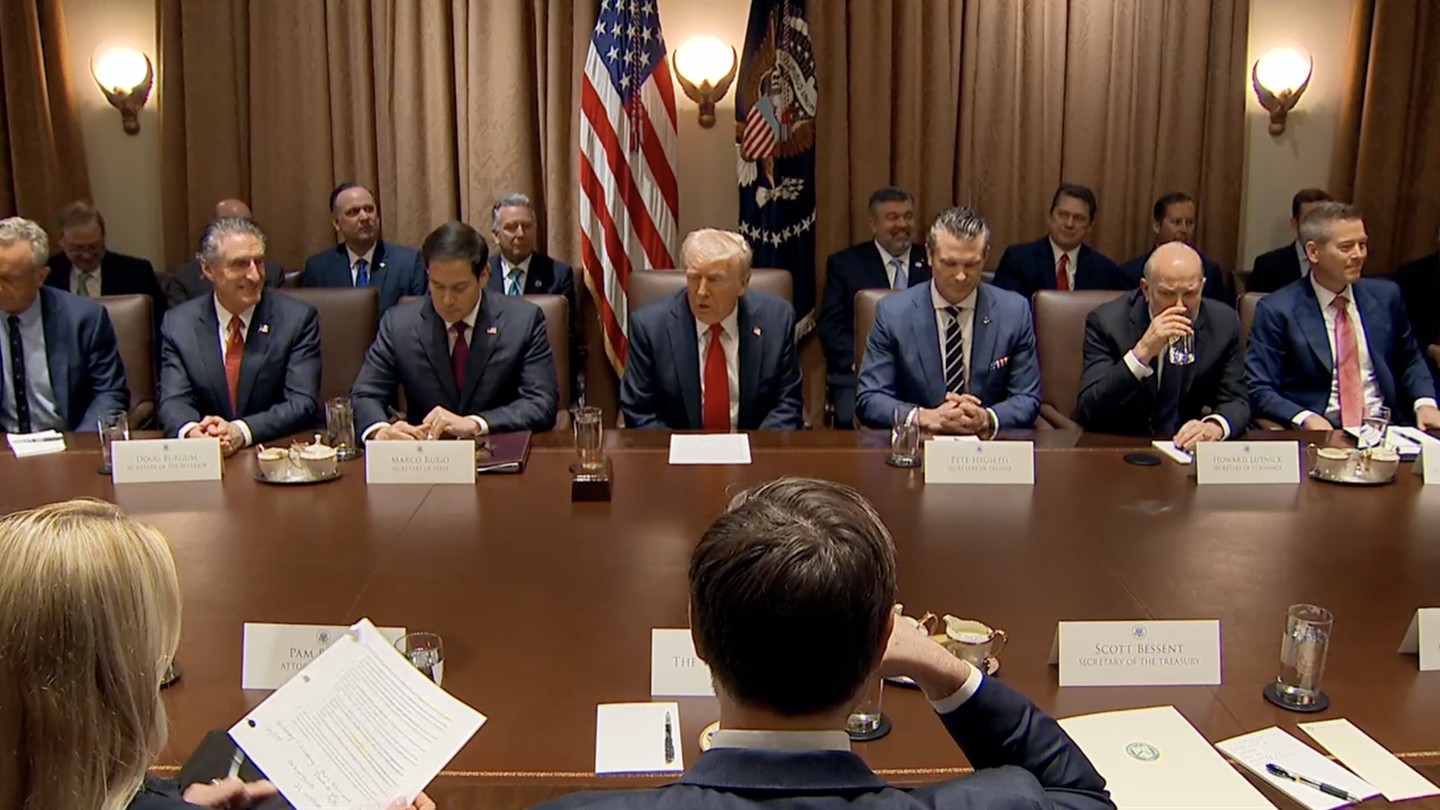
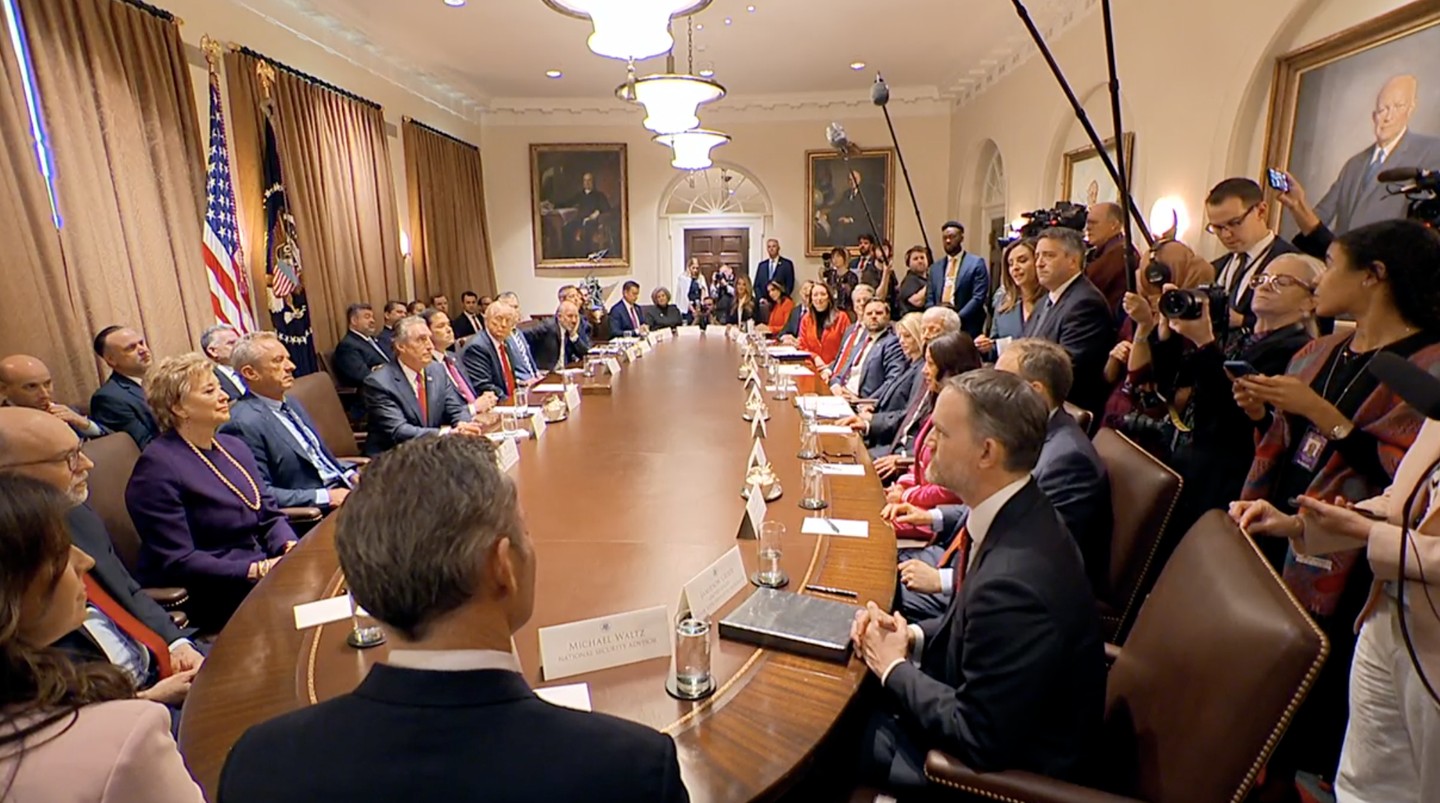
According to CCTV News, on February 26 local time, U.S. President Trump held his first cabinet meeting of his second term.
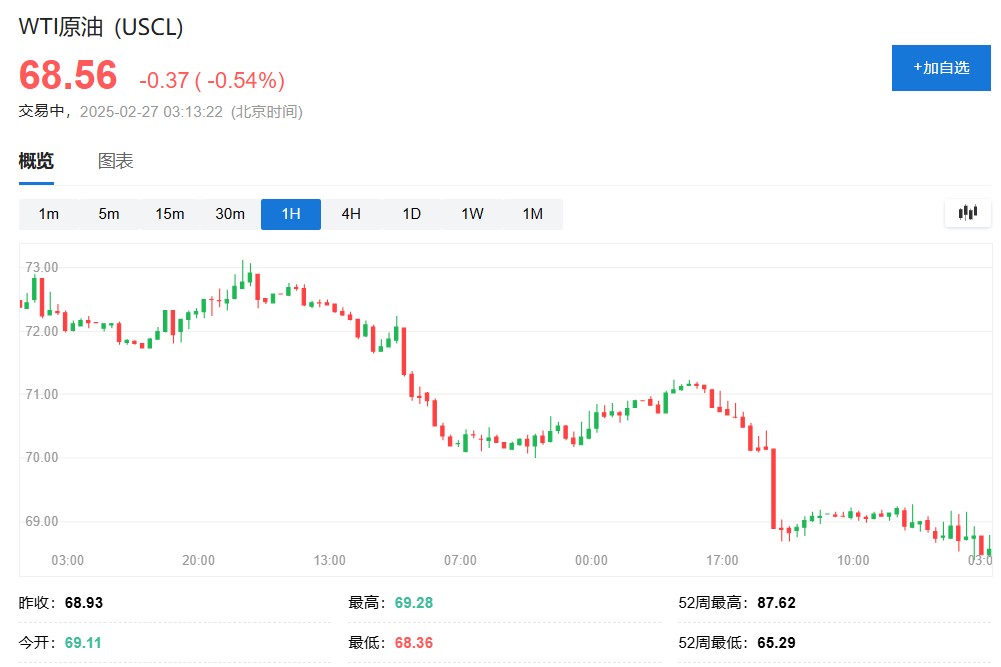
Around 11 a.m. Eastern Time, as the cabinet meeting began, U.S. stocks generally maintained earlier gains for the day, with the S&P 500 index up 0.8%, the Dow Jones up 0.3%, the Nasdaq up 1.3%, and the semiconductor index up nearly 2.8%. WTI crude oil futures rose 0.09%, reported at $68.99 per barrel.
U.S.-Ukraine Mineral Agreement
According to CCTV News, Trump confirmed that the Ukrainian president will visit the U.S. on the 28th to sign a rare earth-related agreement. Trump stated that Ukrainian President Zelensky will visit Washington, D.C. on the 28th, and the U.S. and Ukraine will sign agreements regarding rare earths and other aspects. Trump said, "We will get our money back."
Regarding the upcoming U.S.-Ukraine mineral agreement, Trump introduced that the U.S. "will cooperate with Ukraine on rare earths." The U.S. hopes to recover the $350 billion allocated to Ukraine through the mineral agreement.
According to previous media reports, under the agreement, the U.S. and Ukraine will jointly establish a fund, with the Ukrainian side injecting 50% of the future revenues from its oil, gas, and mineral resources into the fund. The U.S. will maximize its economic benefits from the fund, using part of the income for reinvestment in Ukraine.
Trump also stated, "The U.S. will not provide security guarantees to Ukraine in the agreement to end the Russia-Ukraine conflict, but Europe will." He further mentioned that Ukraine "can forget" about joining NATO.
Trump hopes for more talks between the U.S. and Russia. He stated that Russian President Putin "must" make concessions in the negotiations to end the Russia-Ukraine conflict. He also expressed a desire to first see if the U.S. can reach an agreement with Russia before discussing easing sanctions Trump stated that maintaining peace is easy, but reaching an agreement (to achieve peace) is difficult.
U.S. Government Efficiency, Deficit, Layoffs
According to CCTV News, Elon Musk, head of the Office of Government Efficiency, although not a cabinet member, also attended the meeting. Musk stated that the overall goal of the Office of Government Efficiency is to help address the massive fiscal deficit. Musk claimed that the U.S. cannot afford an annual fiscal deficit of $2 trillion. If this situation continues, the U.S. will face "bankruptcy." He plans to achieve a $1 trillion reduction in the deficit by fiscal year 2026.
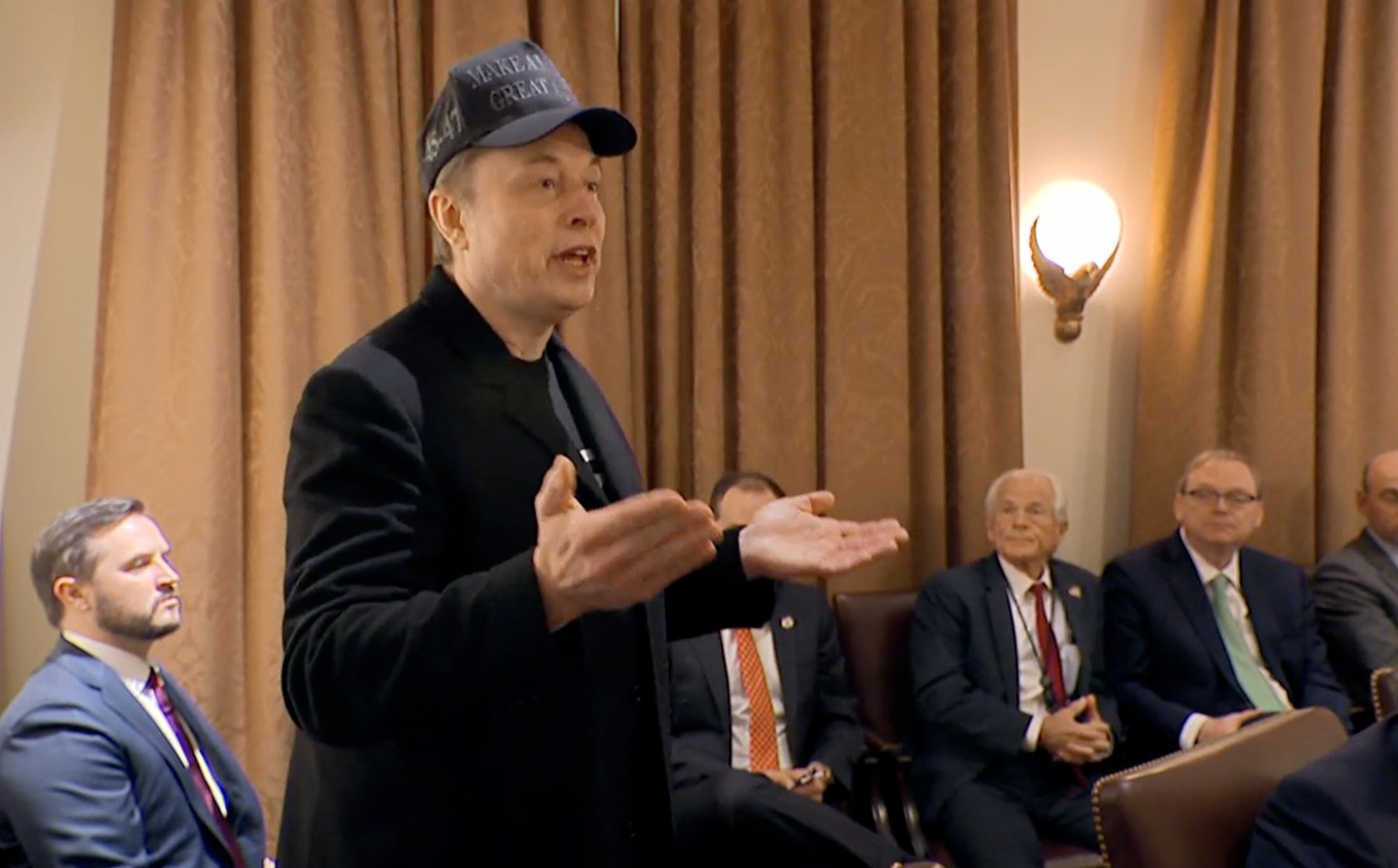
Trump expressed the desire to have the Office of Government Efficiency (DOGE) save the U.S. federal government up to $1 trillion in expenditures, hoping to reasonably balance the federal budget in the short term, aiming to balance the budget next year or thereafter.
Trump stated that careful selection of layoff targets in the State Department is necessary. The U.S. will reduce government size. The head of the U.S. Environmental Protection Agency, Zeldin, plans to cut 65% of the agency's staff.
It is reported that a memorandum issued by the Federal Human Resources Agency's Office of Personnel Management and the Office of Management and Budget indicates that the Trump administration has instructed agencies to work with the "Government Efficiency Team Leader" to submit "restructuring plans" by March 13 in preparation for large-scale layoffs.
Trump Mentions Inflation
Trump acknowledged that U.S. inflation is declining, partly due to high interest rates.
Trump Discusses Tariffs
The market is highly concerned about Trump's tariff issues. During a cabinet meeting on Wednesday local time, Trump discussed tariffs on Canada, Mexico, and the European Union According to CCTV News, on February 26 local time, Trump stated at a cabinet meeting that most tariffs will continue to be implemented. The United States will impose a 25% tariff on goods imported from Mexico and non-energy goods imported from Canada starting April 2.
On February 1, Trump signed an executive order imposing a 25% tariff on products imported from Mexico and Canada, with a 10% tariff on Canadian energy products. On the 3rd, Trump announced a 30-day delay in the implementation of the tariff measures for the two countries and continued negotiations. According to this decision, the relevant tariff measures will take effect on March 4. On the 24th, Trump stated that the plan to impose tariffs on Mexico and Canada would "proceed as scheduled." In addition, on the 13th, Trump signed a memorandum requiring relevant departments to determine "reciprocal tariffs" with each foreign trading partner.
According to Xinhua News Agency, Trump said that the U.S. has decided to impose a 25% tariff on the European Union and will announce it "soon." Trump told the media during a cabinet meeting at the White House that overall, the tariff rate on the EU will be set at 25%, applicable to automobiles and various other goods. The EU "takes advantage of the U.S." and "refuses to accept American automobiles and agricultural products" for various reasons, with a trade deficit of about "$300 billion" between the U.S. and the EU.
The U.S. political news website Politico previously reported that the trade deficit between the U.S. and the EU is not as large as Trump claims. According to EU data, the U.S. had a goods trade deficit of 155.8 billion euros (approximately 168.6 billion dollars) with the EU in 2023; however, in services trade, the U.S. achieved a surplus of 104 billion euros (approximately 112.6 billion dollars). Overall, the U.S. trade deficit with the EU is 51.8 billion euros (approximately 56 billion dollars).
It should be noted that Trump provided a series of contradictory answers regarding tariffs on Canada, Mexico, and the EU on Wednesday:
At Wednesday's cabinet meeting, a reporter asked Trump if he planned to officially implement the 25% tariff on Canada and Mexico on March 4. Trump replied, "I will not stop the tariffs."
Trump announced these tariff measures earlier this month, but then reached an agreement with the leaders of the two countries to postpone the implementation date by one month in exchange for stricter border control measures. This postponement will expire next week.
However, later on Wednesday, Trump stated that the tariffs on Mexico and Canada would take effect on April 2.
U.S. Secretary of Commerce Wilbur Ross said at the meeting that the overall tariff actions against various countries would be implemented on April 2.
Some analysts say it is unclear whether Trump was referring to giving Mexico and Canada additional time or if he confused this tariff measure with another global "reciprocal tariff" plan being developed by the U.S. Department of Commerce and the Office of the U.S. Trade Representative. Trump's statements on the tariff timeline often leave the market confused, as he tends to mention multiple plans when responding to reporters' questions.
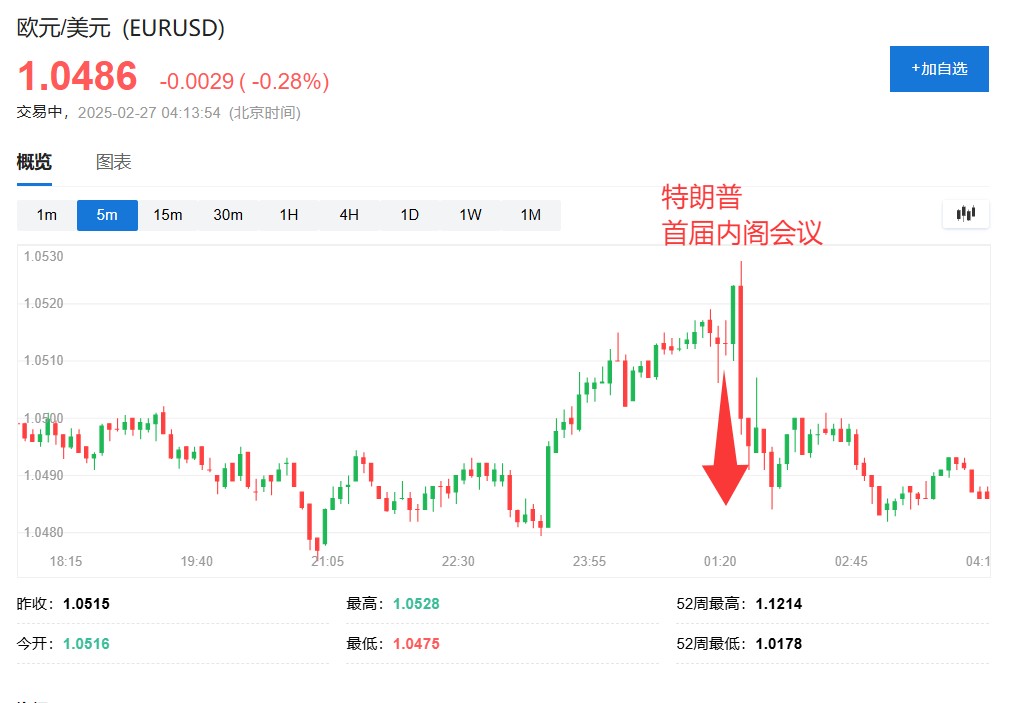
After Trump's statement on Wednesday, the market believed he might delay the imposition of tariffs on imported goods from Canada and Mexico, leading to a temporary rise in related assets in Mexico, Canada, and Europe:
- The Mexican peso quickly rose against the dollar, climbing from below 20.45 pesos to above 20.30 pesos, reaching a daily high.
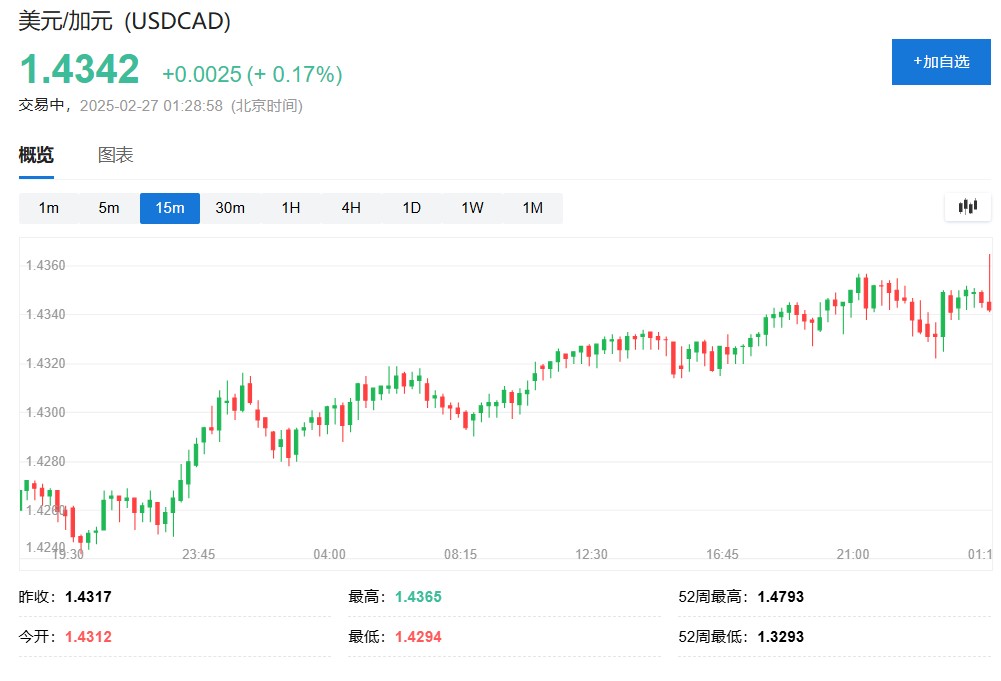
- The U.S. dollar rose about 0.2% against the Canadian dollar, trading at 1.4342.
- The euro almost completely recovered earlier losses against the dollar. The iShares Europe ETF listed in the U.S. rose 0.75%, and the iShares Eurozone ETF rose 0.89%, holding steady near daily highs.
- Electric vehicle concept stock Lucid fell 10.7%, Tesla fell 0.9%, Honda rose 1.5%, Ford rose 1.6%, General Motors rose 5.5%, and Chinese concept stock XPeng rose 15%.
However, related assets later reacted to the impact of the tariffs, with U.S. stocks continuing to decline, and the euro and European ETFs listed in the U.S. retreating after earlier gains:
- U.S. stocks gave back most of their early gains, with the Nasdaq 100 reversing an early gain of over 1% to turn negative, hitting a daily low. Component stocks Axon rose 16.81% during the day, Intuit rose 11.46%, Micron Technology and Broadcom rose over 4.4%, NVIDIA rose 3.4%, Meta rose 2.6%, and Palantir rose 1.87%; Apple fell over 2.7%, Tesla fell over 2.8%, Kraft Heinz, Mondelez International, PepsiCo, VRSK, and KDP fell over 3%, and AppLovin fell 12.69%, still performing the worst.
- The euro fell again against the dollar by over 0.2%, hitting a low of 1.0484. The iShares MSCI Europe ETF listed in the U.S. fell from a daily high of $58.86, rising 0.22% during the day and refreshing its daily low to $58.50. The iShares MSCI Eurozone ETF listed in the U.S. rose 0.35%, refreshing its daily low to $53.38, quickly retreating from a daily high of $53.82 Since then, the euro has fallen 0.28% against the US dollar, reporting at 1.0486. According to reports from the European Commission cited by AFP, the EU will "immediately and resolutely" counter the US tariffs.
US President Trump Orders Termination of Oil Trade with Venezuela
According to CCTV News, on February 26 local time, Trump announced the revocation of the "concessions" granted to Venezuela by former President Biden. Trump stated that he is rescinding the "concessions" in the "oil trade agreement dated November 26, 2022."
Venezuela severed diplomatic relations with the US in January 2019, and the US has continuously expanded economic sanctions against Venezuela, including banning the import of Venezuelan crude oil and freezing the assets of the Venezuelan oil company in the US. On November 26, 2022, the US government announced that it would issue a license to Chevron Corporation, allowing the company to partially resume its crude oil extraction operations in Venezuela and transport the country's crude oil to the US.
WTI crude oil futures fell 0.54%, reporting at $68.56 per barrel.
"Immigrant Gold Card" to Launch in About Two Weeks
During Wednesday's cabinet meeting, Trump again mentioned the "Gold Card" plan, stating that the plan will launch in about two weeks, and the revenue generated can be used to pay off the national debt.
Previously, on February 25 local time, Trump told the media at the White House that he plans to start selling the US "Gold Card" priced at $5 million each in two weeks, targeting wealthy immigrants. According to him, this "Gold Card" will not directly grant the purchaser US citizenship, thus not requiring approval from the US Congress, but will provide rights similar to those of a "Green Card," serving as a "powerful pathway to obtaining US citizenship."
White House Rejects Reporters from AP and Other Media from Covering Trump's Cabinet Meeting
According to CCTV News, under the new policy regarding media coverage by the US government, the White House denied reporters from the Associated Press and other news agencies access to Trump's first cabinet meeting of his second presidential term. It is reported that the White House denied access to a photographer from the Associated Press and three reporters from Reuters, The Huffington Post, and Germany's Der Spiegel
