


Federal Reserve Survey: American Workers Report Productivity Gains Due to AI Usage

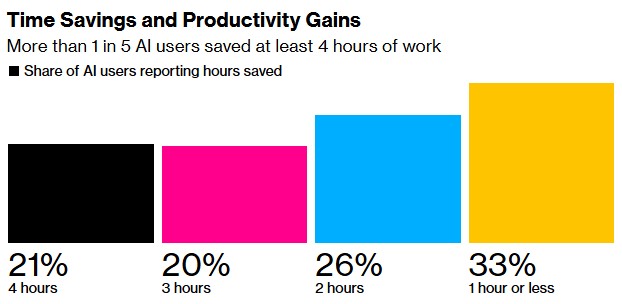
A study conducted jointly by the Federal Reserve Bank of St. Louis, Vanderbilt University, and Harvard University shows that American workers have increased their average hourly productivity by 33% through the use of generative artificial intelligence. The survey found that 21% of respondents reported saving 4 hours or more of work time using this technology. Employees who frequently use generative artificial intelligence save more time, indicating that a certain amount of learning time is required. Workers in the information services industry use generative artificial intelligence the most and save the most time, while the leisure and hospitality industry has the lowest usage rate
According to Zhitong Finance, a study conducted jointly by the Federal Reserve Bank of St. Louis, Vanderbilt University, and Harvard University shows that American workers report saving a significant amount of work time by using generative artificial intelligence. The paper found that "after using generative artificial intelligence, workers' productivity increased by an average of 33% per hour."
The researchers measured the impact of generative artificial intelligence on work efficiency based on what they believe to be the first nationally representative survey of generative artificial intelligence adoption in the United States, assessing the extent and intensity of workers' use of the technology. They found that users saved a considerable amount of time.
Among respondents who used generative artificial intelligence last week, 21% reported saving 4 hours or more, 20% reported saving 3 hours, 26% reported saving 2 hours, and 33% reported saving 1 hour or less.
Users who utilized the technology more frequently reported saving more time, indicating that applying this technology requires a learning period. Among employees who used generative artificial intelligence daily the previous week, 34% said it saved them 4 hours or more, while only 12% of those who used it for just one day that week felt the same.
Alexander Bick from the Federal Reserve Bank of St. Louis, Adam Blandin from Vanderbilt University, and David Deming from Harvard University found that if a person uses artificial intelligence while working 40 hours a week, they typically save 2.2 hours. When non-AI users are included in the mix, the total time saved by all survey participants due to generative artificial intelligence is 1.4% of the total time.
The study indicates that time savings are highly correlated with certain occupations. Information service workers spent the most time using generative artificial intelligence (14%) and saved the most time (2.6%). The report shows that the proportion of work time spent using generative artificial intelligence is lowest in leisure, accommodation, and other services (2.3%), with the least time saved (0.6%).
As the U.S. population ages and concerns about the federal budget deficit grow, productivity growth is seen as key to driving real wage growth, corporate profits, and government tax revenues. However, the report states that the widespread use of artificial intelligence is a relatively recent phenomenon, and its ultimate impact on overall productivity improvement remains uncertain
