


The world's first AI agent Manus, the first wave of overseas comments has arrived: the second DeepSeek moment!

Manus has started to break into the mainstream, with mainstream media beginning to pay attention and overseas tech bloggers discussing it heatedly. Well-known AI blogger Rowan Cheung referred to it as China's "second DeepSeek moment." Some users candidly stated that after seeing the actual effects of Manus, they canceled their monthly $200 ChatGPT subscription. However, some users have found the experience not smooth during testing and remain cautious
Manus has finally gained popularity overseas.
Last week, Manus burst onto the scene as the world's first general AI Agent, trending on domestic social media. However, alongside its explosive popularity, it faced criticism for potential over-marketing, with one major concern being that Manus's "explosion" is primarily limited to the domestic market, with little interest overseas.
This weekend, Manus began to break out of its circle, gaining attention from mainstream media like Forbes, and becoming a hot topic among overseas tech bloggers. Many tech giants have started evaluations, with some media outlets claiming its popularity even surpasses that of pop music queen Taylor Swift's concerts.
Amid the heated discussions, Manus has received numerous positive reviews. For instance, well-known AI blogger Rowan Cheung referred to it as China's "second DeepSeek moment," while the product manager at Hugging Face called Manus the "most impressive AI tool" he has ever tried.
However, some users have expressed reservations after finding the experience not as smooth during testing.
The World's First Fully Autonomous AI Agent
On March 8, Forbes reported that Manus, an AI agent from China, is changing everything.
Forbes described Manus as a revolutionary AI agent capable of independent thought and action, reigniting a debate that has lasted for decades: What happens when artificial intelligence no longer seeks permission but begins to make decisions on its own?
In Forbes's view, Manus is not just a chatbot, nor is it an improved search engine cloaked in a futuristic brand. It is the world's first fully autonomous AI agent:
A system that not only assists humans—it replaces them. From analyzing financial transactions to screening job applicants, Manus navigates the digital world without supervision, making decisions with a speed and precision that even the most experienced professionals would find hard to match. Essentially, it is a digital polymath, trained to manage cross-industry tasks without the inefficiency of human hesitation.

The Second DeepSeek Moment
Renowned AI blogger Rowan Cheung, who previously interviewed Mark Zuckerberg and was the first to release news about Llama-3's open-source release, shared Manus's official video and compared it to "China's second DeepSeek moment," predicting that its entry into the U.S. market is just a matter of time.
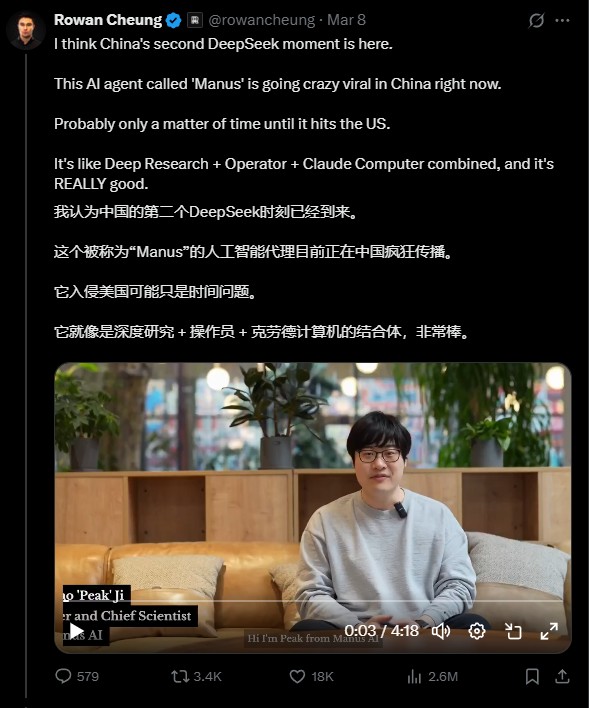
This is Rowan's first post discussing Manus. Currently, this tweet has nearly 600 comments and over 2.6 million views Rowan introduced his experience in the comments. After receiving the invitation code, he first tested Manus's ability to create personal biographies and deploy websites based on those biographies. Manus successfully deployed the website through his social channels and browsing articles, with 100% accurate information, including the latest updates.
Next, Rowan tested Manus's performance in providing practical information, such as finding the best car rental locations in San Francisco, with requirements for low crime rates, a high level of artificial intelligence activity, and a dense population of ambitious young entrepreneurs. Manus provided four very accurate options.
Rowan further tested Manus's ability to complete long-term research tasks, asking it to create a complete course on content creation using artificial intelligence. Manus took nearly two hours to complete, ultimately providing a course consisting of eight chapters, including tools, use cases, and prompt examples.
After the experience, Rowan believed that Manus "is not all hype."

Julian Goldie, an X user focused on search engine optimization (SEO), candidly stated that after seeing the actual effects of Manus, he canceled his $200 monthly ChatGPT subscription, believing that Manus is redefining the capabilities of browser automation.
After testing, Goldie summarized Manus's powerful features: the ability to control 50 browsers simultaneously, create and edit files in real-time, and deploy fully functional websites...
Moreover, Goldie believes that Manus can "crush" competitors in terms of efficiency improvement and cost savings, being faster in research than any competitor, capable of quickly generating comprehensive reports and visualizations, and saving thousands of dollars by using Manus.

Victor M, the product lead at Hugging Face, tested Manus's code generation capabilities, showcasing a game written by Manus that controls an airplane using the Three.js library.
Victor M was greatly impressed, calling it "the most impressive AI tool" he has ever tried. He stated that Manus's user experience (UX) is what many other tools have promised, but Manus truly delivers.

X user Umar Jamil shared his process of using Manus to help him find a house in London, expressing great satisfaction with the communities recommended by Manus, and he is about to move there soon Umar Jamil's requirement is to find an apartment in London with a commuting time of no more than one hour, a rent of no more than £1,750, at least one bedroom, and a large living room.
Manus spent about 10 minutes completing the research task by creating a to-do list to build the research plan and saving all intermediate results in files, continuously editing these files as more information was found. It browses the internet for all useful information related to the research.
In the end, Manus recommended several areas and suggested Walthamstow Central as the best choice, as it has a commuting time of only 17 minutes, rent between £1,300 and £1,700, and offers larger living space within the budget.

After finding a satisfactory house, Umar Jamil tweeted several times expressing his shock, stating that Manus ~= Claude + MCP*1000 + Deep Research + Operator, and asked, "Maradona is 'the hand of God', will Manus be 'the hand of AGI'?"

Too long, inaccurate information... there are many complaints
Manus's rapid rise overseas has also been accompanied by controversy, with some users and experts questioning the maturity of its technology. Some early users have reported that the experience of using Manus has not been smooth and that there are some factual errors.
Alexander Doria, co-founder of the AI startup Pleias, encountered issues with incorrect information and infinite loops while testing Manus.


Professor Derya Unutmaz from Jackson Laboratory compared the performance of OpenAI's Deep Research and Manus.
Deep Research completed the task in less than 15 minutes, while Manus AI failed after running for 50 minutes at step 18/20.
Unutmaz observed Manus AI's output and thought its performance was quite good, and made a second attempt. However, the second attempt also failed after 20 minutes at step 9/20, and Unutmaz speculated that Manus AI's server might be overloaded

Some users have pointed out that Manus makes mistakes on factual questions and does not always cite its sources, sometimes omitting information that is easily found online.
User Teortaxes believes that Manus is a product highly optimized for social media influencers, which explains its popularity:
The product performs well in generating general interest content, travel plans, etc., but it underperforms in assisting with STEM fields and programming, even worse than using Google Search.

Teortaxes mentioned that the output quality of Manus AI when handling certain tasks is not high, and it does not have much advantage over directly inputting documents into ChatGPT/Gemini, calling it "fairly standard GPT nonsense."
TechCrunch reporter Kyle Wiggers also had a poor experience with Manus.
He asked Manus to handle a seemingly simple request: to order a fried chicken sandwich from a top fast-food restaurant in his area. About ten minutes later, Manus crashed. In a second attempt, Manus found menu items that met his criteria but could not complete the ordering process, not even providing a checkout link.

Wiggers also asked Manus to book a flight from New York to Japan, but Manus could only provide links to several airline websites and ticket search engines like Kayak, some of which were invalid. Additionally, Manus failed to book a table at nearby restaurants and to build a fighting game inspired by "Naruto."

Manus's Dual Disruption: Strengthening China's AI Narrative and Redefining Intelligent Boundaries
Currently, Manus still requires an invitation code to use. Is it a prelude to the arrival of AGI, or just another overhyped AI product? The market will naturally provide answers as more people use it.
Regardless, the emergence of Manus brings a dual breakthrough to AI development. On one hand, Manus further strengthens the narrative of Chinese AI. For years, the global AI narrative has revolved around American tech giants like OpenAI, Google, and Meta. With Manus following DeepSeek, it once again proves China's strength in the AI field On the other hand, Manus has disrupted the established path of AI development. In the past, the industry generally believed that whoever could create a more powerful language model or a more complex chatbot would dominate the future of AI. However, the emergence of Manus has broken this path—it is not just an iterative upgrade of existing AI, but has pioneered a completely new intelligent paradigm: from passively responding to commands to actively planning actions, from chatbots to autonomous agents. Manus may very well be the first ray of light for AGI emerging from its cocoon
