


生三个补贴 10 万!呼和浩特官宣,深圳也表态,各地开启 “真金白银” 促生育

Hohhot City announced that it will provide childcare subsidies to families with legal births, with a subsidy of 10,000 yuan for the first child, 50,000 yuan for the second child, and 100,000 yuan for the third child and above. Shenzhen City also stated that it will implement childcare subsidy policies according to national deployment. Local governments are actively introducing fertility support policies. DFZQ analysis believes that a dual approach to fertility support may be formed in the future, including various incentive policies
From economic subsidies to parenting support, from housing benefits to educational welfare, the "real financial" fertility support policies are accelerating implementation.
On March 13, the Health and Health Commission of Hohhot announced that families who legally give birth after March 1 of this year (including March 1) and have their newborns registered in the city for the first time will receive parenting subsidies.
The specific subsidy plan is as follows: a one-time parenting subsidy of 10,000 yuan for the birth of the first child; a parenting subsidy of 50,000 yuan for the birth of the second child, distributed at 10,000 yuan per year until the child is 5 years old; a parenting subsidy of 100,000 yuan for the birth of the third child and above, distributed at 10,000 yuan per year until the child is 10 years old.
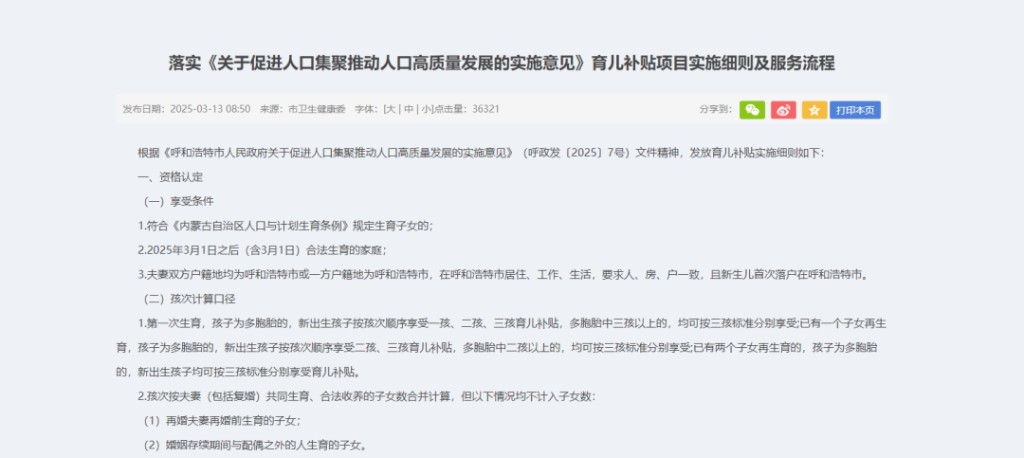
Shenzhen quickly followed suit, stating on the 14th that relevant departments in Shenzhen indicated: "The National Health Commission is currently researching the implementation plan for parenting subsidies in conjunction with relevant departments, and our city will actively and steadily implement it according to national deployment." It is reported that Shenzhen will improve the fertility support policy system and incentive mechanisms, expand the supply of inclusive childcare services, and accelerate the construction of a fertility-friendly society and child-friendly city.
Nationally, in recent years, several local governments have introduced sincere fertility support policies. This year's government work report also pointed out the need to formulate policies to promote fertility, issue parenting subsidies, vigorously develop integrated childcare services, and increase the supply of inclusive childcare services. In this regard, DFZQ believes that China's construction of a dual approach to fertility support framework involving both central and local governments is to be expected, including various forms of incentive policies such as fertility subsidies, marriage subsidies, reproductive services, housing support, and medical insurance.
What are the major strategies to promote fertility?
The analyst team led by Chen Zhiyi from DFZQ pointed out in the latest report that various subsidies and support forms introduced by local governments in the past period are diverse, and there is potential for regions to learn from and replicate each other in the future:
One-time and monthly continuous subsidies: Recently, the large-scale subsidies in Tianmen City, Hubei Province have attracted widespread attention. According to media reports, for local families with three children, the subsidies include a 1,000 yuan reduction in gene screening fees, a 300 yuan childbirth subsidy, a one-time birth reward of 3,000 yuan, a maternity leave subsidy of 4,800 yuan, a monthly parenting subsidy of 1,000 yuan (paid until the child is 3 years old), a housing reward of 120,000 yuan for encouraging childbirth, and a housing subsidy of 60,000 yuan for industrial workers (higher subsidies for dual-income teachers and medical staff), totaling over 280,000 yuan.
Marriage subsidies: In 2023, Changshan County in Quzhou City, Zhejiang Province proposed to provide a reward of 1,000 yuan for couples who register for their first marriage in the county and where the female partner is 25 years old or younger (at least one party must be a Changshan resident); starting in 2025, couples who register for their first marriage in Lvliang City and where the female partner is 35 years old or younger will receive a reward of 1,500 yuan Expanding maternity subsidies to the first child: On February 20, Jiangsu issued "Several Measures to Accelerate the Improvement of the Fertility Support Policy System and Promote the Construction of a Fertility-Friendly Society," which mentioned expanding the subsidy standard for social insurance fees paid by enterprises for female employees during maternity leave to provide a 50% subsidy for the birth of the first child, in addition to the existing subsidies for the second and third children.
Support for assisted reproductive technology: As of the end of October last year, information showed that 27 provinces, including Beijing, Shanghai, Zhejiang, Guangdong, and Chongqing, as well as the Xinjiang Production and Construction Corps, have issued documents to include assisted reproductive technology in the scope of medical insurance reimbursement, an increase of 8 compared to September. In addition, to promote price reductions, several provinces have changed the pricing method from market-adjusted prices to government-guided prices.
Service support and time support: This includes (1) education: For example, in October 2024, Danyu County in Ganzhou, Jiangxi proposed that families who meet the policy for having a third child can choose schools for kindergartens, primary schools, and junior high schools within the county according to parental wishes; (2) childcare: Starting from September 2024, Hangzhou will issue childcare vouchers to families in the five western districts of Fuyang, Lin'an, Tonglu, Chun'an, and Jiande, with monthly subsidies ranging from 600 to 1000 yuan depending on the age of the child; (3) transportation: Dehua County in Quanzhou, Fujian Province has issued regulations that families with three children registered in Dehua can enjoy free admission to county scenic spots (including cable cars) and free public transportation within the county.
Housing support: In addition to common home purchase discounts, some regions have proposed rental support. For example, Dehua County has also proposed that families with three children facing housing difficulties will be given priority in renting public rental housing and will be exempt from rent for two years, with a 50% rent discount after two years.
Medical insurance and other insurance: Relevant cases include Chongyi County in Ganzhou, Jiangxi, which has implemented government payment of basic medical insurance fees for urban and rural residents for the third child before the age of 6 since October 2023; and Shaowu City in Fujian, which has provided family accident insurance for families with three children since November last year.
DFZQ pointed out that the source of subsidy funds is also an important highlight of this type of policy. Hefei proposed that if both spouses are employees of national agencies, public institutions, or state-owned enterprises in the city, the childcare subsidy will be shared equally by both parties' units; if only one party is an employee of such institutions, the childcare subsidy will be fully paid by that party's unit. The "Implementation Plan for Fertility Support Projects in Yunnan Province" issued in 2022 proposed that one-time fertility subsidies will be dynamically borne by the provincial level based on the birth rate of the previous year in cities and states (for birth rates above 10‰, the provincial and municipal levels will share the burden at a ratio of 6:4, and for birth rates below 10‰, the ratio will be 7:3).
The policy effects in some regions have already shown certain results. DFZQ pointed out that Tianmen City in Hubei mentioned above achieved a year-on-year increase of 17% in the birth population in 2024 (the national level growth rate is 5.8%); in addition, Panzhihua, Sichuan, which was the first in the country to launch a childcare subsidy policy in 2021, has seen a continuous positive growth in the total resident population for three consecutive years as of 2023, which is also better than the national level Risk Warning and Disclaimer
The market has risks, and investment should be cautious. This article does not constitute personal investment advice and does not take into account the specific investment goals, financial situation, or needs of individual users. Users should consider whether any opinions, views, or conclusions in this article are suitable for their specific circumstances. Investment based on this is at one's own risk
