巴西跨境包裹税费暴涨 50%,中小卖家压力大了

Brazil's cross-border e-commerce market is facing significant changes. Starting from April 1, the state tax on cross-border goods (ICMS) in 10 states will increase from 17% to 20%, along with a 20% import tax, resulting in a total tax rate for some goods that could be as high as 50%. This means that consumers will need to pay 150 reais for a product priced at 100 reais. This tax increase aims to address the pressure from international e-commerce platforms such as Shopee and Temu on local retailers
Author: Tu Ke Chuhai

Image source | pexels
Starting from April 1, 10 states in Brazil officially raised the state tax on cross-border goods (ICMS) from 17% to 20%. In addition to the 20% import tax on packages valued under $50, the total tax rate on some goods could reach as high as 50%.
This means that for a product priced at 100 reais, consumers may ultimately have to pay 150 reais.
The states implementing this tax increase include Acre, Alagoas, Bahia, Ceará, Minas Gerais, Paraíba, Piauí, Rio Grande do Norte, Roraima, and Sergipe.
As for this tax rate adjustment, there were already signs last year when various states discussed raising it to 25%, but due to various reasons, it was postponed until this year for formal implementation. Currently, the tax rates in other states remain unchanged, but any adjustments will not take effect until 2026.
The Brazilian government's tax increase is not without reason. In recent years, international e-commerce platforms like Shopee and Temu have made significant inroads into the Brazilian market, putting immense pressure on local retailers.
For example, Shopee entered the Brazilian market in 2019 and is now the second-largest e-commerce platform in the region. The latest data shows that Shopee's Brazilian site reached an 8.8% share of traffic in February this year, second only to the Latin American e-commerce giant Mercado Livre.
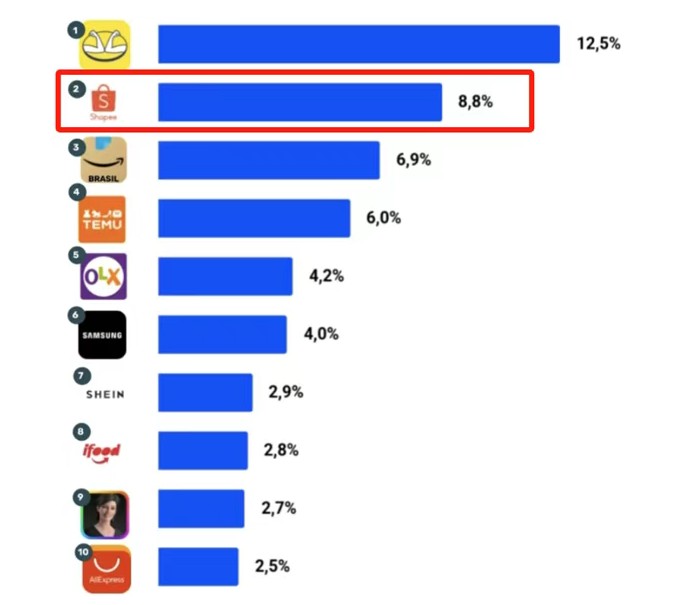
Shopee successfully crowned itself as the second in the Brazilian e-commerce market, image source: Conversion
In 2024, Shopee's Brazilian site is expected to double its sales to 60 billion reais, which is twice that of Amazon's Brazilian site and equivalent to 40% of Mercado Livre's sales.

Shopee's annual sales reach 60 billion BRL, image source: X
Similarly, Temu, which only entered Brazil in May last year, has also shown impressive performance, breaking into the top four of shopping app downloads within two months of launch and topping the overall app download chart in Brazil in July.
 Temu tops the app download chart in Brazil. Source: AppMagic
The popularity of cross-border e-commerce in Brazil can be seen from the data. In 2024, Brazil's cross-border e-commerce gained 134 million new visitors, with monthly visits skyrocketing from 197 million to 331 million, an increase of 68%. With such rapid growth, local businesses are understandably restless, and the government's decision to raise taxes is within reason.
As a result, the most directly affected are consumers. Previously, the biggest advantage of cross-border e-commerce was its low prices, with many small packages being more affordable than local products due to tax exemptions or low taxes. However, with the tax rates rising, this advantage may be diminished. For example, for products under $50, the tax used to be only 17%, but now it has increased to 40%, and some even reach 50%.
Sellers are also facing difficulties. With rising costs, they either have to increase prices, affecting sales, or absorb the costs and compress profits. This is especially tough for those dealing with small items, where profits were already thin, and now it’s even worse. However, large platforms like Shopee and Temu may adjust their strategies, such as building warehouses in Brazil or collaborating with local businesses to cope with the tax increases.
In the short term, this wave of tax increases will definitely make the cross-border small package business harder to operate.
But in the long term, platforms and sellers will always find ways to adapt, such as optimizing logistics, adjusting product structures, or shifting to higher-priced items. After all, with the Brazilian market growing so quickly, no one wants to give up easily.
What everyone is most concerned about now is whether other states will follow suit with tax increases. If more places adjust tax rates next year, the pressure on cross-border e-commerce will be even greater.
However, for now, sellers still have time to adjust their strategies.
This game between cross-border e-commerce and local retail has just begun.