Goldman Sachs sounds the alarm: U.S. stocks may fall into a cyclical bear market, taking five years to return to the starting point

Goldman Sachs sounds the alarm: U.S. stocks may fall into a cyclical bear market, taking five years to return to the starting point
Against the backdrop of the trade war initiated by U.S. President Donald Trump, an increasing number of Wall Street strategists are warning of a pessimistic outlook for the stock market.
A team of strategists at Goldman Sachs, led by Peter Oppenheimer and Lilia Peytavin, pointed out that as the risk of economic recession intensifies, the stock market sell-off is likely to evolve into a longer-lasting cyclical bear market.
Goldman Sachs strategists noted that cyclical bear markets typically last about two years and take five years to rebound to the starting point. Unlike shocks driven by a single event, cyclical bear markets reflect the economic cycle.
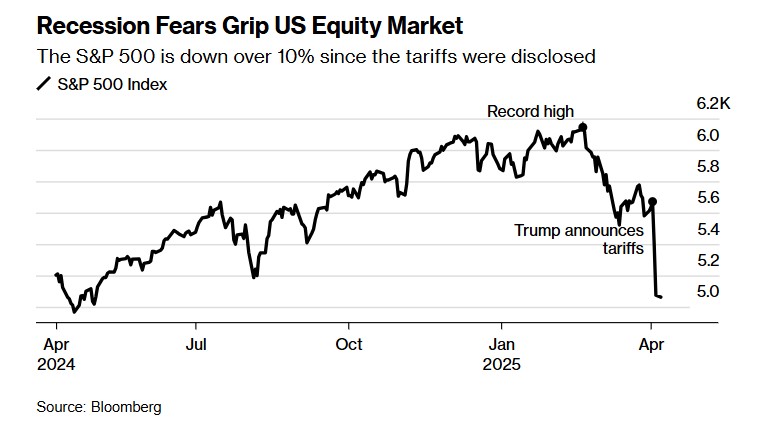
Several international stock benchmark indices have been in continuous decline, meeting the definition of a technical bear market, including the S&P 500 index, which fell as much as 20% from its all-time high set less than two months ago during intraday trading on Monday.
Concerns over economic recession have led to a sharp decline in U.S. stocks.
For now, Goldman Sachs strategists view the current sell-off in U.S. stocks as an event-driven bear market. In both event-driven bear markets and cyclical bear markets, stock prices typically decline by an average of 30%, but they stated, “The difference between the two is duration; event-driven bear markets have shorter decline durations and recover more quickly.”
Goldman Sachs economists have raised the probability of a U.S. economic recession to 45%, and the bank's strategy team, like several other Wall Street forecasting institutions, has lowered its target expectations for the S&P 500 index.
BlackRock strategists Jean Boivin and Wei Li downgraded the three-month outlook for U.S. stocks from overweight to neutral on Monday, stating that given the “significant escalation of global trade tensions, risk assets are expected to face greater pressure in the short term.”
Larry Fink, CEO of BlackRock, stated that most CEOs he has spoken with believe the U.S. is already in a recession. Meanwhile, traders have significantly increased their bets that the Federal Reserve will cut interest rates sharply, as they worry that the U.S. government's trade policies could lead to a global economic downturn.
Strategists in Fink's company's research department indicated that they are increasing their allocation to U.S. short-term government bonds, as short-term government bonds may benefit when investors flock to safe-haven assets.
Boivin and Li wrote, “The comprehensive responses from various countries to the U.S. and the specific negotiations with the U.S. will take time, making it difficult to predict when and how trade tensions will be resolved. A massive shrinkage of wealth could undermine market sentiment and consumer spending.”
Despite the global stock market losing nearly $10 trillion over the past three days, most analysts and investors have not yet seen the direct risks facing the global financial system. However, they did point out some signs of tension—such as the freezing of the corporate bond market and the surge in default risk indicators—which have been accumulating due to the rapid deterioration of the economic outlook