What impact will the U.S. tariff stick have on Chinese games?

The United States implemented a 34% reciprocal tariff on China, causing global market turbulence, leading to a sharp decline in U.S. stocks and a pullback in the gold market. Although Chinese gaming stocks fell under the influence of market panic, the gaming industry is not the main target of the tariff war, as it primarily serves the domestic market. In contrast, the Japanese gaming industry is more significantly affected by hardware manufacturing, with Nintendo and Sony facing tariff challenges
Author: bias

Image source | pexels
What is meant to come will eventually come.
On April 2nd, U.S. time, Trump officially announced the "reciprocal tariff" policy, imposing a 34% reciprocal tariff on China and varying degrees of reciprocal tariffs of 20%, 24%, 25%, and 46% on the EU, Japan, South Korea, and Vietnam, respectively.
The news caused a global uproar. U.S. stocks fell for several consecutive days, setting a record for declines in recent years, and the gold market also ended its days of rising, experiencing a downturn. Major Asian economies were not spared either, with Japan and South Korea's stock markets plummeting on Monday. The Chinese stock market also saw a significant drop after opening, with stocks of listed gaming companies suffering as well.
Tariff impact, is hardware the first to bear the brunt?
As a gaming media outlet, we are most concerned about the impact of this round of tariff war on the gaming industry.
In fact, Trump's initiation of this trade war primarily targets the manufacturing sector, with the main goal of the tariffs being to encourage manufacturing to return to the U.S. and alleviate issues such as the trade deficit and debt. Gaming, as a virtual product, belongs to the service trade sector and is not the target of the tariff war. On the contrary, the U.S. has maintained a trade surplus in the service trade sector for many years. Whether it is Hollywood movies or AAA games, they are essentially the U.S. exporting and making money globally.
Therefore, the recent decline in Chinese gaming stocks is somewhat a collateral damage from market panic. After all, many A-share companies primarily serve the domestic market, which is not affected by tariffs, and companies that go overseas do not involve hardware production, significantly reducing the impact of this round of tariff war on them.
In contrast, the Japanese gaming industry is suffering much more. This is mainly because the Japanese gaming industry integrates both software and hardware. Game hardware (game consoles) involves manufacturing, production, and assembly, making it a direct victim of the trade war.
For instance, Nintendo just held a Switch2 launch event on April 2nd to start pre-orders, only to be hit by the tariff war, forcing them to urgently halt the console pre-sale that had just begun in North America, and they may have to adjust the console prices after the tariffs take effect.
Sony has been preparing since the beginning of this year. According to foreign media reports, Sony began strategically stockpiling goods in North America starting in February, which means that the price of the PS5 will not be affected in the short term. Additionally, since the U.S. only imposes a 20% tariff on Japan, as long as Sony shifts console production from Southeast Asia back to Japan, they can maintain console sales without incurring losses.
The biggest impact of this situation on China is that companies like Sony and Nintendo may become more determined to relocate their console hardware factories out of China. However, this time, countries in Southeast Asia like Vietnam are also facing high tariffs from the U.S., so what better options do Sony and Nintendo have for relocating from China?
To take a step back, even if console manufacturers are determined to ultimately build factories in the U.S., four years later, the U.S. president will change, and it is uncertain whether the tariff policy will continue, while the infrastructure investments made for the factories cannot be easily withdrawn So this wave of tariff wars may be a blow to the entire console gaming market. The commercial sales model of console gaming, which integrates both hardware and software, is a product of the globalization that began in the 1980s, resulting from the division of labor and profit-sharing between the U.S. and Japan.
Now, if Trump insists on ending the previous globalization order, the shrinkage of the console gaming business model may be inevitable.
Of course, the shrinkage of the console market does not have a significant impact on China, aside from the exit of game production factories. This is because the Chinese gaming industry is not highly bound to hardware but is primarily focused on software services, which are less directly affected by tariffs compared to Japan.
Is going overseas still a good business?
However, the tariff war is a negative message for the global market. Although the Chinese gaming industry does not face the hardware troubles that Japanese companies do, it cannot remain unaffected, especially for Chinese gaming companies going overseas, which have their own issues to face.
In the 1980s, the Chinese gaming industry failed to catch the first wave of globalization and did not secure a place in the global division of labor for console gaming. However, in the subsequent internet era, especially during the mobile gaming era, the Chinese gaming industry found its positioning.
Essentially, the ability of the Chinese gaming industry to go overseas on a large scale was due to seizing the opportunity presented by U.S.-led internet globalization. China and the U.S. once had aligned interests in this matter, which allowed the U.S. to let Chinese games go overseas. According to Gamma Data, in 2024, the overseas revenue of Chinese mobile games will see the U.S., Japan, and South Korea ranking in the top three, accounting for 31.06%, 17.32%, and 8.89%, respectively.
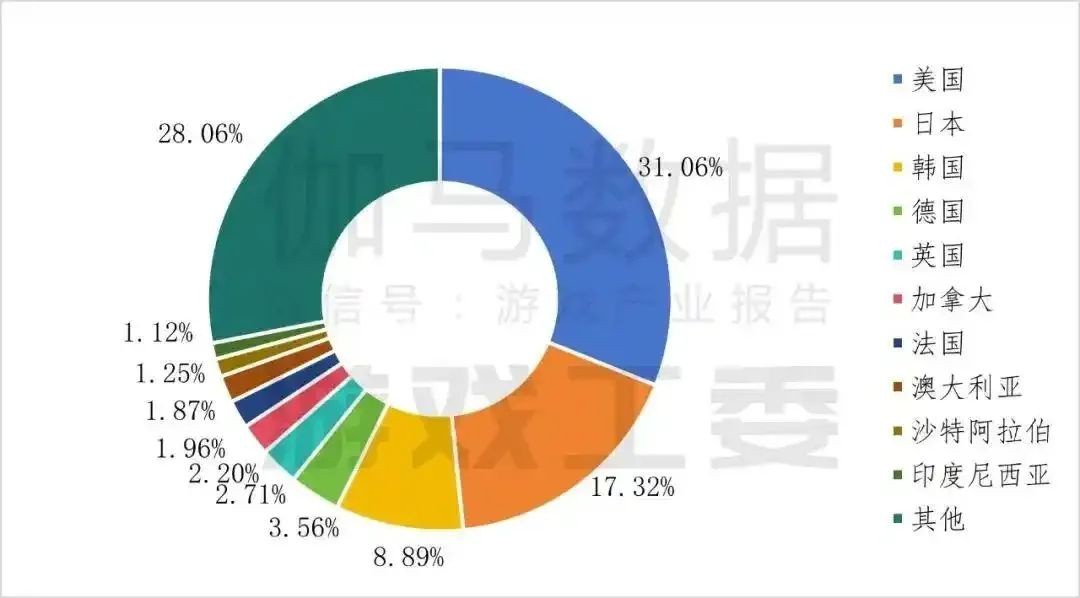
The reason the U.S. accounts for such a high proportion in this data is not because our game products are directly exported to the U.S. in large quantities, but because U.S. internet platforms have effectively achieved global monopoly (tech giants like Microsoft, Apple, Google, etc.).
For a long time, our games going overseas have relied on these U.S. platforms, acting as "workers" who take on the dirty and tiring jobs, earning the least while transferring most of the profits to the platforms. The 30% Apple tax and Google tax do not require the U.S. government to intervene; tech platforms have long been charging companies from various countries. Even engine manufacturers like Unity have attempted to impose taxes, but they were resisted because they have not achieved factual monopoly.
In these areas where the U.S. already holds a dominant voice, Trump has not sought to change the rules of the game. However, for countries like the European Union, any attempt to counter the U.S. tariff stick will inevitably target the U.S.'s advantageous sectors to exert pressure.
Thus, the EU has been taking various actions against U.S. tech giants, imposing restrictions through legislation, fines, and taxes. These countermeasures by the EU will inevitably affect the business of U.S. tech giants, and Chinese companies that do business relying on these tech platforms will also be impacted: possibly through increased customer acquisition costs or more regulatory scrutiny In the short term, the profits of overseas enterprises will inevitably be affected, and it will become more difficult to maintain profits. However, as long as we endure this short-term turbulence and adapt to the new rules, there should still be no problem for overseas operations in Japan, South Korea, and Europe in the medium to long term. We just have to be prepared for the worst-case scenario of losing the large U.S. market.
How to digest excess capacity?
In recent years, many projects have failed, and it is often said in the industry that the Chinese gaming industry is also in a state of "overcapacity," similar to manufacturing, needing to rely on exports to solve this excess capacity. However, in my view, the content service industry may not truly have "overcapacity." Players' needs are always changing, good content is always scarce, and what is excessive is only imitation and shoddy production.
Therefore, upgrading and iterating the industry is the right way to solve overcapacity, rather than continuously producing low-end products and competing by maintaining cost advantages through low wages and a 996 work schedule. Companies that survive through internal competition should be eliminated.
However, for the industry to upgrade, some pressure is needed to force change; otherwise, even large enterprises will "just rest on their laurels and accomplish nothing." The pressure brought by this tariff war is a good opportunity for such a push.
Cases like "Black Myth: Wukong" have already shown that good products can "create" market opportunities. The domestic demand of Chinese players is still far from being satisfied; it depends on how gaming companies seize this opportunity. Truly good products attract not only Chinese players but also global players.
From a long-term perspective, if the U.S. truly adopts isolationism, it would also be beneficial for the export of cultural services like gaming.
Many analyses point out that America's global leadership status comes from its past responsibilities on a global scale. Now, Trump feels that the U.S. should not bear so much responsibility and wants to use tariffs to keep all benefits within the U.S. However, by returning to isolationism, America's hegemonic status will inevitably decline, and the loss of economic hegemony will lead to a decline in cultural hegemony as well.
To put it bluntly, as the U.S. is unwilling to be the "big brother" anymore, the appeal of Hollywood-style heroes and AAA games set in American cities to global audiences will decrease. The market void left by the retreat of American culture is precisely the opportunity for industrial countries like China.
If we say that the productivity of 100 years ago allowed people to only consume lipstick for comfort during economic downturns, then the industrialized Chinese cultural industry will be able to: allow global users to spend lipstick money and gain the satisfaction of diamond rings.
As a part of the cultural industry, gaming products will not only be able to produce better products at lower costs but also have the opportunity to seize the last missing piece of the puzzle: cultural discourse power, evolving into a complete entity. Achieving this goal is certainly not easy, but opportunities are always embedded in crises.