


高盛:银行股估值已部分消化悲观预期,花旗和大摩等成关注焦点

Goldman Sachs' research report released on April 9, 2025, pointed out that the shares of large U.S. banks have cumulatively fallen by 25%, mainly due to economic uncertainty. Although the price-to-book ratio is close to the long-term average, it is still higher than the lows during economic recessions. Goldman Sachs analyzed six major downside risks and estimated that the earnings per share (EPS) of large banks could face about a 45% downside risk by 2026, with ROTCE potentially declining by about 8 percentage points. PNC and Bank of America have the largest EPS downside risks, at 19% and 17%, respectively
According to the Zhitong Finance APP, Goldman Sachs released an in-depth research report on the U.S. banking industry on April 9, 2025, reassessing the downside scenario for large banks. Since the peak in February 2025, large bank stocks have cumulatively fallen by 25%, primarily driven by uncertainties regarding the impact of tariffs on the economy, leading to a slowdown in loan growth, a flattening yield curve, a weak capital market, and deteriorating credit quality.
Goldman Sachs believes that although the current price-to-tangible book value (P/TBV) of large banks has fallen from its peak to around 1.4 times, close to the long-term average level, it is still higher than the lows reached during previous economic recessions (approximately 0.3 to 0.4 times). In a pessimistic scenario, banks can still achieve an ROTCE (Return on Tangible Common Equity) of about 8.5%, higher than the 7.5% during past recessions, which may provide some support for bank stocks.
Six Major Downside Drivers: Quantitative Shock and Bank Differentiation
Goldman Sachs detailed six downside risk factors in the report and their impact on expected earnings for 2026, estimating that large banks could face about a 45% downside risk to their earnings per share (EPS) in 2026, with average ROTCE potentially declining by about 8 percentage points.
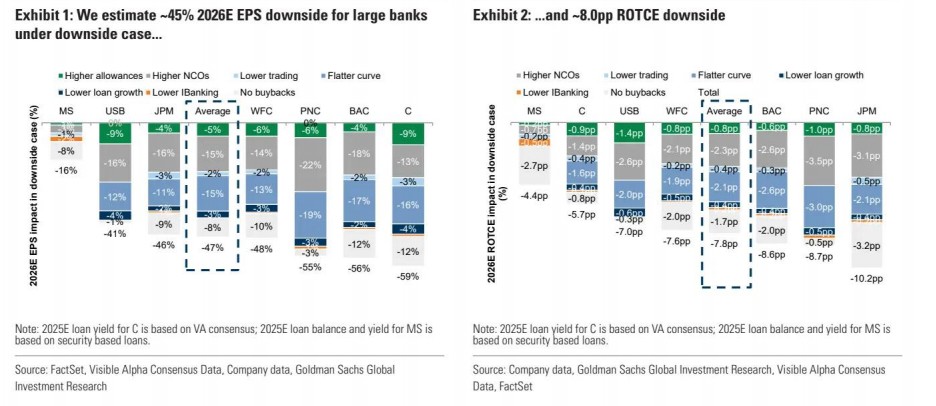
Figure 1
Flattening Yield Curve
Since the beginning of the year, the yields on 5-year and 10-year U.S. Treasury bonds have decreased by approximately 55 and 40 basis points, respectively. If the 5-year U.S. Treasury yield in 2025 and 2026 is 100 basis points lower than the current forward curve expectations, bank net interest income could decline by 3% and 10%, respectively, leading to EPS declines of 4% and 15%. Among the banks, PNC Financial Services Group (PNC.US) and Bank of America (BAC.US) face the largest EPS downside risks, at 19% and 17%, respectively, while JPMorgan Chase (JPM.US) has relatively smaller EPS downside risk.
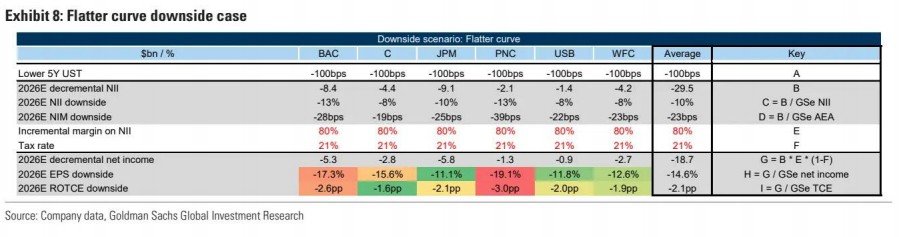
Figure 2
Weak Capital Market Revenue
In the investment banking sector, assuming a 20 percentage point slowdown in growth, this would lead to a 1% decline in EPS and a 20 basis point reduction in ROTCE. Specifically, Morgan Stanley (MS.US) could see a 2% decline in EPS, while Wells Fargo (WFC.US) might only experience a 0.3% decline, indicating significant differentiation among banks
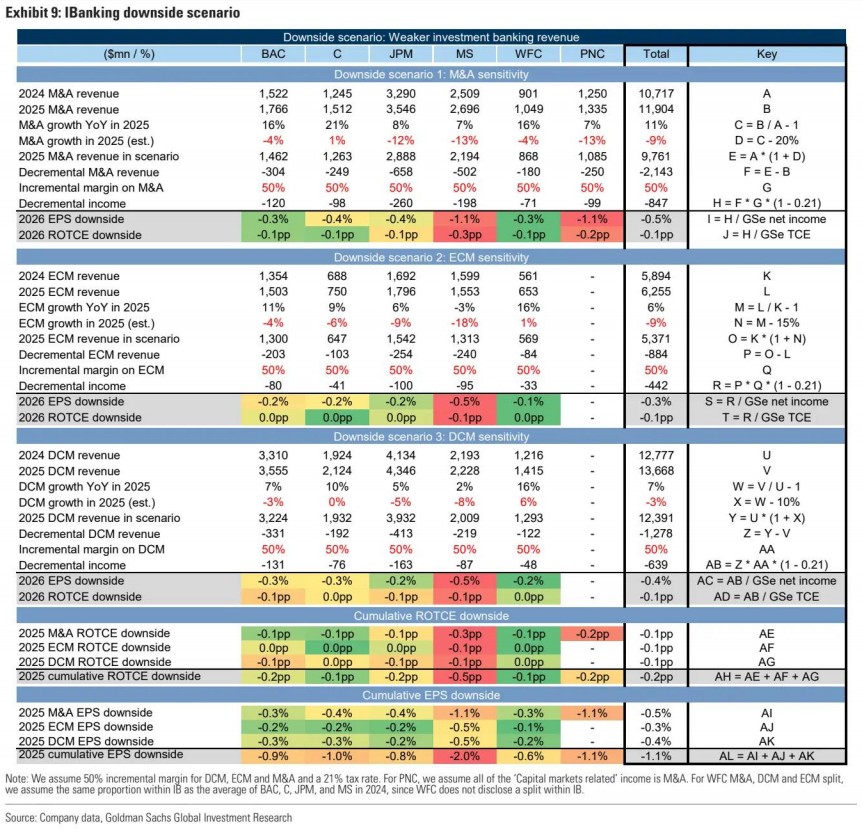
Figure 3
Decline in Trading Revenue
Goldman Sachs expects trading revenue to decline by 8%, leading to a 2% drop in EPS and a 40 basis point decrease in ROTCE. Assuming a year-on-year decline in trading revenue of 4% (similar to levels in 2013-2014), it is expected to result in a 2% reduction in EPS and a 40 basis point drop in return on tangible common equity (ROTCE). In this scenario, Citigroup's (C.US) EPS may decline by 4%, while JP Morgan's EPS may decrease by 3%, indicating significant risk exposure.
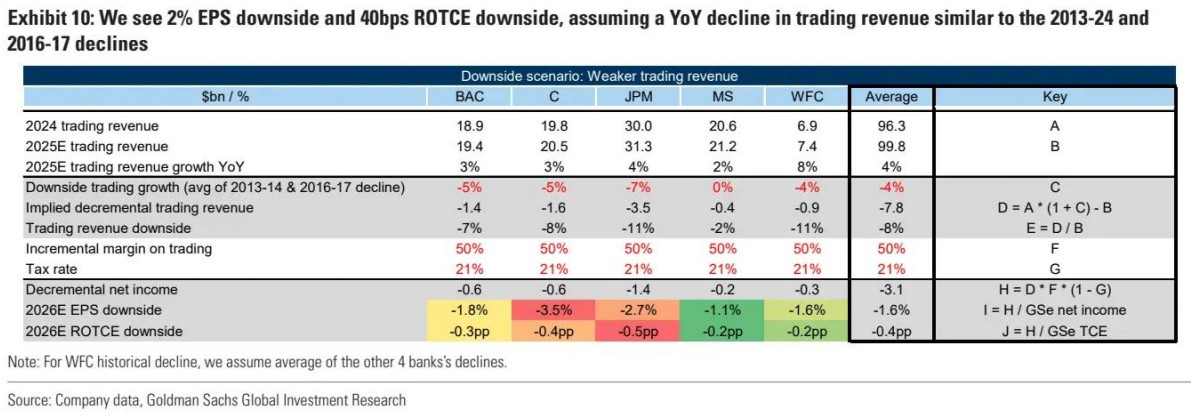
Figure 4
Deterioration in Credit Quality
Goldman Sachs estimates that in a recession scenario, the bad debt ratio for large banks could reach 125 basis points, approximately 65 basis points higher than current levels, based on historical average loss rates, macro stress testing models, and the DFAST loss estimates of the companies. Based on the composition of the loan portfolio, Citigroup and JP Morgan may face the highest loss rates.
Goldman Sachs believes that the market may have partially digested these higher loss rates, but PNC Financial Services Group, Bank of America, and JP Morgan may face the greatest risk of earnings downgrades, while Morgan Stanley is least affected by losses. Goldman Sachs estimates that the increase in bad debts could lead to about a 15% decline in EPS and approximately a 230 basis point drop in ROTCE.
Slowdown in Loan Growth
An economic slowdown may impact loan growth in the second half of 2025, with certain categories (such as commercial and industrial loans) potentially experiencing negative growth. Goldman Sachs assessed the impact of loan growth being 2 percentage points lower than expected in 2025, estimating it could lead to a 2% decline in net interest income, a 3% drop in EPS, and a 40 basis point decrease in ROTCE. Among them, Citigroup faces the highest EPS downside risk at 4%, while Morgan Stanley has the lowest EPS downside risk.
Suspension of Stock Buybacks
Goldman Sachs assumes that banks will suspend stock buybacks until the end of 2026, which could lead to an 8% decline in EPS and approximately a 170 basis point drop in ROTCE. Citigroup and Bank of America are most affected, with EPS impacts of about 12% each.
Valuation Analysis
Goldman Sachs believes that although bank stocks have fallen 17% since the beginning of the year, valuations are only marginally attractive. The average price-to-book ratio for large banks is 1.4 times, slightly above historical lows. Goldman Sachs also analyzed two valuation methods, P/TBV and P/PPOP, suggesting that in the current economic environment, the market may prefer valuation methods based on book value P/TBV Valuation
Goldman Sachs pointed out that the P/TBV of large banks has fallen from a high of 1.9 times after the 2024 presidential election to 1.4 times, slightly above the lowest level of 1.3 times on April 4. Goldman Sachs also compared the valuation gap between high ROE banks and low ROE banks, finding that this gap has compressed from 19.6 to 14.9. Based on the regression analysis of 2026E PTBV and ROTCE, Bank of America and U.S. Bancorp (USB.US) are the cheapest in terms of valuation, while the USB valuation adjusted for AOCI impact is the most attractive.
P/PPOP Valuation
Goldman Sachs noted that the current P/PPOP multiple is 7.4 times, still above the average level of 7.1 times since 1991 (excluding 2008/2009). In recession periods without capital shortages (such as the early 2000s), the low point for P/PPOP was 6 times, while in capital shortage periods, the low point for P/PPOP was 3-4 times. Goldman Sachs adjusted the expected bad debt ratio and added actual bad debts back into P/PPOP, finding that the current valuation is 7.6 times, which still has certain attractiveness compared to the average level of 7.5 times and the low point of 4 times in the last cycle.
Market Expectations and Investment Recommendations
Goldman Sachs believes that the market seems to have priced in about 45-50% of the pessimistic scenario. Goldman Sachs also analyzed the performance of different banks under pessimistic scenarios, believing that Citigroup, U.S. Bancorp, and Morgan Stanley are the most attractive at current valuations. Additionally, Goldman Sachs pointed out that the 7-year U.S. Treasury yield has fallen by about 50 basis points so far this year, which could bring an 11 basis point increase to banks' CET1 ratios and about a 120 basis point increase to tangible book value
