


Will Weakness in Otter Tail Corporation's (NASDAQ:OTTR) Stock Prove Temporary Given Strong Fundamentals?

Otter Tail Corporation's stock has declined 5.7% over the past month, but its fundamentals remain strong, particularly with an 18% Return on Equity (ROE) compared to the industry average of 9.1%. The company has achieved a 27% net income growth over the past five years, significantly outpacing the industry growth rate of 5.4%. Otter Tail retains 75% of its income, indicating efficient reinvestment of profits. However, analysts predict a potential decline in future earnings despite past growth, raising questions about the sustainability of its performance.
With its stock down 5.7% over the past month, it is easy to disregard Otter Tail (NASDAQ:OTTR). However, stock prices are usually driven by a company’s financial performance over the long term, which in this case looks quite promising. In this article, we decided to focus on Otter Tail's ROE.
Return on Equity or ROE is a test of how effectively a company is growing its value and managing investors’ money. In short, ROE shows the profit each dollar generates with respect to its shareholder investments.
AI is about to change healthcare. These 20 stocks are working on everything from early diagnostics to drug discovery. The best part - they are all under $10bn in marketcap - there is still time to get in early.
How Do You Calculate Return On Equity?
The formula for return on equity is:
Return on Equity = Net Profit (from continuing operations) ÷ Shareholders' Equity
So, based on the above formula, the ROE for Otter Tail is:
18% = US$302m ÷ US$1.7b (Based on the trailing twelve months to December 2024).
The 'return' is the amount earned after tax over the last twelve months. Another way to think of that is that for every $1 worth of equity, the company was able to earn $0.18 in profit.
See our latest analysis for Otter Tail
What Is The Relationship Between ROE And Earnings Growth?
So far, we've learned that ROE is a measure of a company's profitability. We now need to evaluate how much profit the company reinvests or "retains" for future growth which then gives us an idea about the growth potential of the company. Assuming everything else remains unchanged, the higher the ROE and profit retention, the higher the growth rate of a company compared to companies that don't necessarily bear these characteristics.
Otter Tail's Earnings Growth And 18% ROE
At first glance, Otter Tail seems to have a decent ROE. Especially when compared to the industry average of 9.1% the company's ROE looks pretty impressive. This certainly adds some context to Otter Tail's exceptional 27% net income growth seen over the past five years. However, there could also be other causes behind this growth. For example, it is possible that the company's management has made some good strategic decisions, or that the company has a low payout ratio.
We then compared Otter Tail's net income growth with the industry and we're pleased to see that the company's growth figure is higher when compared with the industry which has a growth rate of 5.4% in the same 5-year period.
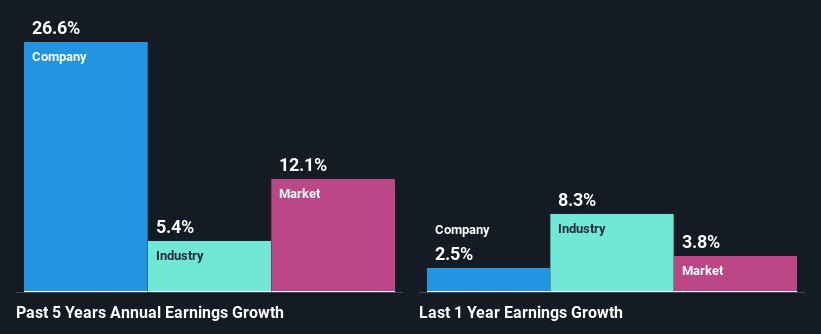
Earnings growth is an important metric to consider when valuing a stock. What investors need to determine next is if the expected earnings growth, or the lack of it, is already built into the share price. Doing so will help them establish if the stock's future looks promising or ominous. One good indicator of expected earnings growth is the P/E ratio which determines the price the market is willing to pay for a stock based on its earnings prospects. So, you may want to check if Otter Tail is trading on a high P/E or a low P/E , relative to its industry.
Is Otter Tail Making Efficient Use Of Its Profits?
Otter Tail's three-year median payout ratio is a pretty moderate 25%, meaning the company retains 75% of its income. This suggests that its dividend is well covered, and given the high growth we discussed above, it looks like Otter Tail is reinvesting its earnings efficiently.
Besides, Otter Tail has been paying dividends for at least ten years or more. This shows that the company is committed to sharing profits with its shareholders. Upon studying the latest analysts' consensus data, we found that the company's future payout ratio is expected to rise to 45% over the next three years.
Conclusion
On the whole, we feel that Otter Tail's performance has been quite good. Specifically, we like that the company is reinvesting a huge chunk of its profits at a high rate of return. This of course has caused the company to see substantial growth in its earnings. With that said, on studying the latest analyst forecasts, we found that while the company has seen growth in its past earnings, analysts expect its future earnings to shrink. Are these analysts expectations based on the broad expectations for the industry, or on the company's fundamentals? Click here to be taken to our analyst's forecasts page for the company.
If you're looking to trade Otter Tail, open an account with the lowest-cost platform trusted by professionals, Interactive Brokers.
With clients in over 200 countries and territories, and access to 160 markets, IBKR lets you trade stocks, options, futures, forex, bonds and funds from a single integrated account.
Enjoy no hidden fees, no account minimums, and FX conversion rates as low as 0.03%, far better than what most brokers offer.
Sponsored Content
