


Gained 56% this year, Yan Siqian: The AI market will continue, humanoid robots may be a trillion-level opportunity

Yan Siqian performed exceptionally well in the Penghua Carbon Neutral Fund in 2025, with assets under management exceeding 10 billion. She believes humanoid robots represent a huge investment opportunity, even surpassing automobiles. AI technology has rapidly developed since the beginning of 2023, with domestic and international tech giants continuously increasing their investments in the AI field. It is expected that this technological development cycle will last for 5 to 10 years, and AI applications are still in the early stages of an explosion
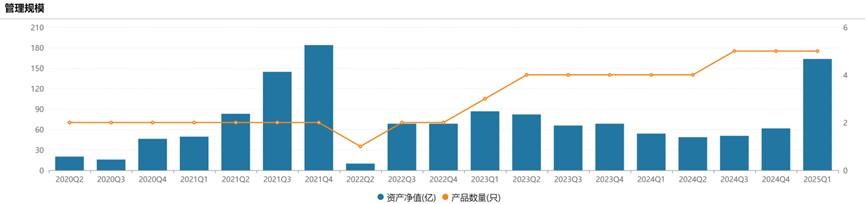
With the impressive leading performance of the Penghua Carbon Neutral Fund in 2025, Yan Siqian's managed scale has once again surpassed 10 billion after nearly three years at the end of the first quarter.
In the public fund industry, fund managers who can break through the circle a second time should never be underestimated.
Yan Siqian, General Manager/Investment Director/Fund Manager of the Equity Investment Department of Penghua Fund, recently held a live broadcast. Last weekend, she personally witnessed the humanoid robot marathon held in Beijing, which she believed exceeded expectations and was something to be very proud of.
She also believes that humanoid robots represent the biggest opportunity after houses and cars. In fact, this opportunity may be even greater than that of cars.
Moreover, Yan Siqian's focus is not limited to humanoid robots; her latest key sharing theme is the resonant development of the AI and robotics sectors.
Using the first-person perspective, some content has been omitted.
AI Market Will Continue
Since the emergence of ChatGPT at the beginning of 2023, AI has been developing very rapidly.
Initially, we observed the changes in large models, including multimodal text, images, and videos; then we looked at the computing power industry chain, as pre-training requires a large amount of computing power, from advanced overseas computing power to the development of domestic computing power, as well as the subsequent construction of data centers.
Last year, we often saw some data from the US stock market and leading cloud computing companies adjusting their capital, and this year (2025), many tech giants, including domestic ones, are continuously increasing their investments in AI.
Domestic internet giants are also approaching investment plans of nearly 100 billion, which even exceed the capital expenditures of the past 10 years in the AI field, which is quite astonishing. This also indicates that the development speed of AI is very fast.
Additionally, there is global attention on the development of AI applications, as AI is being applied across various industries, all moving towards AI+. Therefore, our investment framework has not changed significantly.
The new technological development cycle of AI resonates globally, and the technology development cycle requires at least 5 to 10 years of development stages to complete the larger cycle. Thus, from the beginning of 2023 to now, the more than two years of AI development stage is still in the early phase of the AI application explosion.
AI applications are undergoing significant changes across various industries, including edge AI glasses, AI robots, AI applications, and in the software industry, such as AI healthcare, AI education, etc.
We always say that we want to fish where there are fish, or in other words, we want to find industries with beta, and identify good alpha in those segments. Because we place great importance on fundamentals and the quality of companies, even in a rapidly developing niche like AI, we believe that the speed of technological iteration of excellent companies, the release of their fundamentals, and their competitiveness will develop even better So we believe that the AI market will continue.
Technology is Less Affected by Economic Cycles
At the beginning of the year, we saw the emergence of DeepSeek, which gave us a lot of confidence in technology, especially in the era of universal AI. However, the recent trade war has also brought significant pressure to our overall market environment.
I have several feelings on this matter. On one hand, the worst expectations regarding trade conflicts or the worst pressure testing points may have already occurred in the past. It can be said that when tariffs on both sides reach over 100%, there is basically no point in increasing them further.
We have also seen the violent rise in gold prices, including the global impact on the US dollar exchange rate and the credit system. We have observed that most countries basically do not want reciprocal tariffs, and we have seen the responses from various countries, which aim to ease this trade conflict. Therefore, I believe Chinese assets have advantages.
Many of our asset prices are already at relatively low positions, with not much bubble or risk. Currently, we are merely facing the test of export trade, which has undergone an extreme pressure test. This situation has become quite extreme, and the market has encountered pressure again.
We remain optimistic about technology because historically, AI and technology cycles are not heavily influenced by economic recessions, economic crises, or even some political games. Especially in the long run, many technological innovations continue to progress. So even from a medium to long-term perspective, looking at a 50-year or longer cycle, the world is constantly changing, and after globalization, there may be a trend towards a more fragmented development. However, even in relatively chaotic times, technology is more necessary, especially in the face of trade conflicts. Technology represents self-reliance and confidence, which is our foundation.
Therefore, in such circumstances, we need to increase our layout and development in technology and the future of AI. Looking at it from a broader perspective, it actually serves as a better impetus for the productivity of technologically advanced countries.
Most Optimistic About Robotics in Hardware
There are many investment directions related to AI. From the earliest large models to AI computing power, then to AI applications, and even data centers, this year there is a significant shortage of diesel generators, including AI distribution and the entire power supply industry chain, which has very good opportunities due to rapid development.
Specifically, for example, in the transition from computing power to applications, AI applications are just getting started. Recently, we saw that ByteDance has an "Button" intelligent entity that can help you develop various AI applications. You can customize your AI assistant on it, which will quickly connect all your data, help you generate models, create PPTs, spreadsheets, etc., and assist you in many tasks.
AI applications in various industries also have significant development opportunities. Some sales companies use their top salespeople to train large models, and the results show that the large model performs like the top salesperson, providing various services, answering questions, and handling various situations in the most intelligent and customer-needs-oriented manner, with excellent results. This includes the AI medical field, where even traditional Chinese medicine invites some renowned TCM doctors to train large models. Once trained, for example, when we often have minor health issues that may not require a hospital visit, we used to search on Baidu, or now we can use DeepSeek. In the future, if there are models trained by renowned doctors, allowing you to access them for a small fee, I think everyone will feel more professional and very interested.
Of course, there is also AI education. Because it is all trained by famous teachers using large models, AI classrooms, etc. So there are many development opportunities for AI applications.
Of course, if AI applications are implemented in hardware, there are AI glasses and AI toys, everything is AI. However, we are most optimistic about the application of robots in AI and hardware, which is the combination of manufacturing and AI technology.
Marathon Exceeds Expectations
The robot marathon in Beijing has garnered a lot of attention. I think first we should be proud; it is very good. Personally, I feel it has exceeded expectations. The first place performed very well, achieving the initially set goal steadily.
But what everyone sees are the second and third places. This morning there was a report saying to be patient and to be patient capital to accompany humanoid robots, meaning that even if the head is broken, they still persist, and if they fall, they still strive forward, which also represents a kind of spirit.
For humanoid robots, which are a very primitive stage of technology products, we are in the stage of technological breakthroughs from 0 to 1. It is not a very mature product, so this should also be called "the road we have traveled." Many technological breakthroughs require ten years of sharpening a sword.
There are also some capital, especially primary capital, that may have invested for a few months and then exited, saying that the robot industry has bubbles. Personally, I also feel that we need to have some patient capital because the most perfect humanoid robot may become a new species in the future, helping us humans do many things.
Of course, what Musk talks about is helping us go to Mars, being able to do many jobs and tasks, becoming increasingly intelligent, even approaching humans.
I think in the future it will be a new species, even our friends, our subordinates, our workers, but we cannot jump to that step immediately; there must be a process in between.
Looking back at the development history of electric vehicles, we have experienced electric vehicles that could only run 200 kilometers, and those that displayed a range of 300 kilometers but seemed to run out of power after 100 kilometers, including some chaotic situations in the past subsidies, but still, in the process, we have developed the world's best power battery leaders. The current technology of electric vehicles, including autonomous driving, is also very advanced. This is all our road traveled, a necessary process.
So, regarding the marathon, I personally feel that at least humanoid robots in China have run a marathon, which is the first case globally. This is something to be proud of. The first case did not happen in other countries; it happened in China, which is something we are very proud of and impressed by.
Additionally, many things require ten years of sharpening a sword, and we still need patience.
Especially yesterday at the Shanghai Auto Show, He Xiaopeng brought his robot to walk around the exhibition, engaging in fully anthropomorphic conversations. People might wonder if the videos you filmed and the actions you displayed were all pre-set and trained many times, but yesterday at the auto show, He Xiaopeng brought his humanoid robot to this new scene, and it performed this series of actions and language, which was still very beyond expectations
Humanoid Robots Are the Biggest Opportunity Besides Housing
(In the past) I thought that besides housing, the biggest opportunity we encountered was in automobiles. Now I believe that the space for humanoid robots may be even larger than that of automobiles, possibly 10 times or 20 times larger. While new energy vehicles could be a trillion-level market, humanoid robots could potentially reach tens of trillions or even hundreds of trillions.
If Musk really achieves sending robots to Mars, and if they can truly assist us in various industries, scenarios, and fields, the potential is enormous.
This is because their individual value is high, and they are a hardware that combines with the most advanced technology, AI. It represents the largest market space for the integration of software and hardware.
Events like marathons, including the upcoming ones, are still happening. For instance, the Beijing Marathon will take place, and leading companies like Yushu did not participate, but they will specifically join the boxing championship in the next couple of days, allowing robots to box, which raises everyone's expectations.
Many domestic tech giants have already entered the humanoid robot field, and even some domestic car manufacturers and internet companies are eager to produce more mature products faster and apply them in established scenarios.
Humanoid Robots Are Developing Faster Than Electric Vehicles
Looking back at the development of electric vehicles, they needed at least 800 kilometers of range and charging infrastructure to be considered a complete consumer product that could be delivered to customers. This was the breakthrough from 0 to 1.
For a consumer product, breaking through 1 million units is a milestone indicating the solution from 0 to 1.
Before 2018 and 2019, electric vehicles were in a phase of subsidies and support, and their range did not meet the basic needs of consumers. From the launch of Tesla's first product in 2012 to 2018, (domestic) electric vehicles took 6 to 7 years to solve the 0 to 1 problem.
The breakthrough and development speed of humanoid robots is faster now. On one hand, electric vehicles had internet giants entering the market, especially after 2019, including "Wei Xiaoli," which joined in 2016 and 2017. However, without mentioning the concept version, humanoid robots have transitioned into the real physical world and become products only in the last two to three years. In such a short time, we have seen these products become viable, with global tech giants entering the field.
Especially in China, robots rely on the automotive industry chain, the entire manufacturing of automobiles, hardware manufacturing, as well as large models for autonomous driving and AI. This round, the domestic industry chain has a foundation, with a mature automotive industry chain, a basis for autonomous driving, and large models like DeepSeek. At the same time, we see that tech giants have already joined. This round, especially evident from the marathon events, shows that China is still leading, and the pace of hardware manufacturing and the entry of tech giants in China is quite rapid
There Are Many Technical Bottlenecks to Break Through in the Component Field
We have a foundation in the industrial robot industry, so the core breakthroughs are still in some components that have been difficult to achieve breakthroughs in the past, such as ball screw sensors, dexterous hands, and harmonic reducers used in humanoid robots.
In industrial scenarios and industrial robots, we also see very simple operations with two-finger and three-finger setups. The flexibility of the dexterous hand can be fully humanoid, with more than 20 degrees of freedom. One of our fingers can be divided into three joints, and it also has tactile feedback, so we provide a simple gripper and enhance its sensing and agility. The latest dexterous hands can achieve more than 20 degrees of freedom, while a small ball screw for the hand can use 40.
The harmonic reducer has a Japanese technology route that includes 30 or more reducers smaller than a coin, so the transmission structure has multiple technical routes, and the development speed is very fast.
To achieve more operations, we first need a dexterous hand. More than 50% of the tasks humans perform are likely done with their hands, so the dexterous hand is very important. Next are components like ball screws; of course, some domestic companies have different technical routes, such as choosing fully rotating joints, which perform very beautifully in backflips, and the rotating joints are made very well.
The algorithms for motors are also very advanced. There are many technical routes for reducers, including planetary reducers, RV reducers, and helical gear reducers, while harmonic reducers have been difficult to realize even in drawings over the past two years. Our ball screws may also be seen in drawings but cannot be immediately manufactured, especially the internal threads of the nuts, which initially required one day to grind one, and later one hour to grind one, and this equipment also relies on imports. Therefore, one is that the grinding speed needs to be improved, and on the other hand, we need to achieve localization of the equipment; there are many technical bottlenecks that need to be broken through in the component field.
I believe this speed is very fast. We have spent two to three years, and there is hope to achieve large-scale production of components next. If we cannot produce the equipment, it may take longer for the components. Therefore, the development speed of China's industrial chain in the past two to three years has been very fast.
AI Empowerment is Very Important
Robots first need a good brain, and the brain must be as smart as a human. We see that ChatGPT can chat with you and is as smart as a human, but we also need intelligence in the physical world; humanoid and bionic in the physical world is very difficult.
We have developed autonomous driving for many years, but to achieve fully autonomous driving, there is still a long way to go. And autonomous driving is just in a single scenario on the road; although it is already very difficult, humanoid robots, when they enter real life, must be able to go wherever I want, which means they need to be autonomous in all scenarios outside of the road. They must be able to respond to various obstacles, sudden scenarios, and various situations, while their components can execute their actions without any errors, which is very difficult. Moreover, the large model training data we have accumulated is relatively scarce. If you record every human action and every scenario, it is too difficult, so we need AI training to achieve the best humanoid state in a very short time with less data The most intelligent and clever state.
He Xiaopeng also mentioned that domestic humanoid robots, if compared to autonomous driving, may currently be at the L1 stage and are developing towards L2. From simple programming of single actions to fixed scenes and fixed actions, to some generalizable scenes and more actions. This is end-to-end and scene generalization, which will become more difficult. If it approaches humans infinitely, it must be able to meet different scenes and diverse actions at any time, so AI empowerment in this area is very necessary.
After the hardware can perform difficult actions, training the brain is a crucial step for humanoid robots to become more human-like.
Risk Warning and Disclaimer
The market has risks, and investment requires caution. This article does not constitute personal investment advice and does not take into account the specific investment goals, financial conditions, or needs of individual users. Users should consider whether any opinions, views, or conclusions in this article are suitable for their specific circumstances. Investing based on this is at your own risk
