


Does adidas (ETR:ADS) Have A Healthy Balance Sheet?

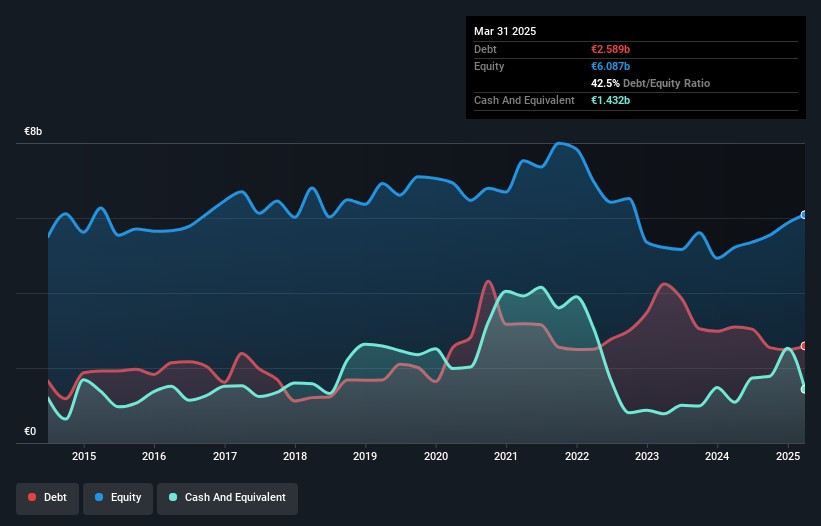
Adidas AG (ETR:ADS) has a net debt of approximately €1.16 billion, with total liabilities of €14 billion against €1.43 billion in cash and €3.24 billion in receivables. Despite its debt, Adidas has a low net debt to EBITDA ratio of 0.54 and an EBIT that covers interest expenses 16.3 times over. The company has shown significant growth, with EBIT increasing by 187% over the past year, indicating a manageable debt situation. Overall, Adidas appears to be prudent with its debt, with risks well managed.
Warren Buffett famously said, 'Volatility is far from synonymous with risk.' So it might be obvious that you need to consider debt, when you think about how risky any given stock is, because too much debt can sink a company. We note that adidas AG (ETR:ADS) does have debt on its balance sheet. But is this debt a concern to shareholders?
We check all companies for important risks. See what we found for adidas in our free report.
When Is Debt Dangerous?
Debt and other liabilities become risky for a business when it cannot easily fulfill those obligations, either with free cash flow or by raising capital at an attractive price. If things get really bad, the lenders can take control of the business. While that is not too common, we often do see indebted companies permanently diluting shareholders because lenders force them to raise capital at a distressed price. Of course, the upside of debt is that it often represents cheap capital, especially when it replaces dilution in a company with the ability to reinvest at high rates of return. When we think about a company's use of debt, we first look at cash and debt together.
What Is adidas's Net Debt?
The image below, which you can click on for greater detail, shows that adidas had debt of €2.59b at the end of March 2025, a reduction from €3.10b over a year. However, it does have €1.43b in cash offsetting this, leading to net debt of about €1.16b.
How Healthy Is adidas' Balance Sheet?
According to the last reported balance sheet, adidas had liabilities of €8.94b due within 12 months, and liabilities of €5.06b due beyond 12 months. On the other hand, it had cash of €1.43b and €3.24b worth of receivables due within a year. So its liabilities outweigh the sum of its cash and (near-term) receivables by €9.33b.
adidas has a very large market capitalization of €39.1b, so it could very likely raise cash to ameliorate its balance sheet, if the need arose. But we definitely want to keep our eyes open to indications that its debt is bringing too much risk.
Check out our latest analysis for adidas
We use two main ratios to inform us about debt levels relative to earnings. The first is net debt divided by earnings before interest, tax, depreciation, and amortization (EBITDA), while the second is how many times its earnings before interest and tax (EBIT) covers its interest expense (or its interest cover, for short). The advantage of this approach is that we take into account both the absolute quantum of debt (with net debt to EBITDA) and the actual interest expenses associated with that debt (with its interest cover ratio).
adidas has a low net debt to EBITDA ratio of only 0.54. And its EBIT easily covers its interest expense, being 16.3 times the size. So you could argue it is no more threatened by its debt than an elephant is by a mouse. Even more impressive was the fact that adidas grew its EBIT by 187% over twelve months. If maintained that growth will make the debt even more manageable in the years ahead. The balance sheet is clearly the area to focus on when you are analysing debt. But it is future earnings, more than anything, that will determine adidas's ability to maintain a healthy balance sheet going forward. So if you're focused on the future you can check out this free report showing analyst profit forecasts.
Finally, a business needs free cash flow to pay off debt; accounting profits just don't cut it. So we always check how much of that EBIT is translated into free cash flow. Over the last three years, adidas actually produced more free cash flow than EBIT. There's nothing better than incoming cash when it comes to staying in your lenders' good graces.
Our View
adidas's interest cover suggests it can handle its debt as easily as Cristiano Ronaldo could score a goal against an under 14's goalkeeper. And the good news does not stop there, as its conversion of EBIT to free cash flow also supports that impression! Considering this range of factors, it seems to us that adidas is quite prudent with its debt, and the risks seem well managed. So we're not worried about the use of a little leverage on the balance sheet. Above most other metrics, we think its important to track how fast earnings per share is growing, if at all. If you've also come to that realization, you're in luck, because today you can view this interactive graph of adidas's earnings per share history for free.
If, after all that, you're more interested in a fast growing company with a rock-solid balance sheet, then check out our list of net cash growth stocks without delay.
If you're looking to trade adidas, open an account with the lowest-cost platform trusted by professionals, Interactive Brokers.
With clients in over 200 countries and territories, and access to 160 markets, IBKR lets you trade stocks, options, futures, forex, bonds and funds from a single integrated account.
Enjoy no hidden fees, no account minimums, and FX conversion rates as low as 0.03%, far better than what most brokers offer.
Sponsored Content
