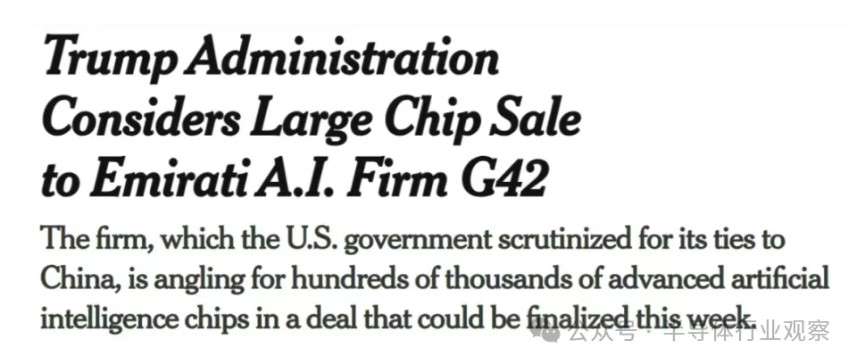
The UAE actively lays out its chip strategy as the US seizes the opportunity to consolidate its AI hegemony, potentially reshaping the global computing power landscape

Zhitong
2025.05.25 04:11
portai
I'm PortAI, I can summarize articles.

The UAE has signed an AI chip import agreement with the United States, allowing the import of over 1 million NVIDIA AI chips annually, becoming an important player in the global semiconductor and artificial intelligence fields. This agreement is a geopolitical maneuver by the UAE to exchange massive investments for a leap in computing power, aiming to strengthen its position in the global AI competition. Meanwhile, the global semiconductor industry is undergoing deep adjustments, with countries reinforcing their domestic industrial chains through policies and capital investments

According to Zhitong Finance APP, against the backdrop of the global semiconductor industry restructuring, the United Arab Emirates is rising as an important player in the semiconductor and artificial intelligence fields. The semiconductor industry observation team stated that recently, the UAE signed an AI chip import agreement with the United States, allowing the import of over 1 million advanced AI chips from NVIDIA each year, and is deeply cooperating with OpenAI, Microsoft, and others to promote industrial leaps. At the same time, the UAE is actively laying out chip manufacturing, establishing data centers, and initiating the MGX fund, aiming to build a complete industrial ecosystem. Overall, the UAE's AI chip agreement with the United States is a geopolitical game of "technology for capital": the UAE exchanges massive investments for a leap in computing power, attempting to occupy a differentiated position in the global AI competition; the United States, in turn, consolidates ally relationships through technology access, reinforcing its "AI hegemony."

In recent years, the global semiconductor industry has accelerated its restructuring amid the tide of de-globalization, with countries strengthening the resilience of their domestic industrial chains through policy support, capital investment, and technology blockades.

From the $52 billion subsidies of the U.S. CHIPS and Science Act, to the €43 billion industrial layout of the EU Chips Act, to the fierce competition in advanced processes and storage fields between Japan and South Korea, as well as the continuous breakthroughs in manufacturing and design by Taiwan and mainland China, the global semiconductor landscape is undergoing deep adjustments. Meanwhile, emerging markets such as India, Malaysia, and Vietnam have become new hotspots for industrial chain relocation, leveraging their low-cost advantages and policy dividends.

In this context, the UAE, as a pioneer of technological transformation in the Middle East, is quietly rising as an important player in the global semiconductor and artificial intelligence fields with its unique resource endowments and strategic vision.

One million advanced NVIDIA AI chips are heading to the UAE

Recently, the AI chip import agreement signed between the United States and the UAE shocked the industry: the U.S. allows the UAE to import 500,000 of the most advanced AI chips from NVIDIA each year, totaling over 1 million chips, which is four times the limit set during the Biden administration. This agreement is expected to last at least until 2027, and may even extend to 2030.

However, it is important to note that there is also a clear plan for the distribution of these chips—20% will go to the UAE's local AI giant G42 for the development of Arabic language large models and local data centers; the remaining 80% will be allocated by American companies such as Microsoft and Oracle for their data centers being built in the UAE.

At the same time, the agreement also requires G42 to build a mirror facility in the U.S. for every new data center established in the UAE, forming a "two-way technology binding." This move not only alleviates U.S. concerns about technology outflow but also allows Middle Eastern capital to deeply participate in U.S. technological infrastructure.

Additionally, in exchange, the UAE has committed to investing $1.4 trillion in the U.S. over the next 10 years, covering areas such as AI infrastructure, semiconductors, energy, and manufacturing. The U.S. is easing export restrictions in return for Middle Eastern capital's support for its technology projects and consolidating geopolitical strategic alliances It is not difficult to see that the UAE's "1.4 trillion dollar investment for chips" deal is essentially an equivalent exchange between oil capital and technological hegemony— the UAE uses massive investments over the next decade to obtain a ticket for the computing infrastructure of the "Desert Silicon Valley"; while the United States incorporates the Middle East into its dominant "Digital NATO" system through chip allocation rights—data centers operated by American companies, computing power flowing under U.S. regulation, and technology standards aligned with the U.S., forming a peculiar pattern of "physical presence in Abu Dhabi, control in Silicon Valley."

To analyze the significance of this initiative for both parties and the focal points of their competition, we can look at it from the perspectives of the UAE and the United States:

The author believes that behind the UAE's "computing power ambition" lies multiple logics:

From oil to AI computing power power transition: 500,000 advanced AI chips annually will drive the establishment of one of the world's largest AI parks, with computing power sufficient to support training models several times more complex than GPT-4, and to build the world's largest AI data center park (5 gigawatts capacity). This "computing power arms race" is not only a technological showcase but also aims to attract global companies to migrate their training tasks to the Middle East by hoarding advanced chips, with the UAE attempting to gain regional AI pricing power.

Bilateral diplomacy walking a tightrope between China and the U.S.: Experts point out that as China's largest trading partner (with a bilateral trade volume of $72 billion in 2024) and a security ally of the U.S., the UAE demonstrates superb balancing skills: on one hand, G42 announced the divestment of Chinese investments to comply with U.S. requirements, yet Huawei's 5G equipment still covers its communication network; on the other hand, its data centers use NVIDIA chips but allow Alibaba Cloud to expand its business locally. This "technology reliant on the U.S., market linked to China" strategy not only avoids sanction risks but also maintains economic ties.

From capital export to technology ecosystem construction: By controlling GlobalFoundries through its sovereign fund and investing in OpenAI, the UAE is transitioning from a mere "chip buyer" to an "ecosystem participant." Its goals are to be achieved in three phases: accumulating computing power resources from 2025 to 2027, independently training AI models from 2028 to 2030, and exporting solutions to neighboring countries after 2030, ultimately becoming a "global AI superpower."

In contrast, the U.S. calculations revolve around the dual strategy of technological hegemony and capital bundling. For the U.S., this agreement is a strategic layout of "killing three birds with one stone":

Economic benefits: Opening the Middle Eastern "computing power market." NVIDIA can circumvent export restrictions to China through this, with orders from the UAE alone expected to contribute over $10 billion in revenue before 2027; American companies like Microsoft and Oracle lock in the Middle Eastern cloud service market through data center construction, with significant growth expected in the regional cloud computing scale over the next five years.

Geopolitical control: Building a "de-China-ized" AI alliance. The Trump administration treated chips as "hard currency," incorporating the UAE into the "technology moat" system. This agreement requires chip flows to be monitored by the U.S. and implements a "mirror data center" clause (G42 must replicate its center in the U.S.), achieving a two-way binding of technology. This "regulatory outsourcing" model essentially integrates the Middle Eastern AI infrastructure into the U.S. technological hegemony map Strategic Deterrence: A New Pivot in the "Chip Blockade" Against China. By establishing the Middle East as the "third pole of AI," the United States aims to dilute China's influence in the global computing power network. Although the UAE has promised not to resell chips, the agreement still raises concerns—American companies may indirectly provide computing resources to Chinese enterprises through cloud services at data centers in the UAE, which has become the biggest point of contention before the agreement is finalized.

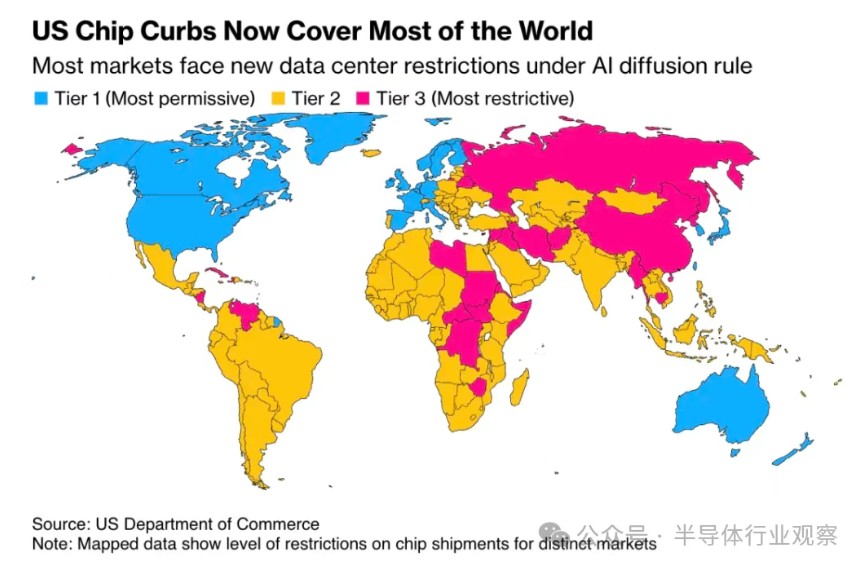
U.S. Chip Export Restrictions Now Cover Most Regions Globally

Overall, the AI chip agreement between the UAE and the United States is a geopolitical game of "technology for capital": the UAE seeks to exchange massive investments for a leap in computing power, attempting to occupy a differentiated position in the global AI competition; the U.S. aims to solidify ally relationships and reinforce its "AI hegemony" through technology access.

However, the sustainability of the agreement depends on whether both parties can balance commercial interests with national security, and whether the UAE can overcome resource and talent bottlenecks to translate its strategic vision into actual competitiveness. This cooperation will not only reshape the technological landscape of the Middle East but also provide a new paradigm of "capital-technology" interaction for global AI governance.

Regardless of the outcome, the computing power hub rising in the Middle Eastern desert is destined to become a new variable in the global AI competition—it could serve as a station on the "Digital Silk Road" or as an outpost of technological hegemony. In the next decade, the success or failure of this experiment will redefine the power equation of "resources" and "technology."

UAE Partners with OpenAI and Microsoft to Propel AI and Semiconductor Industries

In addition to signing the aforementioned agreement with the U.S., the UAE is actively positioning itself by injecting strong development momentum into its related industries through deep cooperation with OpenAI and Microsoft.

OpenAI's "Stargate" Project: OpenAI plans to engage in large-scale cooperation with the UAE's tech company G42 in Abu Dhabi, creating a data center park covering an area of 10 square miles and consuming 5 gigawatts of electricity in the desert. This project is a crucial part of OpenAI's "Stargate" initiative, aimed at building a supercomputing cluster to meet the computing power needs for training and running advanced AI models.

It is understood that the scale of this data center is astonishing, far exceeding any known data center projects globally, with power consumption more than four times that of OpenAI's first 1.2-gigawatt "Stargate" data center being built in Abilene, Texas, equivalent to five nuclear power plants. As early as 2023, OpenAI reached a strategic cooperation agreement with G42, laying the foundation for this large-scale project collaboration.

Microsoft's Multifaceted Involvement: Microsoft plays a key role in this cooperation. In April 2024, Microsoft announced an investment in UAE's G42, with the two companies establishing a $1 billion fund for AI developers. Microsoft subsequently invested $1.5 billion in G42, acquiring a minority stake and a board seat, with Microsoft President Brad Smith joining the G42 board In addition, Microsoft's Azure cloud services will serve as one of the technological foundations for the "Interstellar Gateway" project. Microsoft has also established a new development center in Abu Dhabi, which is its first center in the Arab world. The collaboration includes setting up a climate technology laboratory in Abu Dhabi and using it as a research and development center.

These collaborations have attracted more global AI companies to focus on the UAE, promoting the clustering of AI-related enterprises. For example, Oracle has participated in the data center project, while NVIDIA and Cisco have also provided support, with NVIDIA supplying hardware configured with the Blackwell GB300 system. The gathering of numerous enterprises helps build a complete AI industry ecosystem, forming a virtuous cycle from chip supply, data processing, algorithm development to application scenario expansion, driving the overall development of the UAE's AI industry.

Moreover, the UAE's collaboration with OpenAI and Microsoft to build large-scale data centers creates a massive demand for chips. To meet the chip requirements of AI infrastructure such as data centers, the UAE will push forward in the semiconductor-related supporting industries. This includes research and development and industrial layout in areas such as chip cooling technology and chip packaging technology, promoting the coordinated development of the semiconductor industry chain and enhancing the UAE's overall strength in the semiconductor industry.

At the same time, the development of high-end projects requires a large number of professional talents. On one hand, the collaborative projects provide practical opportunities for local AI talents in the UAE, cultivating a group of professionals who understand cutting-edge technologies; on the other hand, they also attract global AI talents to gather in the UAE, injecting fresh blood into the industry and enhancing the UAE's attractiveness and competitiveness in the global AI talent field.

Is TSMC and Samsung planning to build factories in the UAE?

In September last year, media reports revealed that TSMC and Samsung Electronics plan to build a super-large-scale chip manufacturing factory in the UAE, with a total investment potentially exceeding $100 billion.

In 2024, executives from TSMC and Samsung visited the UAE to discuss the construction of a chip factory comparable in scale to those in Taiwan. According to preliminary terms, the project will be led by the UAE government and the sovereign wealth fund Mubadala, aiming to reduce prices by increasing global chip production while promoting the development of the local technology industry. However, TSMC responded in September 2024 that it is currently focused on existing global expansion projects and has no new investment plans to disclose; Samsung has not made a public response.

Assuming the factory can ultimately be established smoothly, the UAE will achieve breakthroughs in chip design and manufacturing, providing foundational support for its AI industry. For example, Abu Dhabi's MGX Fund has listed semiconductor manufacturing as a strategic core, planning to complete the "education-research-industry" closed-loop ecosystem through investments in chip factories. At the same time, the technology transfer from TSMC and Samsung will drive the development of the local supply chain, attracting upstream and downstream enterprises to cluster, forming the first semiconductor industry cluster in the Middle East.

The plan sounds very enticing, but it currently seems to be in the early discussion stage and still faces many challenges and difficulties.

The first challenge is the technical and infrastructure bottleneck; chip manufacturing requires a large amount of ultra-pure water, while the UAE relies on seawater desalination, making purification costs high. Additionally, there is a lack of a mature semiconductor supply chain locally, with key equipment and materials needing to be imported from the Asia-Pacific region, increasing logistics costs by 30%-40% In terms of talent, the UAE needs to bring in engineers from overseas, but its ability to retain talent long-term is in doubt. For example, TSMC's project in Arizona, USA, faced delays due to talent loss.

Additionally, geopolitical issues and export restrictions are significant obstacles. The U.S. is concerned that advanced chips could flow from the UAE to sanctioned countries, leading to oversight of factory production and transportation. If oversight measures are too strict, it may weaken the UAE's attractiveness as a "technologically neutral country," affecting its strategy to attract global companies.

If the project is successful, the UAE is expected to establish semiconductor manufacturing capabilities by 2030, becoming the first country in the Middle East with the ability to mass-produce advanced chips. This will not only promote the development of its AI industry but could also change the global semiconductor supply chain landscape, alleviating the risks of capacity concentration brought about by the U.S.-China technological rivalry.

However, challenges related to technology, politics, and costs are unlikely to be resolved in the short term, and the project's final implementation will still take time. The UAE needs to accelerate local talent development, improve supply chain support, and attract investment through policy innovations (such as tax incentives and sovereign fund guarantees) to transition into a "technology powerhouse."

UAE Launches "Arms Race": Funding, Education, and Policy on Multiple Fronts

UAE Initiates MGX Fund

The core of the UAE's National Artificial Intelligence Strategy 2031 is the MGX Fund, a $100 billion AI special program initiated by Abu Dhabi's sovereign wealth fund Mubadala and AI company G42. The MGX Fund holds significant value and driving force for the AI and semiconductor industries.

In the AI industry, the MGX Fund has clear goals, aiming to drive AI-driven economic growth, with plans to have AI account for 20% of the UAE's non-oil GDP by 2031. In the field of AI infrastructure, its investments cover various aspects, from expanding data centers to enhancing connectivity, laying a solid hardware foundation for AI development. In the core technologies and applications of AI, it focuses on AI models, software, data, life sciences, and robotics, promoting continuous advancements in AI technology and expanding its application boundaries across various industries. For example, the Falcon LLM, the country's first large language model developed by the Abu Dhabi Technology Innovation Institute (TII) in 2022, exemplifies the progress of AI technology, and the investment from the MGX Fund is expected to generate more such outcomes. At the same time, the MGX Fund has attracted the attention and cooperation of international tech giants; for instance, in April 2024, Microsoft invested $1.5 billion in G42, which not only confirms the UAE's significant position in the global AI field but also reflects the favorable industrial environment created by the MGX Fund, attracting more external resources to support the development of the AI industry.

In the semiconductor industry, the MGX Fund will focus its investments on the design and manufacturing of logic and memory chips. As a solid foundation for AI-driven computing, the importance of semiconductors is self-evident. By investing in the semiconductor industry, the MGX Fund can ensure that the UAE has autonomous control or stronger industrial discourse power in AI computing hardware, preventing the development of its AI industry from being restricted by external semiconductor supply issues, thus providing stable underlying support for the long-term development of the AI industry, ensuring that the demand for chips in AI technology development is met, and promoting the collaborative advancement of the AI and semiconductor industries In addition, the UAE is acquiring the UK AI chip company Graphcore through its sovereign fund, bypassing US technology restrictions; collaborating with Russia to develop domestically controllable chips based on the Elbrus architecture, with plans to achieve 40% localization of computing power facilities by 2025. "While others are still discussing computing power bottlenecks, we have turned supercomputers into national infrastructure," revealed Omar Sultan, the UAE Minister of Artificial Intelligence, stating that by 2030, the national computing power will meet 15% of the global AI training demand.

UAE's AI Education Revolution and Policy Layout

While laying out the AI and semiconductor industries, the UAE is accelerating the construction of core competitiveness in the semiconductor and AI industries through a dual-wheel strategy of "education foundation + policy drive."

Currently, the semiconductor and AI industries are facing a widespread talent shortage. This shortage stems from high employee turnover rates, an aging workforce, high talent demand due to industry expansion, and insufficient training programs and related graduates. The UAE faces similar issues in building a local semiconductor ecosystem, and the industry urgently needs to formulate new strategies to fill the talent gap.

In response, the UAE has positioned AI education as the foundational infrastructure of its national strategy, constructing a multi-dimensional training system covering K12 education + higher education:

1. Basic Education Stage (Kindergarten to 12th Grade)

Enlightenment Level (Kindergarten - Primary School): Using tangible tools such as programming robots and voice interaction games to help children understand algorithm logic and data concepts.

Application Level (Secondary School): Introducing hardcore courses like Python programming and TensorFlow framework, where high school students can participate in practical projects such as smart city data labeling and developing intelligent tour guide systems. Students at Dubai International School can independently complete training of computer vision-based waste classification models.

Ethics Level (Permeation across all grades): Making AI ethics a compulsory course, debating "ethical dilemmas of autonomous driving" in virtual courtrooms and discussing "boundaries of AI military applications" in simulated United Nations settings, fostering a balanced mindset between technology and humanities.

2. Higher Education and Research Collaboration

Collaborating with top institutions like MIT and NVIDIA to establish AI research institutes and supercomputing centers, focusing on cutting-edge fields such as climate prediction large models and computing power infrastructure. For example, the supercomputing center at UAE University ranks first in the Middle East in computing power, supporting local company G42 in developing the "Falcon" chip with an energy efficiency ratio 2.3 times that of traditional GPUs.

Implementing an "industry mentor system," students majoring in AI at Sharjah University must complete at least six months of practical training at G42 or the Microsoft Middle East Research Institute, directly connecting to core positions in chip design and large model training.

By 2025, 87% of public schools in the UAE will complete the transformation of AI courses, with an expected annual output of 100,000 AI graduates, providing localized talent reserves for semiconductor design, AI algorithm development, and other fields.

On the other hand, the UAE is leveraging a combination of policies, using "petrodollars" as leverage, through a triple policy tool of strategic funds + international cooperation + standard formulation, to streamline the "technology introduction - local transformation - ecosystem output" chain:

  1. Trillion-level capital layout

Establish a $30 billion national AI investment fund, expanding to $100 billion within ten years, focusing on areas such as chip design, computing power infrastructure, and large model research and development. For example, through the sovereign wealth fund Mubadala Investment, enter the semiconductor manufacturing sector by acquiring a stake in GlobalFoundries, the world's third-largest foundry.

Using $1.4 trillion in investments in the U.S. as leverage, secure the import rights for 500,000 advanced AI chips from NVIDIA annually, and attract companies like Microsoft and Oracle to build data centers in Abu Dhabi, forming a strategic closed loop of "capital for computing power."

  1. Geopolitical technology arbitrage strategy

A supply chain layout that "eats both east and west": Collaborate with the U.S. to build a 5-gigawatt AI data center park, with 80% of chips used for U.S. company data centers to gain technological trust; to the east, allow Huawei to build a cloud computing center and train the Arabic large model Jais, maintaining a technological link with China. This model avoids U.S. sanctions while preserving space for diverse cooperation.

Leading global standard discourse power: Establish a "Global AI Ethics Alliance," attracting members from 43 countries and companies, attempting to set "Middle Eastern rules" in areas such as AI ethics and cross-border data. The Dubai Future Foundation promotes an "AI sandbox regulatory mechanism," allowing companies to test cutting-edge technologies in specific areas, attracting companies to establish regional headquarters.

  1. Industry scenario landing drive

Create the world's first AI zero-carbon city in Masdar City, Abu Dhabi, deploying 3,000 smart sensors to optimize energy distribution; Dubai Customs introduces a "digital twin" system, reducing cargo clearance time from 7 days to 15 minutes, forming a positive cycle of "technology-scenario-data."

Establish an "AI Innovation Visa," providing a 10-year residency and 90% business license subsidy for tech entrepreneurs, attracting over 3,000 AI companies to settle in the Dubai International Financial Center.

Overall, through a combination strategy of "educating and cultivating local talent + capital acquisition of technological assets + policies to attract global companies," the UAE attempts to establish unique advantages in the AI application layer and ethical standards while relying on U.S. companies for chip manufacturing.

Data shows that the UAE's AI industry scale grew by 217% year-on-year in 2023, contributing over 9% to GDP, and is expected to surpass oil as the largest economic pillar by 2030. The synergistic development of semiconductors and AI will drive the UAE's transformation from an "oil-exporting country" to a "computing power and data service exporting country."

In this process, the UAE invests in U.S. companies like OpenAI and Anthropic while also holding shares in Chinese firms like SenseTime and ByteDance, aiming to become a collaborative partner of global tech giants. This role allows it to acquire high-end chips while avoiding risks from a single camp, creating strategic buffer space for the semiconductor and AI industries.

In conclusion

In fact, as early as 2009, the UAE laid the groundwork for its early layout in semiconductor manufacturing by acquiring a stake in GlobalFoundries, the world's third-largest foundry. In 2020, the UAE's Next Orbit Ventures and Israel's Tower Semiconductor established a joint venture, investing $3 billion to set up a chip manufacturing plant in India, further expanding the UAE's layout in the semiconductor manufacturing sector In recent years, with the surge in global AI computing power demand, the United Arab Emirates has further increased its investment in the semiconductor and artificial intelligence sectors: collaborating with the United States to build a 5-gigawatt capacity AI data center park, planning to import 500,000 advanced NVIDIA chips annually to support AI model training; negotiating with Samsung and TSMC for a billion-dollar chip factory project through the sovereign wealth fund Mubadala, attempting to establish a complete industrial chain covering design, manufacturing, and packaging; establishing MGX Technology Investment Company, focusing on semiconductor design, data centers, and other AI infrastructure, and collaborating with G42 Group to develop custom chips to challenge industry giants.

This dual-track strategy of "technology introduction + ecosystem construction" not only demonstrates the UAE's determination to reduce oil dependence and achieve economic diversification but also reflects its wisdom in seeking a differentiated position in the global semiconductor industry chain. From investing in GlobalFoundries to laying out AI chips, from building regional data center hubs to attracting global tech companies, the UAE is leveraging oil dollars to draw a blueprint for a "Middle East Silicon Valley" at the intersection of semiconductors and artificial intelligence.

However, despite the grand layout, challenges are equally sharp: chip manufacturing relies on high-purity water from desalination, there is a structural shortage of professional talent, and core facility operating rights and chip allocation rights are largely controlled by American companies, posing significant "technological dependency" risks. The United States' vigilance against technology outflow and the balancing pressure under the US-China rivalry further subject it to the geopolitical test of being a "fence-sitter."

Nevertheless, the UAE's practice has already proven that resource-rich countries can break through by leveraging capital and geopolitical advantages, but the foundation of a technologically strong nation ultimately lies in local innovation and strategic determination. When the tide of "oil dollars" transforms into "digital capital" recedes, only indigenous roots can take hold in the desert