


CICC: The "Great Beauty Act" will increase the U.S. fiscal deficit in the future, and short-term U.S. dollar interest rates will face upward risks

CICC released a research report stating that Trump signed the "Great Beauty Act" on July 4, 2025, fulfilling his tax reduction promise. The act includes tax cuts for corporations and individuals, reductions in clean energy subsidies, and medical assistance, and is expected to increase the fiscal deficit, with a net deficit of approximately $1.3 trillion over ten years. Although the deficit rate remains around 6%, the current economic situation is good, and the risk of government debt is not high. The core content of the act is consistent with Trump's campaign platform, emphasizing the idea of a small government
According to the Zhitong Finance APP, China International Capital Corporation (CICC) released a research report stating that on July 4, 2025, Trump officially signed the "Great Beauty Act," essentially fulfilling his core tax reduction promise made during the campaign. The act is divided into five main parts, covering corporate tax cuts, individual and family tax cuts, reductions in clean energy subsidies, cuts to Medicaid, and reductions in the Supplemental Nutrition Assistance Program (SNAP). Overall, the "Great Beauty Act" will increase the fiscal deficit in the future, but part of the deficit can be offset by tariff revenues. Estimates show that the act will boost real GDP by less than 0.5 percentage points in 2026 and will raise inflation by no more than 0.15 percentage points; over the next decade, the combination of tariffs and tax cuts will increase the net deficit by approximately $1.3 trillion, with the deficit rate remaining around 6%. Given the current low unemployment rate, moderate inflation, and healthy private sector balance sheets, there is no urgent risk to U.S. government debt.
In the medium term, fiscal constraints will depend more on excessively high inflation and declining fiscal efficiency, but neither of these scenarios has yet emerged. Under the premise of controllable inflation, the fiscal space in the U.S. may be larger than mainstream economics has thought over the past 40 years.
CICC's main points are as follows:
1. What are the core contents of the "Great Beauty Act"?
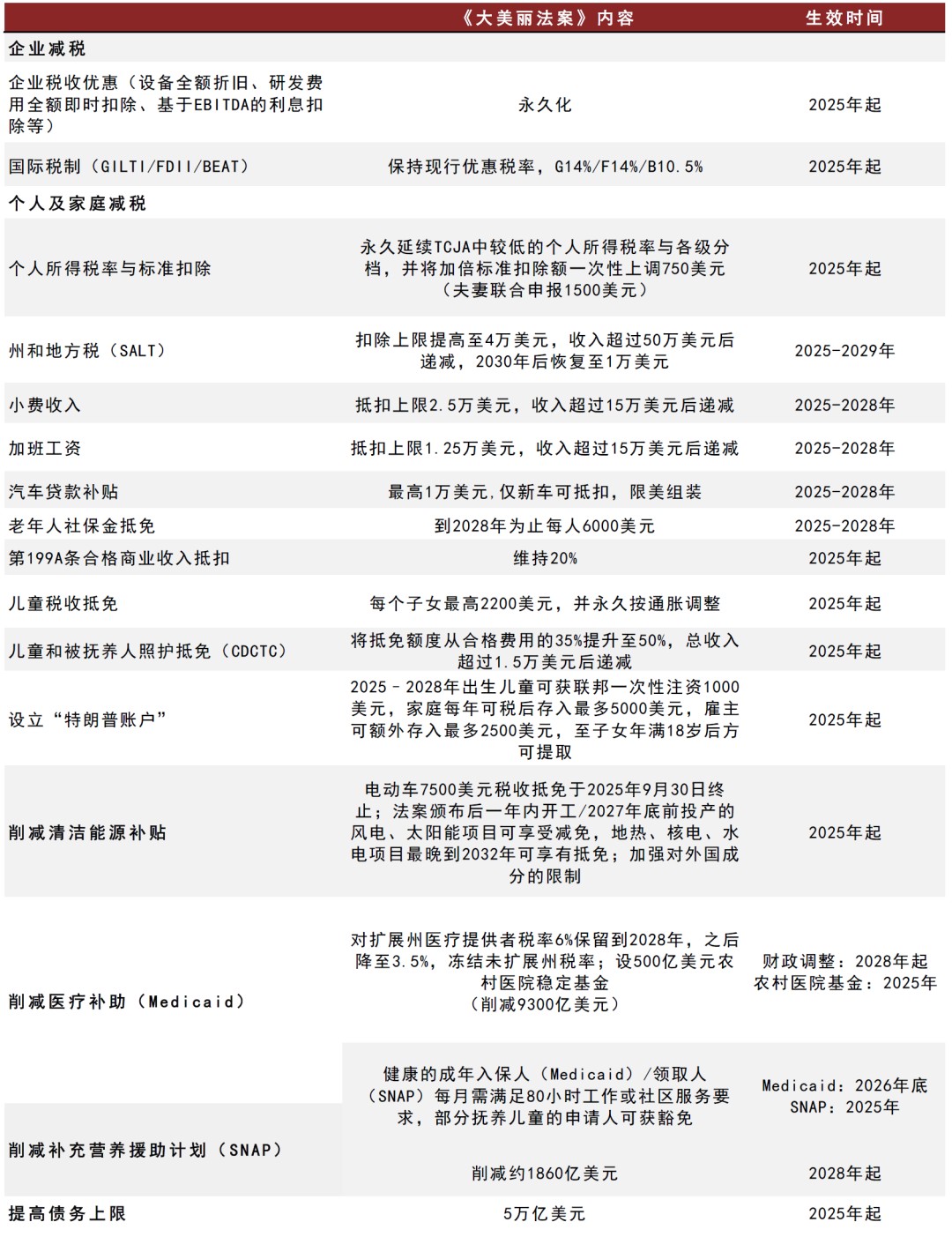
The act essentially realizes Trump's proposal of "permanently reducing taxes for businesses and families" made during last year's campaign, while adhering to the Republican principle of "small government," compressing and cutting social welfare expenditures such as Medicaid and nutrition assistance programs to achieve the goal of "not supporting the lazy." In addition, the act accelerates the cancellation of clean energy subsidies, which is consistent with Trump's support for fossil fuels and opposition to new energy (Chart 1). Specifically:
Chart 1: Core contents of the "Great Beauty Act"
Source: CBS News, New York Times, Bipartisan Policy Center, PWC, Bloomberg, CICC Research Department
- Corporate tax cuts: The act continues the core measures of the 2017 "Tax Cuts and Jobs Act" (TCJA), explicitly making three key corporate tax incentives permanent: first, full depreciation of equipment, allowing companies to deduct the entire cost of specific assets at once, enhancing investment return efficiency; second, full immediate deduction of R&D expenses, which encourages technological innovation and benefits industries with high R&D spending; third, an interest deduction limit based on EBITDA, which helps reduce financing costs, particularly beneficial for capital-intensive industries.
To further alleviate the tax burden on multinational corporations, the act cancels the planned adjustments for global intangible low-tax income, foreign-derived intangible income, and base erosion and anti-abuse measures originally scheduled for 2026, maintaining the current lower preferential tax rate level. In addition, the act removes the controversial Section 899 (i.e., retaliatory taxes) Previously, Treasury Secretary Besant announced that the United States has reached an agreement with other G7 countries on the "second pillar" of the OECD global tax reform framework: the low-tax profit rule and income inclusion rule will not apply to U.S. multinational companies and their subsidiaries, effectively protecting the competitiveness of U.S. businesses amid changes in global tax rules.
- Individual and Family Tax Cuts: The bill will permanently extend the lower personal income tax rates and bracket structure established by the Tax Cuts and Jobs Act (TCJA), maintaining the current top marginal tax rate of 37%. At the same time, the bill increases tax deductions: it will permanently retain the doubled standard deduction set by the TCJA and provide a one-time increase of $750 starting in 2025. For state and local tax deductions (SALT), the cap will be raised from the current $10,000 to $40,000 (effective from 2025), but a "sunset clause" will be set to revert it back to $10,000 starting in 2030. The bill also offers tax benefits for certain items in labor income: tip income up to $25,000 will be tax-exempt, and overtime pay will have a tax-exempt limit of up to $12,500.
Additionally, interest on auto loans can be deducted up to $10,000 per year; seniors aged 65 and older can enjoy an annual special tax deduction of up to $6,000 for Social Security benefits. The bill also makes permanent the 20% qualified business income deduction under Section 199A, continuing to support sole proprietors and partnerships. In terms of family taxation, the child tax credit will be permanently increased from the current $2,000 per child to $2,200; the credit rate for child and dependent care will be raised from the current 35% to 50%. The bill also proposes the establishment of "Trump Accounts," specifically for newborns born between 2025 and 2028: the federal government will make a one-time contribution of $1,000 for each newborn, and families can contribute up to $5,000 annually, with the account balance invested in funds tracking U.S. stock indices. Employers can also contribute up to $2,500 to employee accounts, and this amount will not be counted as employee income.
- Reduction of Clean Energy Subsidies: The bill adjusts several clean energy tax credit provisions from the 2022 Inflation Reduction Act (IRA) and terminates some preferential policies early. Specifically, the previously offered tax credit of up to $7,500 for each electric vehicle will officially expire on September 30, 2025, and will not be extended. For clean power projects, the bill stipulates that projects such as wind and solar must commence within 12 months of the bill's enactment or be completed by December 31, 2027, to continue enjoying production tax credits (PTC) and investment tax credits (ITC). In contrast, tax credits for other renewable energy projects such as nuclear and geothermal can be retained until 2032, providing more flexibility.
At the same time, the bill further strengthens restrictions on "Foreign Entities of Concern" (FEOC) regarding critical material supply and capital investment. Specific measures include: refining the legal definitions of "designated foreign entities" and "foreign-influenced entities," and establishing a cap on the proportion of critical component sources—if the proportion of FEOC sources in a project is too high, the project will be directly disqualified from enjoying tax credits. This move aims to enhance U.S. national security control in the new energy sector through supply chain reviews and access restrictions 4) Reducing Medicaid: The bill significantly tightens the federally and state-funded Medicaid program. Medicaid primarily serves low-income individuals, people with disabilities, the elderly, and children, covering about 21% of the U.S. population and accounting for approximately one-fifth of national healthcare spending. The bill introduces a new work requirement for obtaining benefits: unemployed adults must complete at least 80 hours of work, training, or volunteer service each month to maintain Medicaid eligibility. The bill also tightens asset reviews and eligibility verification processes. Additionally, the cap on the "provider tax" for state matching funds will be gradually reduced from the current 6% to 3.5% by 2032, which will decrease state funding and correspondingly reduce federal subsidy ratios.
According to estimates from the Congressional Budget Office (CBO), these reforms are expected to cut about $1 trillion in federal spending over the next decade, but will also result in approximately 11.8 million people losing Medicaid coverage. Since residents in rural areas generally rely more on Medicaid than those in urban areas, this move could push many rural hospitals into financial distress. To mitigate the impact, the bill proposes the establishment of a special fund totaling $50 billion over five years to support rural hospitals in maintaining their operations and service capabilities.
- Reducing the Supplemental Nutrition Assistance Program (SNAP): The bill includes three reform measures to cut SNAP spending: first, adjusting the thrifty food plan; second, expanding work obligations for beneficiaries; and third, redistributing the cost-sharing mechanism between federal and state governments. Under the current system, the federal government fully covers the funding needed for SNAP benefits, while administrative costs are shared equally between federal and state governments. The new bill requires states to increase their share of administrative costs from 50% to 75% and introduces a new cost-sharing mechanism: if a state has a high "error rate" (i.e., the proportion of incorrectly issued benefits), that state must also share part of the benefit issuance costs that should have been covered by the federal government.
This effectively shifts more financial pressure to state governments. According to CBO forecasts, these changes will reduce federal SNAP spending by about $186 billion over the next decade. Research from the Center on Budget and Policy Priorities (CBPP) indicates that these cuts could ultimately affect the benefits of over 40 million people, including about 16 million children, 8 million elderly individuals, and 4 million non-elderly disabled persons.
- Raising the debt ceiling: The bill will increase the federal debt ceiling from the original House version of $4 trillion to $5 trillion.
2. How significant is the stimulus effect of the "Great Beauty Act"?
Estimates from different institutions show that the "Great Beauty Act" will overall raise the fiscal deficit; however, since the Trump administration is simultaneously using tariffs to increase fiscal revenue, it is necessary to comprehensively assess the economic stimulus effect of the combination of "external tax increases and internal tax cuts." According to estimates from CBO and the Committee for a Responsible Federal Budget (CRFB), under the current "Great Beauty Act," considering interest expenses and tariff revenues, the deficit rate for fiscal year 2024 will be 6.3%, falling to 5.6% in fiscal year 2025, and rising to 6.1% in fiscal year 2026. This indicates that fiscal policy will be marginally tightening in 2025, but will shift back to expansion in 2026 Assuming the fiscal multiplier is about 1, the fiscal stimulus to GDP growth in 2026 is approximately 0.5 percentage points. In addition, literature shows that the impact multiplier of fiscal shocks on inflation is between 0.1 and 0.5; let's assume this multiplier is 0.3, then the upward effect on the inflation rate in 2026 is about 0.15 percentage points.
Fiscal expansion boosts GDP growth, which will increase the demand for money transactions. Meanwhile, the Federal Reserve continues to "taper," which is equivalent to putting more U.S. Treasury bonds into the market while withdrawing liquidity, leading to a decrease in money supply. On the other hand, the fiscal deficit means the government will issue more Treasury bonds, requiring investors to forgo liquidity to hold more bonds, which necessitates higher interest rates. Consequently, short-term U.S. dollar interest rates will face upward risks, and the depreciation pressure on the dollar exchange rate may also weaken.
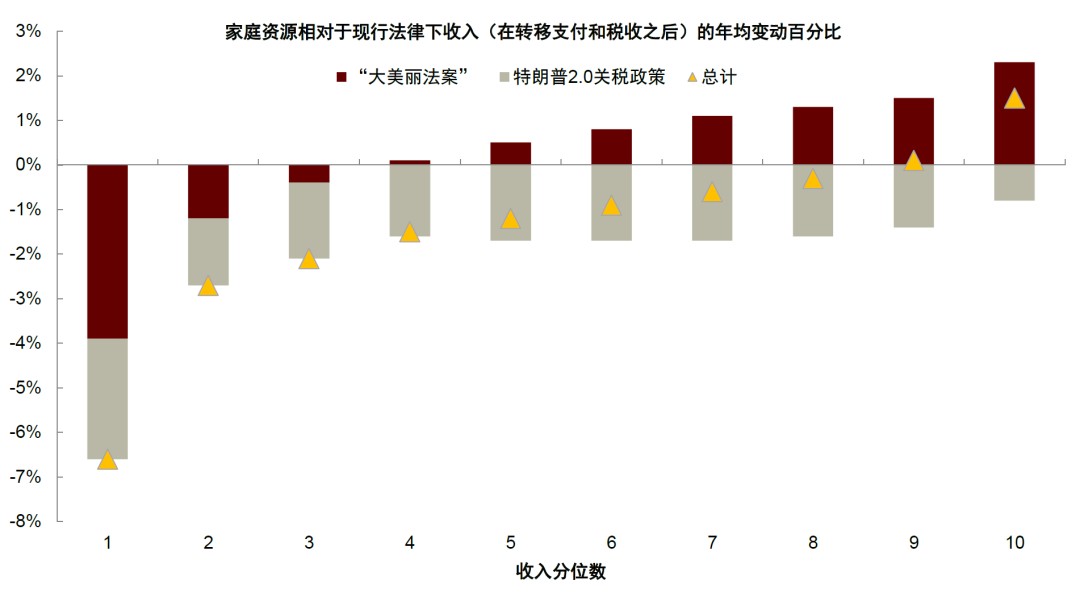
Another observation is that the "Great American Rescue Plan" encourages corporate investment and labor supply but may suppress consumption spending among low-income groups. This makes the plan favorable for large corporations, unfavorable for low-income individuals, and raises suspicions of "robbing the poor to pay the rich." For example, the plan has made several corporate tax incentives permanent, reducing the policy uncertainty faced by businesses, which is beneficial for capital expenditure. The tax-exempt treatment of tips and overtime income helps enhance labor incentives, while stricter Medicaid and SNAP eligibility reviews will prompt some labor force to re-enter the market, increasing labor supply. However, on the other hand, the plan cuts welfare support for low-income groups, who have a higher marginal propensity to consume, and the reduction in actual disposable resources will inevitably weaken their consumption capacity. According to estimates from the Yale Budget Lab, the combination of tax cuts and tariffs may lead to a decline in average income after taxes and transfer payments for the bottom 80% of American households, while the income of the top 10% of households may rise (Chart 2). From the perspective of income distribution, the "Great American Rescue Plan" may exacerbate wealth inequality; however, from the perspective of inflation impact, this distribution effect may actually increase supply and suppress demand, thereby alleviating inflation pressure. With controllable inflation risks, the sustainability of fiscal expansion will also be enhanced.
Chart 2: Tariffs and the "Great American Rescue Plan" may exacerbate wealth disparity
Source: Yale Budget Lab, CICC Research Department
3. How high are the deficit costs of the "Great American Rescue Plan"?
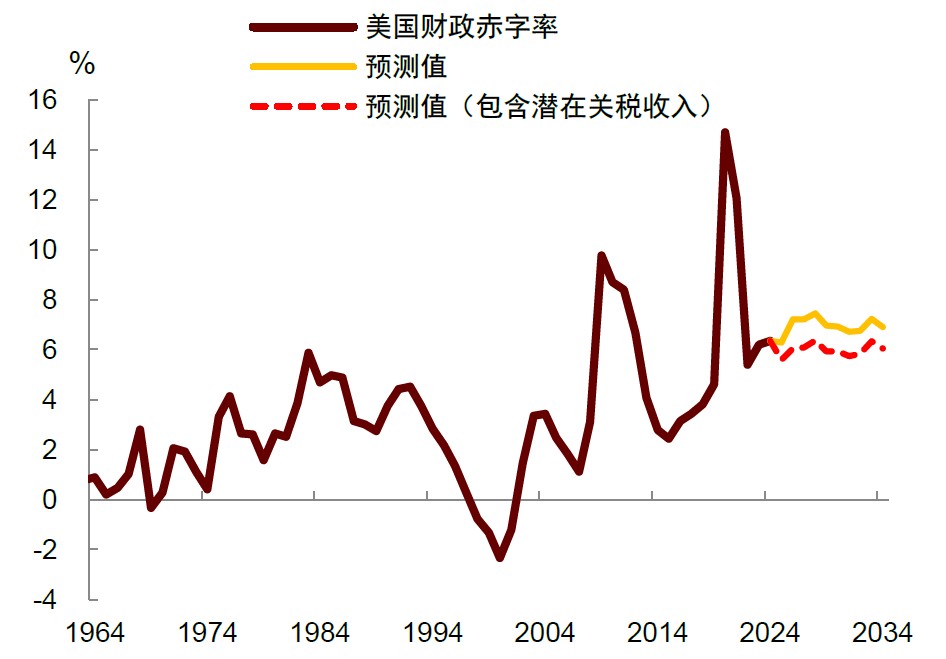
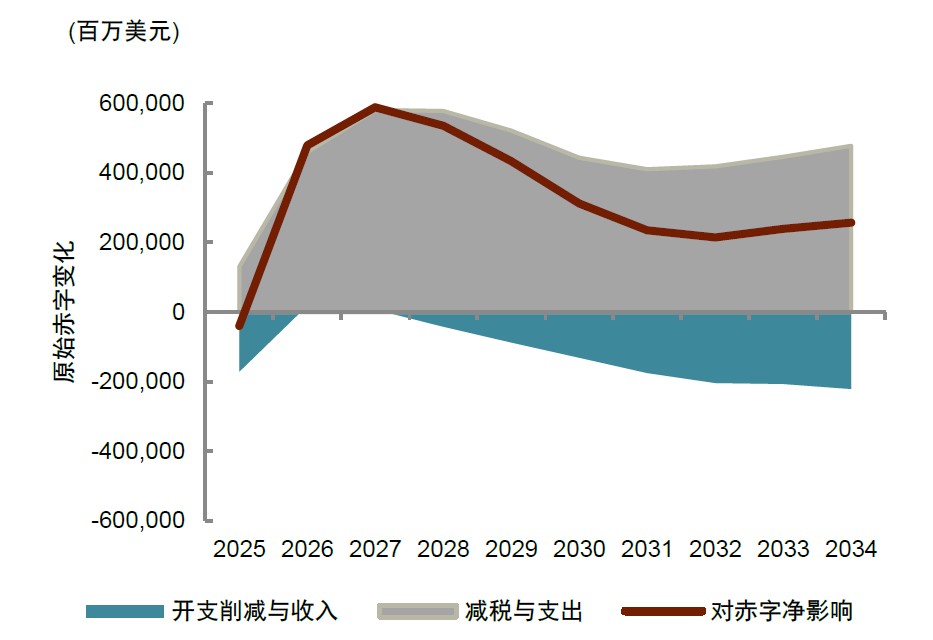
According to CBO estimates, the "Great American Rescue Plan" will increase the federal deficit by approximately $3.4 trillion between 2025 and 2034. On this basis, adding about $0.7 trillion in new interest expenses, the deficit increase will rise to about $4.1 trillion. On the other hand, CBO estimates that tariffs could bring in about $2.8 trillion in potential revenue over the next decade; if this revenue is deducted, the new net deficit over the next decade will be reduced to $1.3 trillion. Also referencing estimates from different institutions such as CRFB, JCT, and Tax Foundation, on average, the central prediction for the new net deficit over the next decade from the four institutions is $1.5 trillion (Chart 3) According to these estimates, the deficit rate is expected to remain around 6% from 2025 to 2034 (Chart 4). In terms of pace, the deficit rate shows a "high at the beginning and low at the end" trend, as most tax reduction measures will be implemented between 2026 and 2029, and by 2030, several tax reduction measures will gradually expire (Chart 5).
Chart 3: Different institutions' forecasts of the deficit cost of the "Great Beautiful Act"
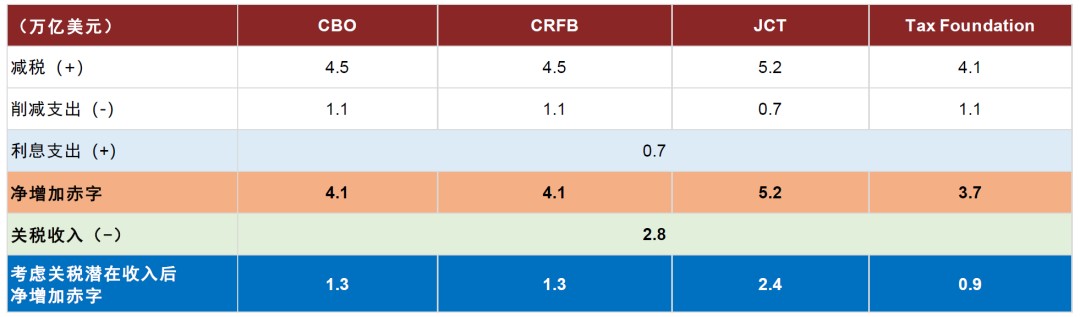
Note: Interest expenditures are uniformly calculated using CRFB, and tariff revenues are uniformly calculated using CBO. Source: CBO, CRFB, JCT, Tax Foundation, CICC Research Department
Chart 4: The U.S. fiscal deficit rate may remain around 6%
Source: CRFB, CBO, CICC Research Department
Chart 5: The deficit rate shows a "high at the beginning and low at the end" trend
Source: CBO, CICC Research Department
Regarding the U.S. fiscal outlook, there is currently debate in the market. The mainstream view holds that as the federal government debt level continues to rise, the U.S. fiscal situation is unsustainable, and therefore, fiscal tightening policies should be adopted to curb it. This view is heavily influenced by the classical school’s concept of "balanced finance," which centers on treating government finance as a household income and expenditure account, emphasizing that the government should cut spending or increase taxes to avoid long-term fiscal deficits and reduce excessive intervention in the economy. To constrain government issuance of currency and fiscal expansion, classical economists endorse the commodity money theory and advocate for the implementation of a "gold standard."
However, Keynesians hold a different view. They emphasize that the government should play an active role in economic operations. When the economy falls into recession, the government should increase fiscal spending to boost demand, even if it results in a deficit; conversely, when the economy is overheating and inflation is rising, it is necessary to cool it down through tax increases or spending cuts. An extension of this idea is the "functional finance" concept, where the starting point of fiscal policy is not to maintain budget balance but to serve macroeconomic goals—such as full employment, economic growth, and price stability. Fiscal deficits or surpluses are not the key issues; the key is whether fiscal policy is "effective" for the overall economic operation. This does not mean that Keynesians are unconcerned about government debt; rather, they believe that the main constraint on government debt comes from inflation, not the debt ratio itself Furthermore, Keynes advocated for the national monetary theory, opposing the "gold standard," which he referred to as "the last barbarism." The modern monetary theory, which evolved from Keynesianism, posits that there is a fundamental difference between government debt and private debt; for countries with monetary sovereignty, fiscal constraints are relatively minor. This presents a possibility: under the premise of controllable inflation, the space for fiscal expansion in the United States is greater than mainstream economics has suggested over the past 40 years.
The Keynesian perspective aligns more closely with the current macroeconomic environment: the U.S. economy is currently at full employment, inflation is moderate, and there is no need for further fiscal expansion, nor is there a necessity to deliberately pursue tightening. Maintaining the current level of deficit does not necessarily increase government debt risk; rather, an excessive pursuit of fiscal balance can lead to unnecessary unemployment, which is detrimental to economic stability. In fact, the "Great American Rescue Plan" already includes numerous measures to cut welfare spending, and if the tax reduction provisions in the plan cannot be extended, combined with tariff shocks, it will lead to significant fiscal tightening effects.
In the medium term, the constraints on U.S. fiscal expansion mainly stem from inflationary pressures and declining fiscal efficiency, but as of now, neither of these situations has manifested. Moreover, post-pandemic experiences indicate that controlling inflation is not as difficult as it may seem. Even though the Federal Reserve's interest rate hikes in 2022 were somewhat delayed, it ultimately succeeded in suppressing inflation. This leads to another inference: in a relatively loose fiscal environment, U.S. monetary policy may remain in a relatively tight state for an extended period. The Federal Reserve will shift from being the "main character" to a "supporting role," with the focus of monetary policy shifting from "anti-deflation" to "inflation prevention."
