US-EU trade negotiations sprint: 10% tariff "ceasefire agreement" may be finalized this week, key industries seek exemptions

The European Union is seeking to reach a preliminary trade agreement with the United States to lock in a 10% tariff rate and avoid a significant increase in tariffs after August 1. Key industries such as aircraft and alcoholic beverages are seeking exemptions. The United States has postponed the universal tariffs originally scheduled for implementation on July 9, and both sides are discussing compensation mechanisms to reduce tariffs on automobiles and metals. The preliminary agreement may be short-term and non-binding, and both sides also hope to reach a consensus on non-tariff barriers and digital trade
According to Zhitong Finance APP, the European Union is seeking to reach a preliminary trade agreement with the United States this week in order to lock in a 10% tariff rate after the August 1 deadline, while both sides continue to negotiate a permanent agreement.
Informed sources revealed that the EU is seeking to exempt certain key products from the 10% tariff, including aircraft, aircraft parts, as well as wine and spirits. As part of a principled agreement, some form of relief is expected to be offered. The European Commission, which handles trade affairs for the EU, updated member states on the progress of the negotiations on Monday.
The United States announced on Monday that the universal tariffs originally scheduled to take effect on July 9 would be postponed at least until early August. For the EU, if an agreement cannot be reached before then, nearly all tariffs on goods exported to the U.S. will jump to 50% starting August 1.

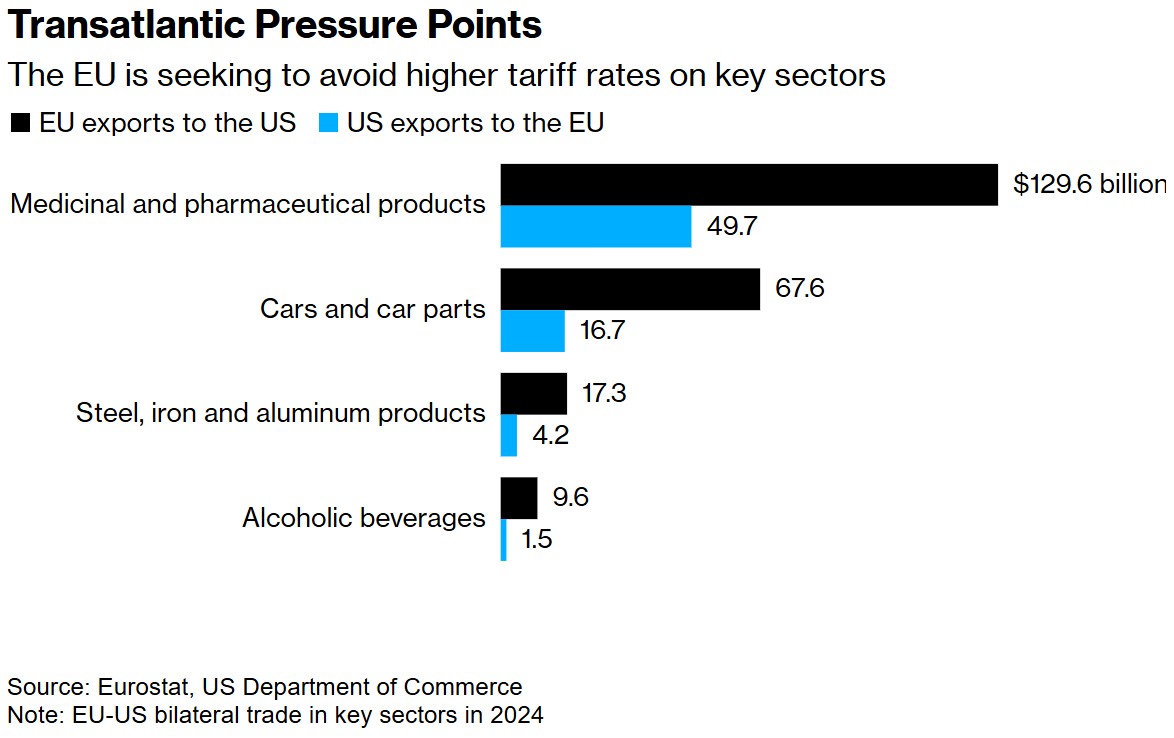
The EU is seeking to avoid higher tariffs on key industries.
Trump imposed tariffs on nearly all U.S. trading partners, claiming he wanted to revive domestic manufacturing, needed to pay for tax cuts, and prevent other countries from taking advantage of the U.S.
Informed sources stated that the EU has also urged the U.S. to implement quotas and exemptions to effectively reduce Washington's 25% tariff on automobiles and auto parts, as well as the 50% tariff on steel and aluminum. However, breakthroughs on these tariffs are not expected immediately.
Sources indicated that both sides are discussing a so-called compensation mechanism that would allow companies producing cars in the U.S. to export a certain number of tax-free vehicles. Bloomberg News previously reported that some officials are concerned that such arrangements could lead to investment and production shifting across the Atlantic.
Any preliminary agreement is likely to be short and non-binding. Both sides also aim to reach consensus on non-tariff barriers, digital trade, and economic security. In addition to the so-called reciprocal tariffs and sector tariffs on automobiles and metals, the U.S. is also prepared to impose tariffs on other industries, including pharmaceuticals and semiconductors.
Member states within the EU have differing views on what level of imbalanced agreement should be accepted, with some pushing for a swift agreement while others hope the EU will take countermeasures and negotiate from a position of strength.
The EU will assess any final outcome and decide at that stage what level of asymmetry it is willing to accept and whether any rebalancing measures are needed.
The EU has approved tariffs on €21 billion ($24.6 billion) worth of U.S. goods as a swift response to Trump's tariffs on metals.
These tariffs target politically sensitive U.S. states, including products such as soybeans, agricultural products, poultry, and motorcycles from Louisiana. Louisiana is the home state of House Speaker Mike Johnson.
The EU has also prepared an additional tariff list targeting €95 billion worth of U.S. goods in response to Trump's so-called reciprocal tariffs and automobile tariffs. These tariffs will target industrial products, including Boeing aircraft, U.S.-made cars, and bourbon whiskey The European Union is still consulting with member states to identify strategic areas where the United States relies on the EU, as well as potential measures beyond tariffs, such as export controls and procurement contract restrictions