Trump leaves room for negotiation, trade agreement prospects boost emerging market currencies rebound

Zhitong
2025.07.08 02:44

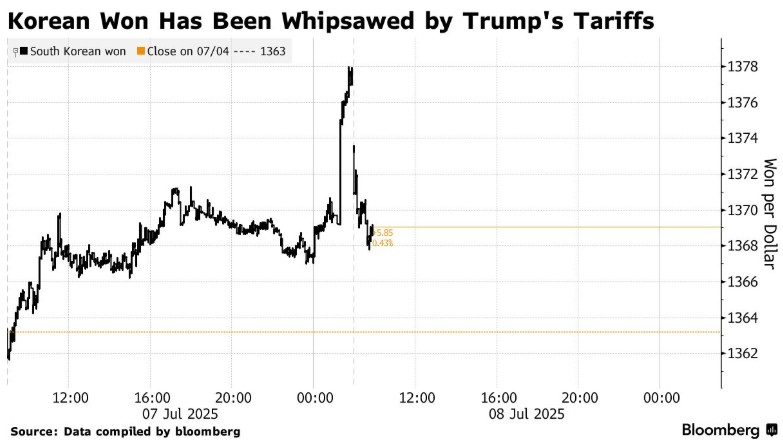
After setting tariffs for more than a dozen countries, Trump expressed a willingness to continue negotiations, leading to a rebound in emerging market currencies. Currencies such as the South Korean won and Thai baht rose against the US dollar, while the South African rand also saw a slight increase. Market speculation about future tariffs intensified, with investors believing that high tariffs could lead to a decline in the valuation of US assets. Trump announced a 25% tariff on products from Japan and South Korea starting in 2025 and set different tariff rates for 12 other countries, postponing the originally scheduled negotiation deadline

According to the Zhitong Finance APP, shortly after U.S. President Donald Trump expressed his willingness to continue trade agreement negotiations following the imposition of tariffs on more than a dozen countries, most emerging market currencies regained lost ground against the U.S. dollar and began to rise.

The South Korean won, which had sharply declined overnight, rebounded strongly, leading the rise among Asian emerging market currencies with an increase of about 0.6%, recovering all of its overnight losses; the Thai baht also erased its early losses. These movements are an important part of the moderate rebound in emerging market currencies, with the South African rand, which faced a heavy blow on Monday, also rising slightly.

On Monday, Eastern Time, Trump sent letters to several countries setting tariff rates but indicated that he remained open to negotiations, stating that these tariffs are "firm, but not 100% firm." However, this move by Trump has plunged the market back into a familiar guessing game: how severe will the final tariff impact be?

The Trump administration has been vague about the tariff rates after the July 9 deadline, but investors have begun to glean some clues from the pricing trends in the currency market: currencies of countries that may face the most severe tariffs have actually strengthened significantly against the U.S. dollar, suggesting that the foreign exchange market is betting on a collapse in U.S. asset valuations under high tariff pressure or that the "American exceptionalism" is gradually crumbling. In the view of the foreign exchange market, the tariff rates set by the U.S. government after July 9 may be much higher than the average 10% tariff rate that U.S. stocks have absorbed.

It is understood that during the U.S. stock market's midday session on Monday, Trump posted letters to Japanese Prime Minister Shigeru Ishiba and South Korean President Lee Jae-myung on social media, stating that the U.S. would impose a 25% tariff on all Japanese and South Korean products starting August 1, 2025.

Subsequently, Trump announced the benchmark tariff rates for another 12 countries. Starting August 1, the U.S. will impose a 25% tariff on products imported from Kazakhstan, Malaysia, and Tunisia, a 30% tariff on South Africa and Bosnia and Herzegovina, a 32% tariff on Indonesia, a 35% tariff on Bangladesh and Serbia, a 36% tariff on Thailand and Cambodia, and a 40% tariff on Laos and Myanmar.

However, for these countries that received trade letters, Trump signed an executive order postponing the originally scheduled July 9 tariff negotiation deadline to August 1.

"The 'firm but not 100%' statement has once again put the market into a 'Trump Tuesday Taco' buying mode," said Tony Sycamore, an analyst at IG Markets based in Sydney. "The market is still driven by headlines, so it largely depends on what he says next and what specific actions he takes."

Trump first announced plans to impose a 25% tariff on Japanese and South Korean goods. Subsequently, more countries were affected, with plans to impose tariffs on goods from U.S. trading partners such as South Africa, Indonesia, Thailand, and Cambodia being announced in succession In the emerging market stock market, the MSCI Emerging Markets Stock Index showed little change in early trading on Tuesday. The Korea Composite Stock Price Index (Kospi) led the regional indices, rising about 1.5%. However, one of the largest weighted stocks, Samsung Electronics, dragged down the South Korean stock market, mainly due to Samsung Electronics' dismal performance in the second quarter, with its operating profit plummeting 56% year-on-year to 4.6 trillion won (approximately USD 3.3 billion), far exceeding analysts' previous expectations of a 41% decline. This also marks the first profit decline for the company since the first quarter of 2023