The earnings season for chip giants starts off with a whimper as simulation leader Texas Instruments has its "tariff illusion" punctured

Zhitong
2025.07.23 00:36
portai
I'm PortAI, I can summarize articles.

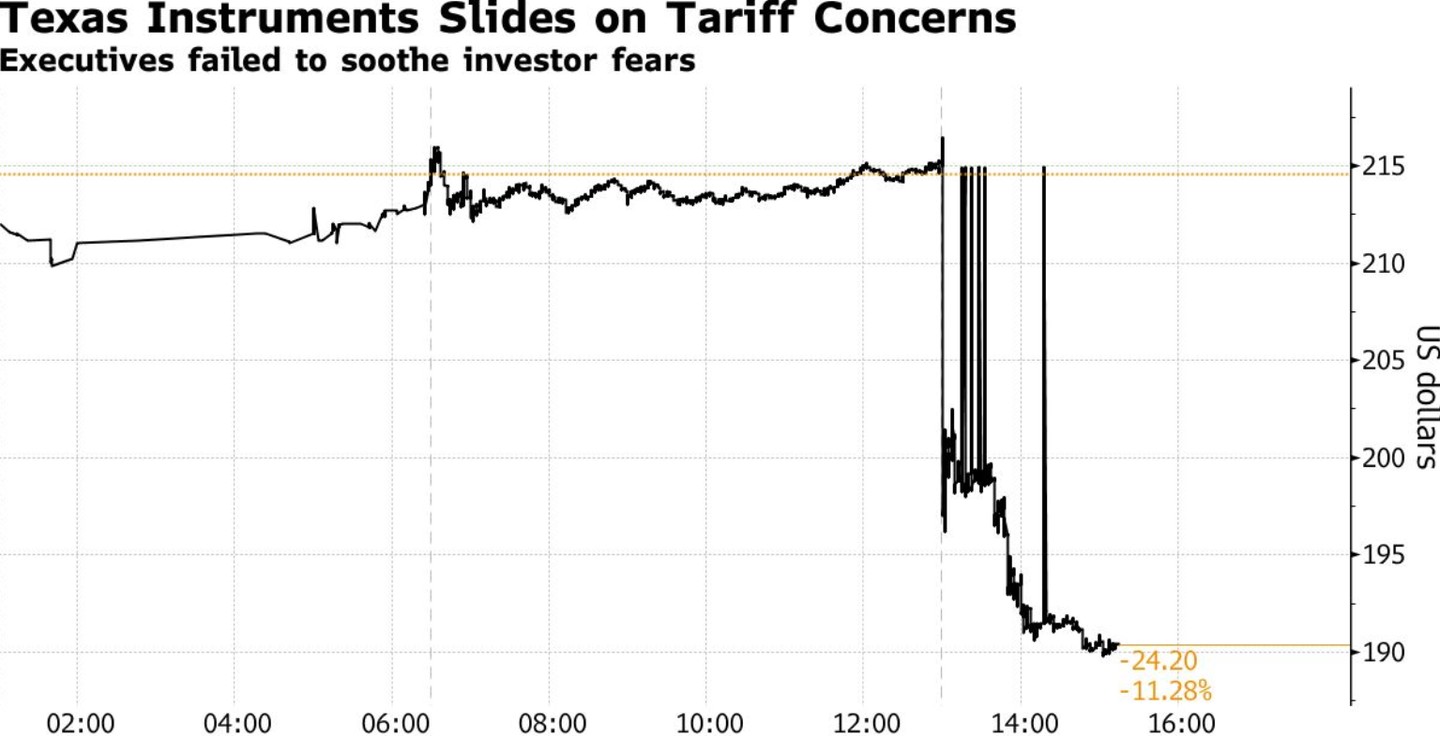
Texas Instruments' financial report released on July 23 showed that the revenue expectation for the third quarter is between $4.45 billion and $4.8 billion, lower than market expectations, leading to an 11% drop in stock price after hours. The market is concerned that the surge in chip demand driven by Trump's tariff policy may only be a temporary phenomenon, and Texas Instruments' performance outlook failed to boost market confidence, affecting the stock prices of other chip companies. Executives stated that despite facing challenges, they are confident in the company's strategy

According to Zhitong Finance APP, Texas Instruments (TXN.US), a chip giant focused on analog chips and embedded processing solutions, announced its earnings report on the morning of July 23. After the financial report data and management's performance outlook were released, the stock price of this major supplier of critical chips for global large automotive manufacturers and industrial equipment producers fell sharply by over 11% in after-hours trading, mainly due to market concerns that the surge in chip demand driven by Trump's tariff policy may be short-lived. Texas Instruments failed to set a positive tone for the chip giant earnings season, leading to a noticeable decline in the stock prices of U.S. chip companies, including NVIDIA, Broadcom, and AMD, after the earnings announcement.

Texas Instruments' management stated in a release on Tuesday Eastern Time that total revenue for the third quarter is expected to reach between $4.45 billion and $4.8 billion. Although Wall Street analysts had an average expectation of $4.57 billion, some analysts' forecasts slightly exceeded $4.8 billion. For Texas Instruments, whose stock price has repeatedly hit new highs this year and where the market generally expects Trump's tariff policy to drive a surge in domestic analog chip demand, this cautious performance outlook clearly did not satisfy the market.

For the third quarter, Texas Instruments' earnings per share are expected to be around $1.48, slightly below analysts' average expectations, bringing uncertainty to the company's path back to growth and the recovery process of analog chip demand.

Texas Instruments' overall revenue has been on a recovery trajectory since 2024, but the global tariff war initiated by Trump in April has made the demand outlook uncertain. Texas Instruments executives stated during the earnings conference call with analysts that they did see strong domestic demand in the U.S. due to tariffs at the beginning of the second quarter, and some customers may have increased inventory to cope with potential price increases caused by tariffs. However, after the second quarter, the company's chip order levels have returned to the expected range for normal recovery periods.

Chief Financial Officer Rafael Lizardi stated during the earnings meeting, "We are very confident in our strategy, and we believe our opportunities outweigh our challenges."

According to the median forecast, third-quarter revenue is expected to grow by 11%, a slowdown compared to the previous quarter. However, Lizardi stated that the chip manufacturer remains confident in eventually breaking through the $20 billion annual revenue peak.

After the financial report and performance outlook were released, Texas Instruments' stock price fell by over 11% in after-hours trading. Since the beginning of the year, driven by the continued recovery of analog chip and MCU demand due to artificial intelligence and inventory factors, as well as the strong rise of global semiconductor-related stocks, the stock has accumulated a rise of over 15%, significantly outperforming the S&P 500 index.

King of Analog + MCU Versatile Player: Texas Instruments is Known as the Global Chip Barometer

Texas Instruments is the world's largest manufacturer of analog chips and MCU chips, whose products perform simple yet crucial functions and are widely used globally, such as converting power to different voltages in electronic devices. More importantly, analog chips have played an indispensable role in various key functional modules and systems of electric vehicles in recent years, including power management, battery management, sensor interfaces, audio and video processing, and motor control.

Analog chips convert real-world signals such as sound, temperature, pressure, and current into the digital domain, supporting scenarios like automotive ADAS, industrial automation, IoT sensing, and smart grids. Analog ICs are difficult to replace and have long design cycles, resulting in long-term stickiness once introduced. MCUs serve as the "brain" of electronic devices, controlling logic and real-time calculations, and are present in almost all connected or electromechanical systems (home appliances, meters, body control, medical monitoring, etc.). Texas Instruments' TI MSP430, C2000, and Arm-M series MCU products lead the market in low power consumption and industrial real-time control.

Texas Instruments boasts the broadest customer base and the largest product range among chip manufacturers, making the company's performance and outlook data a predictive indicator of demand across various industries. Most of its chip products are used in industrial applications and electric vehicles. Since 2024, demand from many end customers in the industrial category has begun to improve, sparking optimism about overall recovery.

Texas Instruments has long held the position of the global leader in analog chips, with a market share of approximately 19%-20%; it also ranks among the top five in the MCU field, with a product line covering over 40,000 embedded devices. The company offers more than 80,000 analog, power, signal chain, and MCU products to over 100,000 major customers, penetrating almost all end markets (automotive, industrial, communications, consumer electronics, medical, etc.). This "ubiquitous" coverage has led Wall Street to refer to its quarterly performance as a barometer of semiconductor demand: changes in sales often foreshadow the prosperity of downstream industries. Whether due to tariff impacts leading to early stockpiling or the inventory destocking cycle reaching its bottom, Texas Instruments is the first to sense and reflect this through its financial reports, allowing the market to gauge the direction of global electronic and macro industrial demand.

Beyond the Automotive Market, Texas Instruments Expects Continued Positive Demand Outlook

According to reports, Wall Street analysts repeatedly asked the company during this earnings call whether its outlook on the demand for analog chips and MCUs would turn pessimistic. Texas Instruments' management stated that, aside from the automotive segment, they maintain a long-term optimistic expansion attitude towards the demand in all the segments covered by Texas Instruments.

"The automotive market has not yet recovered," emphasized Haviv Ilan, CEO of Texas Instruments, during the earnings call.

The revenue scale of automotive chips has been severely impacted since the end of 2022 due to customers' excess inventory, with order volumes from customers slowing across the board. The sharp shortage of automotive chips post-COVID-19 led customers to accelerate inventory accumulation; however, since the Federal Reserve's interest rate hike cycle began in 2022, the sluggish demand for electric vehicles has been difficult to alleviate Under the prolonged high-interest macro environment and the backdrop of overcapacity, global demand for electric vehicles has significantly cooled, compounded by the gradual withdrawal of government subsidies related to electric vehicles, further weakening demand.

In the second quarter, Texas Instruments' revenue in the Chinese market unexpectedly surged by 32%, exceeding almost all Wall Street analysts' expectations. However, Ilan stated that this performance is "somewhat overheated," leading him to be more cautious about the current quarter.

In the second quarter, Texas Instruments achieved a year-on-year revenue growth of 16% to $4.45 billion, with earnings per share of $1.41, also reflecting a year-on-year increase of 16%. In comparison, Wall Street analysts had previously estimated revenue of about $4.36 billion and earnings per share of approximately $1.35, with actual performance exceeding Wall Street expectations. Texas Instruments' operating profit in the second quarter was approximately $1.563 billion, marking a year-on-year surge of 25%. However, Texas Instruments executives admitted that they are unclear how much of this is due to the tariff-related "pull effect"—that is, customers making advance purchases to avoid the price increases caused by tariffs.

Texas Instruments holds an absolute leading position in the analog chip market, which converts real-world signals such as sound and pressure into electronic signals. The company has the broadest range of chip end products and a super large customer list in the semiconductor field, and its financial report data and outlook are seen as important indicators of demand across many industries. Its latest performance will also influence investors' expectations for demand in the entire chip industry.

In the long term, the company expects demand for end chips to continue to grow—thanks to the proliferation of semiconductors in more products. However, intensified competition between China and the U.S. and the global tariff policies led by the Trump administration cast a shadow over industry demand, with concerns that rising prices for end chip products could suppress the demand recovery trajectory for the chip industry since 2024.

About one-fifth of Texas Instruments' revenue comes from the Chinese market, but local chip manufacturers are rapidly rising. Chinese chip companies are heavily investing in production with government support, aiming to reduce import dependence. The company has stated that China—the world's largest semiconductor market—has seen exceptionally fierce competition in recent years.

To enhance its fundamental resilience and gain more leverage in an environment of increasing trade barriers, Texas Instruments is investing heavily in expanding production capacity and continuously integrating generative artificial intelligence modules with consumer electronics and industrial applications. The company has four factories outside the U.S., including a large factory in China; it is also accelerating the construction of new factories in the Dallas area and Utah.

On the other hand, large-scale new factory construction and new equipment investments are eroding cash flow and profitability. The company has committed to refocusing on returning value to shareholders once the expansion is completed.

Texas Instruments kicks off the earnings season for chip giants! Will global chip demand continue to expand in 2025?

Texas Instruments is the world's largest analog chip manufacturer, and if it announces an optimistic earnings outlook, it will set a good tone for the earnings season of U.S. chip giants, likely continuing to boost the bullish trend of the Philadelphia Semiconductor Index, known as the "global chip stock barometer." However, the latest facts are not so; Texas Instruments' performance outlook, which fell short of the market's most optimistic expectations, has instead led to a decline in the U.S. chip sector after hours Chip giants such as ON Semiconductor (ON.US), Intel (INTC.US), AMD (AMD.US), and NVIDIA (NVDA.US) will successively disclose their latest financial reports and performance outlook data from late July to late August. The performance of these chip giants is crucial for the demand outlook of the global chip industry. In terms of the financial market, whether the performance of chip giants is strong is critical for the Nasdaq 100 index, which has repeatedly hit new highs this year, as well as for the bull market curve of the benchmark U.S. stock index—the S&P 500 index. Chip stocks are one of the core driving forces of this long-term bull market in U.S. stocks since 2023.

Goldman Sachs' latest research report indicates that the chip sector is currently the most crowded investment target in the technology, media, and telecommunications (TMT) field, and this sector is seen as the purest way to express enthusiasm for AI. Despite being widely held by various types of investors, including pure long-only funds, hedge funds, and retail investors, Goldman Sachs still observes a continuous inflow of funds into this sector. Among the most popular long positions are NVIDIA, Broadcom, TSMC, Micron, Texas Instruments, Analog Devices, and Microchip Technology. The most popular short positions include Intel, ON Semiconductor, Qualcomm, Skyworks Solutions, Qorvo, and GlobalFoundries.

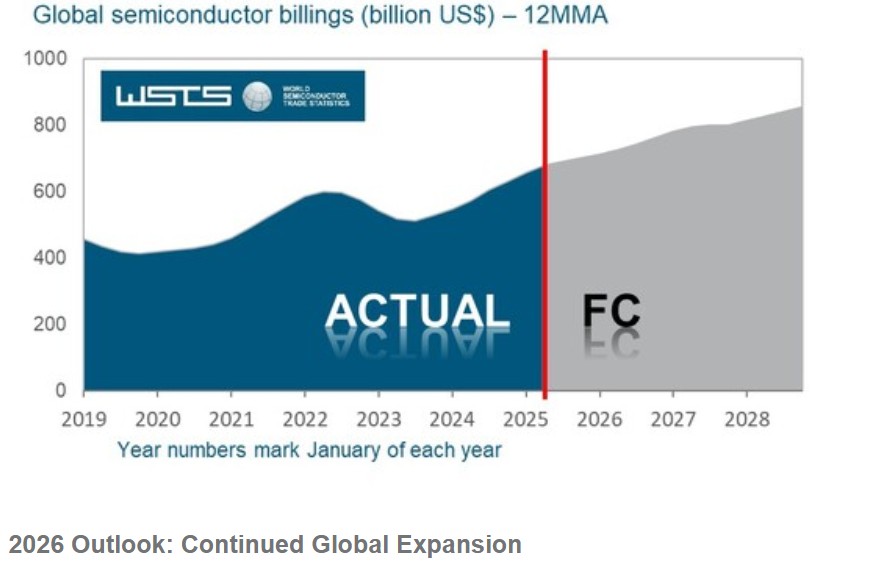
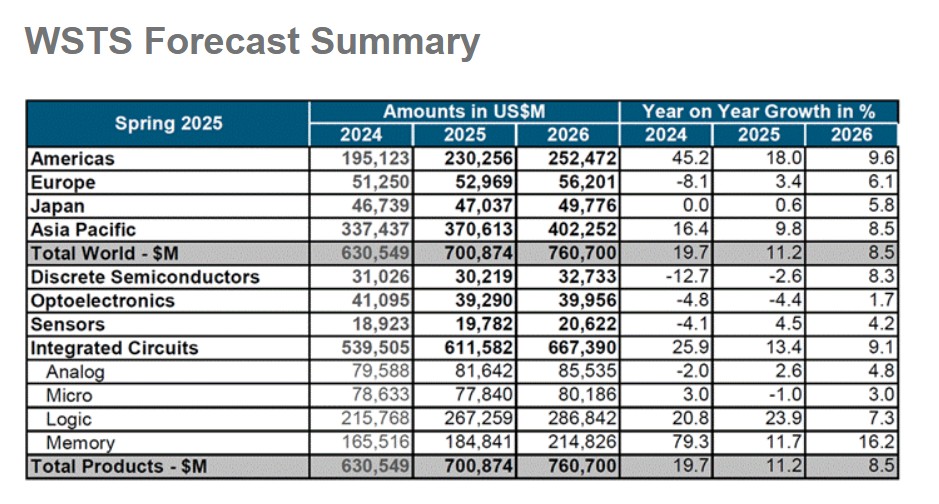
The World Semiconductor Trade Statistics (WSTS) organization recently released the latest semiconductor industry outlook data, indicating that global chip demand recovery is expected to continue from 2025 to 2026, and the analog chips, which have seen weak demand since the end of 2022, are expected to enter a strong recovery curve.

WSTS expects that after a strong rebound in 2024, the global semiconductor market will grow by 11.2% in 2025, reaching a total value of $700.9 billion, mainly driven by the strong momentum in the GPU-dominated logic chip sector and the HBM-dominated memory sector, both of which are expected to achieve strong double-digit growth due to sustained strong demand in areas such as AI inference systems, cloud computing infrastructure, and cutting-edge consumer electronics.

WSTS predicts that the global semiconductor market will grow by 8.5% to $760.7 billion by 2026, building on the strong recovery in 2025. The organization expects growth to be widespread across various regions and a wide range of chip product categories, including analog chips and MCUs. Among these, memory chips are expected to lead growth again, while logic and analog chips will also make significant contributions