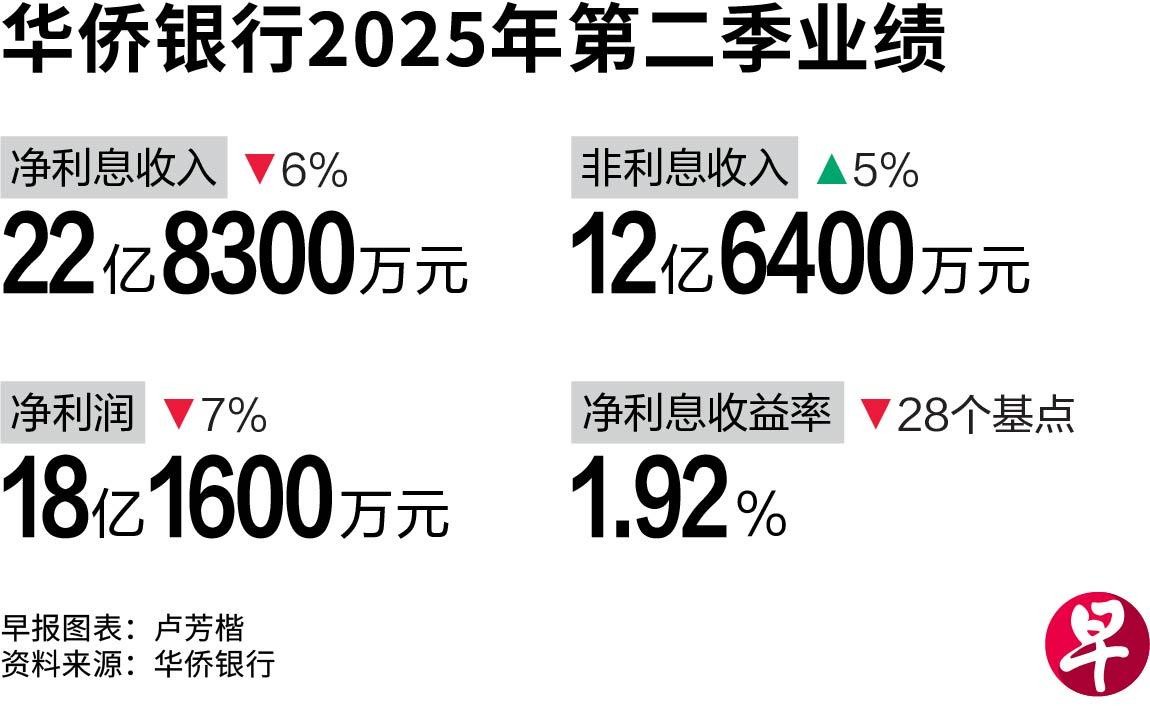
OCBC Bank expects a 7% decline in net profit for the second quarter to 1.816 billion yuan, with greater challenges anticipated in the second half of the year

OCBC Bank expects a 7% year-on-year decline in net profit for the second quarter, down to SGD 1.816 billion, and the operating environment in the second half of the year will face greater challenges. The impact of tariffs may lead to the fragmentation of global trade, resulting in inflationary shocks. The new president, Chen DeLong, pointed out that the ripple effects of tariffs have not yet fully manifested, which may redirect goods to other markets and increase competition, but Singaporean companies may benefit from lower raw material import costs. Huang BiJuan will continue to serve as the chairman of the board of directors of OCBC Bank China
He believes that the chain reaction caused by tariffs has not fully manifested yet. When manufacturing countries like China face higher tariffs, goods may flow to other markets or create intense competition for local businesses; however, many Singaporean companies may benefit from this, such as lower raw material import costs.
Although she will step down as Group President, Huang Bi Juan stated that her connection with Singapore will not be interrupted: "I will still come back often and need to return because I am still one of the board members of Enterprise Singapore, and I also have family in Singapore."
To meet the 10% free float requirement, Great Eastern will issue no more than 473.32 million ordinary red shares or Class C shares. After choosing Class C shares, OCBC Bank's voting rights in Great Eastern will be diluted to 88.19%, while retaining 93.72% of the dividend rights.
Huang Bi Juan will continue to serve as the Chairman of the Board of Directors of OCBC Bank China and as a board member of OCBC Bank Hong Kong.
Huang Bi Juan stated, "The downward adjustment of the net interest margin forecast is mainly due to the current market environment. Loan yields may decline further, but this is expected to be partially offset by a decrease in funding costs."
Based on the backdrop of declining interest rates, OCBC Bank has revised its net interest margin (NIM) outlook for this year to between 1.9% and 1.95%, down from the previous quarter's expectation of around 2%. Therefore, the bank expects a moderate single-digit percentage decline in net interest income this year.
The board announced an interim dividend of 41 cents per share, with a payout ratio of 50%. Huang Bi Juan mentioned that due to a robust capital position, the group will maintain a 60% overall payout ratio for the year.
Regarding OCBC Bank's unsuccessful conditional delisting proposal for Great Eastern Holdings, Huang Bi Juan further responded: "Great Eastern plays an important role in OCBC Bank's journey to becoming a leading wealth management institution in the region, and our strategy towards it will not change. Over the years, we have continuously increased our stake in Great Eastern, deepening (business) integration and enhancing synergies."
She said that planning to retire from this position is a very serious matter and cannot be "retired just like that." In fact, she had already proposed this idea to the board at the beginning of 2024, and after discussions and support from the board, the group initiated the succession process.
Both fee income and trading income have increased, offsetting the decline in insurance income, with the bank's non-interest income rising 5% year-on-year in the second quarter to SGD 1.264 billion.
Expected Decline in Net Interest Income This Year
Chen De Long, who will take over as Group President on January 1 next year, described his views on the impact of tariffs at the earnings conference using the terms "uncertainty" and "chain reaction."
Group Chief Financial Officer Wu Jing Yi stated at the earnings release that although it is anticipated that the Federal Reserve may cut interest rates three times this year, the significant decline in the Singapore Overnight Rate Average (SORA) and the Hong Kong Interbank Offered Rate (HIBOR) still exceeded expectations The other two local banks, DBS Group and UOB, will release their second quarter and first half performance reports on Thursday, August 7.

OCBC Bank expects tariffs to continue affecting the operating environment in the second half of the year, which may bring inflationary shocks, and global trade may further move towards fragmentation.
Helen Wong Responds to Retirement Plans for the First Time
Extended Reading
OCBC Bank's net interest margin for the second quarter was 1.92%, a decrease of 28 basis points year-on-year, resulting in a 6% year-on-year decline in net interest income to SGD 2.283 billion.
Cheng Teck Long currently serves as the Vice President of OCBC Bank Group and will officially take over as Group President on January 1, 2026, to assist in a smooth transition.
Helen Wong emphasized that the group supports the recovery of Great Eastern's trading, and the issuance of ordinary shares or non-voting Class C shares by Great Eastern is an effective solution; currently, OCBC Bank has no plans to make a new offer in the short term.
She revealed that the bank's net interest margin as of the end of June was 1.88%, but as the impact of the interest rate cuts on savings accounts becomes apparent, the net interest margin is expected to reverse its downward trend.
OCBC Bank's stock price closed at SGD 16.79 on Friday, down 0.474%.
Helen Wong, who will retire at the end of this year, shared the above views at the performance briefing for the second quarter and first half of 2025 held on Friday, August 1. The results showed that the group's net profit for the second quarter fell 7% year-on-year to SGD 1.816 billion.
Helen Wong also publicly discussed her retirement plans for the first time at the briefing, stating that the reason is simple: "I need more time to spend with my family in Hong Kong, which is a simple yet very important reason."
The bank has reduced the interest rates on various savings accounts since May this year, including the 360 Savings Account and Bonus+ Savings Account, to reflect the current market interest rate environment.