


Bloomin' Brands(纳斯达克代码:BLMN)使用债务的行为可能被视为具有风险

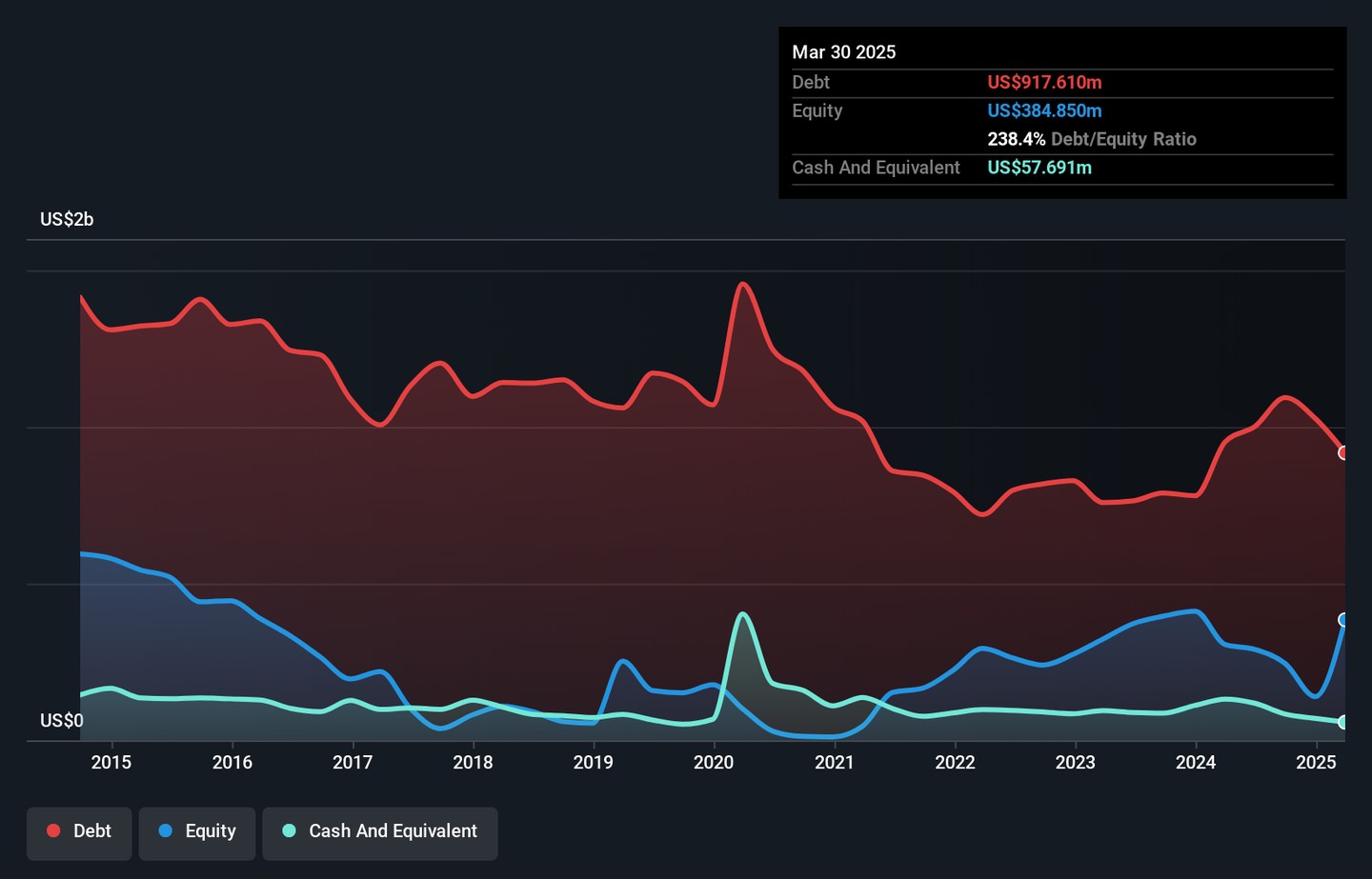
Bloomin' Brands (NASDAQ:BLMN) has a significant debt load of US$917.6 million, with net debt at US$859.9 million after accounting for cash. The company's liabilities exceed its cash and receivables by US$2.71 billion, raising concerns for shareholders. With an EBIT that only covers interest expenses 3.0 times, and a 33% decline in EBIT last year, the risk of debt repayment is heightened. Analysts suggest that Bloomin' Brands may need a major recapitalization if creditors demand repayment, indicating a cautious outlook for investors.
Howard Marks put it nicely when he said that, rather than worrying about share price volatility, 'The possibility of permanent loss is the risk I worry about... and every practical investor I know worries about.' So it seems the smart money knows that debt - which is usually involved in bankruptcies - is a very important factor, when you assess how risky a company is. We can see that Bloomin' Brands, Inc. (NASDAQ:BLMN) does use debt in its business. But is this debt a concern to shareholders?
AI is about to change healthcare. These 20 stocks are working on everything from early diagnostics to drug discovery. The best part - they are all under $10bn in marketcap - there is still time to get in early.
What Risk Does Debt Bring?
Debt and other liabilities become risky for a business when it cannot easily fulfill those obligations, either with free cash flow or by raising capital at an attractive price. If things get really bad, the lenders can take control of the business. While that is not too common, we often do see indebted companies permanently diluting shareholders because lenders force them to raise capital at a distressed price. Of course, plenty of companies use debt to fund growth, without any negative consequences. When we examine debt levels, we first consider both cash and debt levels, together.
What Is Bloomin' Brands's Debt?
As you can see below, Bloomin' Brands had US$917.6m of debt, at March 2025, which is about the same as the year before. You can click the chart for greater detail. On the flip side, it has US$57.7m in cash leading to net debt of about US$859.9m.
How Healthy Is Bloomin' Brands' Balance Sheet?
According to the last reported balance sheet, Bloomin' Brands had liabilities of US$778.5m due within 12 months, and liabilities of US$2.14b due beyond 12 months. Offsetting this, it had US$57.7m in cash and US$154.3m in receivables that were due within 12 months. So its liabilities total US$2.71b more than the combination of its cash and short-term receivables.
This deficit casts a shadow over the US$774.9m company, like a colossus towering over mere mortals. So we definitely think shareholders need to watch this one closely. At the end of the day, Bloomin' Brands would probably need a major re-capitalization if its creditors were to demand repayment.
View our latest analysis for Bloomin' Brands
We use two main ratios to inform us about debt levels relative to earnings. The first is net debt divided by earnings before interest, tax, depreciation, and amortization (EBITDA), while the second is how many times its earnings before interest and tax (EBIT) covers its interest expense (or its interest cover, for short). This way, we consider both the absolute quantum of the debt, as well as the interest rates paid on it.
Bloomin' Brands has net debt worth 2.4 times EBITDA, which isn't too much, but its interest cover looks a bit on the low side, with EBIT at only 3.0 times the interest expense. While these numbers do not alarm us, it's worth noting that the cost of the company's debt is having a real impact. Shareholders should be aware that Bloomin' Brands's EBIT was down 33% last year. If that decline continues then paying off debt will be harder than selling foie gras at a vegan convention. There's no doubt that we learn most about debt from the balance sheet. But it is future earnings, more than anything, that will determine Bloomin' Brands's ability to maintain a healthy balance sheet going forward. So if you're focused on the future you can check out this free report showing analyst profit forecasts.
Finally, a business needs free cash flow to pay off debt; accounting profits just don't cut it. So it's worth checking how much of that EBIT is backed by free cash flow. In the last three years, Bloomin' Brands's free cash flow amounted to 43% of its EBIT, less than we'd expect. That's not great, when it comes to paying down debt.
Our View
On the face of it, Bloomin' Brands's EBIT growth rate left us tentative about the stock, and its level of total liabilities was no more enticing than the one empty restaurant on the busiest night of the year. Having said that, its ability to convert EBIT to free cash flow isn't such a worry. After considering the datapoints discussed, we think Bloomin' Brands has too much debt. That sort of riskiness is ok for some, but it certainly doesn't float our boat. The balance sheet is clearly the area to focus on when you are analysing debt. However, not all investment risk resides within the balance sheet - far from it. Be aware that Bloomin' Brands is showing 4 warning signs in our investment analysis , and 1 of those is concerning...
At the end of the day, it's often better to focus on companies that are free from net debt. You can access our special list of such companies (all with a track record of profit growth). It's free.
