


We Think FirstService (TSE:FSV) Can Stay On Top Of Its Debt

FirstService Corporation (TSE:FSV) has a net debt of US$1.01 billion, with liabilities exceeding cash and receivables by US$1.44 billion. Despite this, its market value of US$9.03 billion suggests manageable risk. The company's net debt is 1.9 times its EBITDA, and EBIT covers interest expenses 4.3 times, indicating some burden from interest payments. However, FirstService's EBIT grew by 33% last year, and it generated free cash flow equating to 57% of EBIT, allowing for potential debt reduction. Overall, the company maintains a sensible approach to debt, though two warning signs should be noted.
Legendary fund manager Li Lu (who Charlie Munger backed) once said, 'The biggest investment risk is not the volatility of prices, but whether you will suffer a permanent loss of capital.' So it might be obvious that you need to consider debt, when you think about how risky any given stock is, because too much debt can sink a company. We note that FirstService Corporation (TSE:FSV) does have debt on its balance sheet. But is this debt a concern to shareholders?
We've found 21 US stocks that are forecast to pay a dividend yield of over 6% next year. See the full list for free.
Why Does Debt Bring Risk?
Generally speaking, debt only becomes a real problem when a company can't easily pay it off, either by raising capital or with its own cash flow. If things get really bad, the lenders can take control of the business. However, a more usual (but still expensive) situation is where a company must dilute shareholders at a cheap share price simply to get debt under control. Of course, the upside of debt is that it often represents cheap capital, especially when it replaces dilution in a company with the ability to reinvest at high rates of return. When we think about a company's use of debt, we first look at cash and debt together.
What Is FirstService's Net Debt?
You can click the graphic below for the historical numbers, but it shows that FirstService had US$1.21b of debt in June 2025, down from US$1.30b, one year before. However, it also had US$201.8m in cash, and so its net debt is US$1.01b.
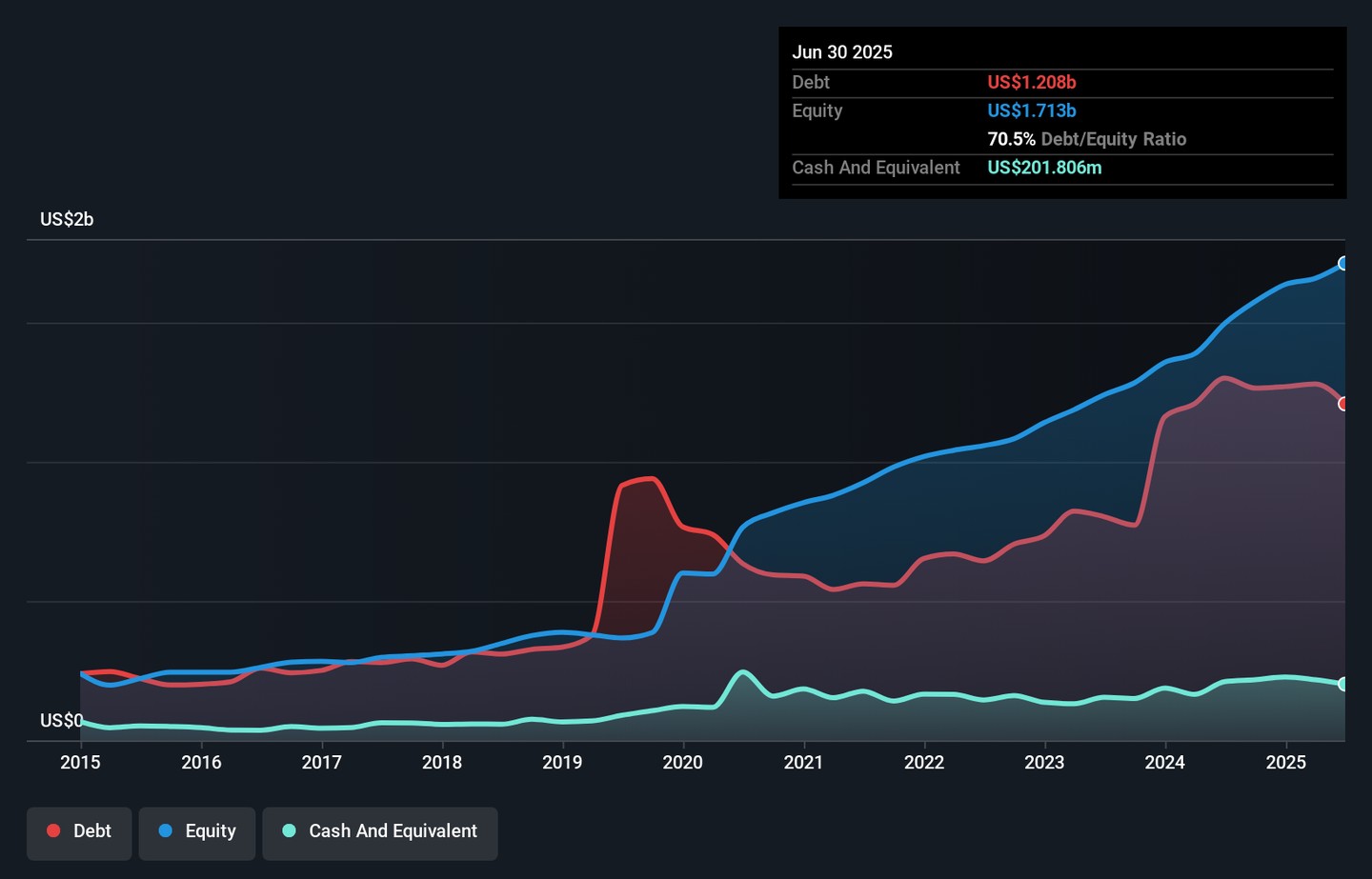
How Healthy Is FirstService's Balance Sheet?
According to the last reported balance sheet, FirstService had liabilities of US$932.0m due within 12 months, and liabilities of US$1.72b due beyond 12 months. Offsetting this, it had US$201.8m in cash and US$1.01b in receivables that were due within 12 months. So its liabilities outweigh the sum of its cash and (near-term) receivables by US$1.44b.
Since publicly traded FirstService shares are worth a total of US$9.03b, it seems unlikely that this level of liabilities would be a major threat. However, we do think it is worth keeping an eye on its balance sheet strength, as it may change over time.
See our latest analysis for FirstService
We measure a company's debt load relative to its earnings power by looking at its net debt divided by its earnings before interest, tax, depreciation, and amortization (EBITDA) and by calculating how easily its earnings before interest and tax (EBIT) cover its interest expense (interest cover). Thus we consider debt relative to earnings both with and without depreciation and amortization expenses.
FirstService's net debt is sitting at a very reasonable 1.9 times its EBITDA, while its EBIT covered its interest expense just 4.3 times last year. While that doesn't worry us too much, it does suggest the interest payments are somewhat of a burden. Importantly, FirstService grew its EBIT by 33% over the last twelve months, and that growth will make it easier to handle its debt. The balance sheet is clearly the area to focus on when you are analysing debt. But ultimately the future profitability of the business will decide if FirstService can strengthen its balance sheet over time. So if you're focused on the future you can check out this free report showing analyst profit forecasts.
But our final consideration is also important, because a company cannot pay debt with paper profits; it needs cold hard cash. So we clearly need to look at whether that EBIT is leading to corresponding free cash flow. During the last three years, FirstService produced sturdy free cash flow equating to 57% of its EBIT, about what we'd expect. This cold hard cash means it can reduce its debt when it wants to.
Our View
The good news is that FirstService's demonstrated ability to grow its EBIT delights us like a fluffy puppy does a toddler. But truth be told we feel its interest cover does undermine this impression a bit. Taking all this data into account, it seems to us that FirstService takes a pretty sensible approach to debt. That means they are taking on a bit more risk, in the hope of boosting shareholder returns. The balance sheet is clearly the area to focus on when you are analysing debt. However, not all investment risk resides within the balance sheet - far from it. For example - FirstService has 2 warning signs we think you should be aware of.
If you're interested in investing in businesses that can grow profits without the burden of debt, then check out this free list of growing businesses that have net cash on the balance sheet.
