From "Devouring the World" to "Being Devoured by AI": The Market Reassesses the Software Sector, Selling Off "Premium Collapse" and "Old Technology"

Zhitong
2025.08.25 13:31
portai
I'm PortAI, I can summarize articles.

Due to the disruptive impact of artificial intelligence, investors are re-evaluating software stocks. Companies like Salesforce, Adobe, and ServiceNow have performed poorly in the S&P 500, with stock prices dropping by at least 16%. For years, software companies have been favored by Wall Street, but the rise of AI has changed market valuations for the software industry. Funds are now flowing towards AI application companies, driving the widespread adoption of generative AI and AI agents to improve business efficiency and reduce costs

For many years, software companies have been the darlings of Wall Street investment institutions like Goldman Sachs and Morgan Stanley. High profit margins, long-term low capital requirements, and a continuously broad performance growth runway prompted venture capitalist Marc Andreessen to declare in 2011 that "software is eating the world," driving the stock prices of broadly defined software companies focused on multiple sectors into a long-term bull market. High-quality fundamental software giants like Microsoft, Google, Oracle, and Salesforce have attracted a flood of global capital.

About thirteen years later, artificial intelligence has sparked a similar investment frenzy in software stocks, with some Wall Street investment institutions preparing to make a significant portion of the software industry a top dish at the "AI feast." Since 2024, as the global tech stock investment wave has simultaneously covered both AI computing infrastructure and AI application software, it has continuously provided significant support for the valuations of AI application companies like Applovin, Trade Desk, Duolingo, and Palantir.

In specific terms, the future of killer generative AI applications covering B-end or C-end industries, as well as "AI agents" that are likely to significantly boost human productivity, is expected to experience explosive growth. This is why global capital has been pouring into some core software stocks on a large scale since 2024.

The urgent need for companies to improve efficiency and reduce operating costs has recently greatly accelerated the widespread application of two core categories of AI application software—generative AI applications and AI agents. Especially represented by OpenAI Deep Research and Manus, AI agents can automate repetitive tasks, perform big data analysis and summarization based on incredibly powerful AI large models, provide real-time monitoring insights, and make appropriate decisions in extremely complex situations in a very short time, thereby enhancing operational efficiency. The logic of efficiency enhancement is fundamentally similar for individual learning and work efficiency. AI agents can also efficiently participate in all stages of large projects across various fields globally, significantly accelerating project progress.

Since 2024, benefiting from the accelerated expansion trend of market demand for AI application software, advertising marketing service provider APPlovin, focusing on "AI + digital advertising," and Palantir, a leader in "AI + data analysis," have both announced incredibly strong performance data and future performance outlooks this year. This indicates that not only is the demand for AI computing infrastructure, represented by NVIDIA AI GPUs, extremely strong, but the demand for AI application software, especially enterprise-level AI application software that can comprehensively enhance operational efficiency, is also robust and accelerating its penetration into various industries.

Meta, the parent company of Facebook and Instagram, has achieved significantly stronger-than-expected performance growth driven by the new advertising engine of "AI + digital advertising," and Meta has raised the lower limit of its capital expenditure for the entire year of 2025 from $64 billion to $66 billion. It is currently expected that total expenditures for 2025 will be between $66 billion and $72 billion, highlighting that the strong growth rate of its advertising business based on the "AI + digital advertising" model is sufficient to support its aggressive investments in AI infrastructure However, since the beginning of this year, not all software stocks have experienced a "super bull market" like software giants such as Facebook's parent company Meta, Palantir, and AppLovin, riding the unprecedented AI wave. The so-called "AI narrative" has not been a significant positive catalyst for the fundamentals and valuations of some software stocks; instead, these long-popular software stocks have become catalysts for a bear market. The software companies that have suffered massive sell-offs leading to severe stock price declines generally share two major labels: under the AI wave, their software products have experienced "price collapse" and "old technology" anxiety.

AI is not a spring breeze for all software stocks

Salesforce Inc., Adobe Inc., and ServiceNow Inc. are among the worst-performing tech companies in the U.S. stock market benchmark index—the S&P 500—this year, having dropped at least 16%, collectively evaporating about $160 billion in market value. According to EPFR statistics, investors withdrew significant funds from the software and services sector of the U.S. stock market in the two months ending in June, following only one instance of net outflows in the previous 18 months.

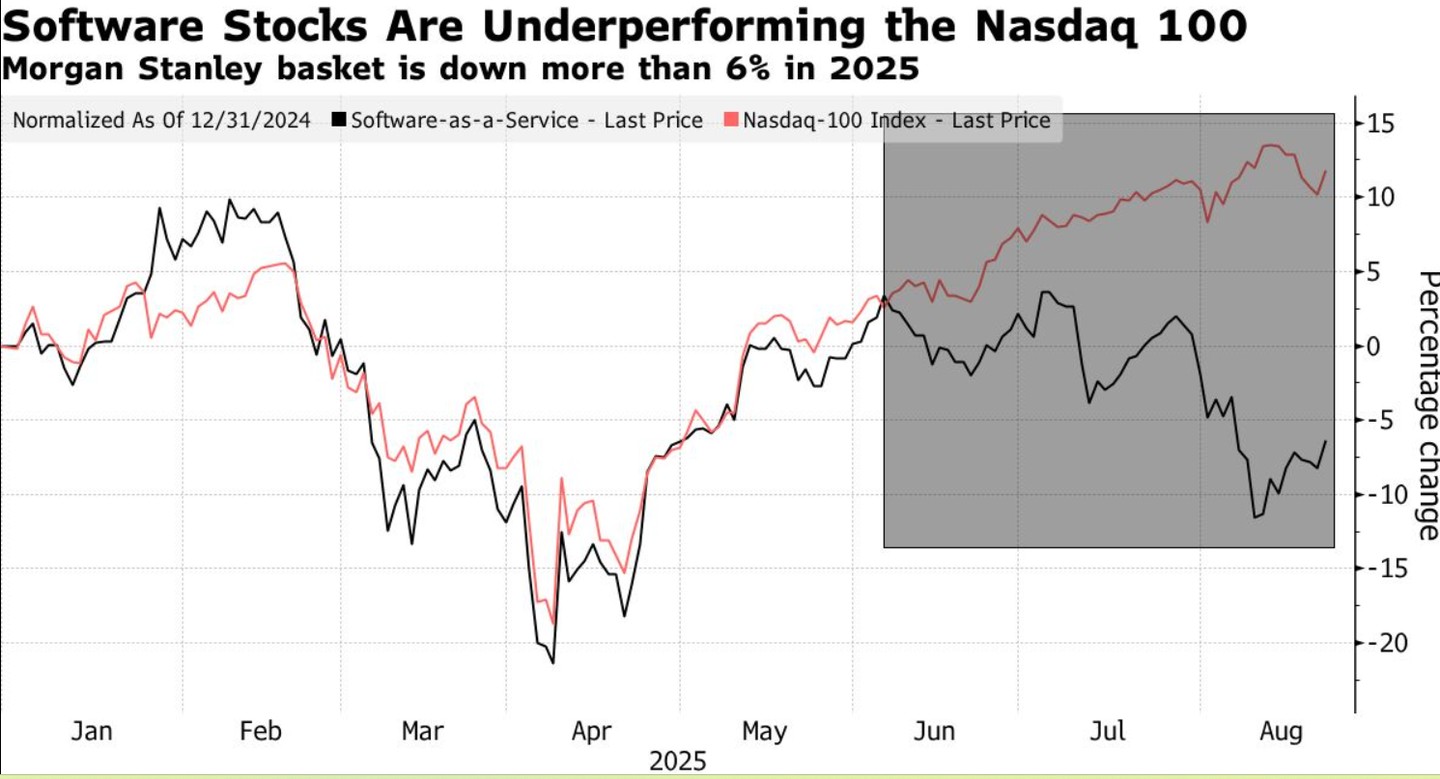
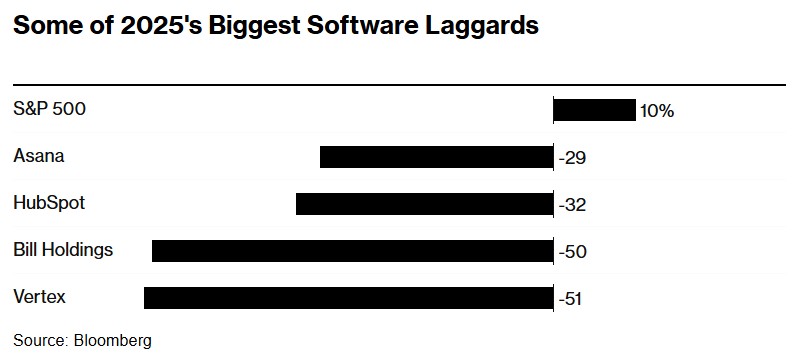
Morgan Stanley's basket of software-as-a-service (SaaS) stocks has fallen over 6% year-to-date, while the tech-heavy Nasdaq 100 index has risen about 12%. The firm did not disclose the specific constituents of this basket, but Morgan Stanley indicated that Asana Inc., HubSpot Inc., Bill Holdings Inc., and Vertex Inc. are among the biggest decliners in SaaS stocks, each down at least 29%.

Although AI threatens various traditional industries that have long relied on SaaS, such as education, talent services, and financial management, investors see the threat of AI large models to software companies that code digital services for customer relationship management and backend functions as more imminent.

"Technological obsolescence can come unexpectedly," said Robert Ruggirello, Chief Investment Officer of Brave Eagle Wealth Management. "There are good reasons for people to be cautious."

This anxiety has put pressure on stock prices, but it does not mean that investors are completely disappointed with the software sector, which has been a long-term bull market segment. After all, tech companies like Microsoft, Oracle Corp, and Palantir Technologies Inc., which have emerged from a "super bull market" since 2023, are all software tech giants and are among the major contributors to significant gains in the S&P 500 index this year What distinguishes these software companies with soaring stock prices from software companies like Salesforce and Adobe that lag behind the S&P 500 index is the market's belief that they can "take the initiative" in their artificial intelligence strategies, rather than steadfastly "defending their existing positions" like Salesforce and Adobe, which have not shifted towards making AI the core of their business growth. After all, tech giants are investing billions of dollars to develop new software product lines based on AI large models and are massively building or expanding AI computing infrastructure.

As investments in artificial intelligence enhance targeted advertising precision and user engagement, the revenue growth of Facebook's parent company Meta Platforms Inc. is accelerating. Palantir's "AI + data analytics" software products are expected to drive a significant 45% increase in its sales this year. Cybersecurity companies like CrowdStrike Holdings Inc. are also performing well, as investors bet that AI cannot easily replace such cybersecurity products, and the cybersecurity systems enhanced by AI are expected to undergo significant upgrades.

Premium Collapse and "Old Technology" Anxiety Lead Software Companies to Face a "Life-or-Death Decision"

However, for many ordinary software companies, the threat is too real: artificial intelligence may disrupt the value proposition of their business segments—namely, providing digital tools that enhance productivity at a premium to customers. If cost-sensitive clients like banks or retailers can obtain nearly identical AI-based software services at lower prices from AI application leaders like OpenAI or Anthropic, the entire business plan could be destroyed.

Investors remain uncertain whether artificial intelligence can replace the work management software dominated by companies like Asana, but the slowdown in new customer additions in the first quarter is enough to raise alarms, causing stock prices to plummet. HubSpot may also adapt to artificial intelligence, but investors are concerned that its CRM customer management tools may face intensified competition related to AI.

The situation is similar for Monday.com. The company's centralized workflow software does not face the risk of being "completely eliminated by the times," but investors worry that AI application software or AI agents will weaken its performance growth. The disappointing revenue guidance on August 11 was enough to trigger a massive sell-off, with its stock price slashed by 30% that day.

Some laggards in the software industry in 2025

"Any company that clings to old technology will either see its fundamentals deteriorate or will have to transition to the field of AI applications. Unless the transition is successful, you will see this enormous selling pressure reflected in the stock price," said Mark Bronzo, Chief Investment Strategist at Rye Consulting Group Currently, investors are not broadly investing in almost all software companies as they did in 2024, but are instead selling off stocks of software companies that lack compelling AI strategies or clear defenses against this groundbreaking technology.

"Perhaps in 2023 or 2024, people will look to buy back into high-quality software companies like Salesforce when they become relatively cheap compared to historical valuations," Bronzo said. "Right now, we may not see that mindset."

This market cap damage is not limited to U.S. software companies. Europe's largest company by market cap, SAP SE, along with software peers like Sage Group Plc and Dassault Systèmes SE, also saw significant declines after Monday.com issued a warning.

With OpenAI's ChatGPT reaching approximately 700 million weekly active users, Ruggirello compared software companies to "an energy company waking up to find itself competing with a company 'the size of ExxonMobil.'"

This concern is reflected in the valuation anxiety within the software sector. Due to rapidly growing sales expectations and the subscription model favored by Wall Street (which brings predictable revenue streams), the sector's valuations have been significantly higher than the broader U.S. stock market—the S&P 500 index—for years.

However, the basket of software stocks compiled by Morgan Stanley has fallen this month to just 23x expected earnings, which is only half of the average valuation level over the past decade and the lowest since Bloomberg began compiling data in 2014. The Nasdaq 100 index currently has an expected price-to-earnings ratio slightly below 27x based on future earnings.

Strategists from UBS have stated that the sharp declines in certain corners of the software sector may present significant investment opportunities. Earlier this month, they advised investors to focus on internet and software companies that have lagged in stock price gains during this wave of AI enthusiasm. "Although AI-related revenue growth has yet to match the aggressive investments in the industry, the significant improvement in AI monetization trends and the encouraging trends in AI adoption and penetration are promising," wrote UBS strategists led by Americas Chief Investment Officer and Global Head of Equities Ulrike Hoffmann-Burchardi in a research report.

However, the overall cautious attitude of global investors towards software stocks cannot be ignored at this time.

In the twenty years leading up to the market peak in 2021, no sector in the S&P 500 saw its weight rise as dramatically as software and services—growing from less than 6% to nearly 14.5% (even after reallocating stocks like Google, Facebook, and Amazon to other sectors in 2018).

However, the weight of this group in the market-cap weighted S&P 500 index is now about 12%, having been completely surpassed by semiconductor giants benefiting from the surge in AI computing hardware demand (led by Nvidia, Broadcom, and TSMC). Notably, had it not been for the significant outperformance of Microsoft, Oracle, and Palantir against the S&P 500, the weight of the software group could be much lower "The market's view is that risks have significantly increased, and we will not gain clarity in the short term," said Ruggirello from Brave Eagle. "What we can confirm at the moment is that a few software companies like Meta and Microsoft continue to win and are also winning major AI battles—but not all software companies are like this."