


In August, it plummeted 17%, the "Bitcoin holding premium" erased more than half, and the "digital currency treasury leader" MSTR faces a test

Strategy (formerly MSTR) originally planned to raise funds through preferred shares to purchase Bitcoin, but recently only raised $47 million, far below expectations. To make up for the shortfall, the company has restarted its common stock issuance plan, violating its previous commitment to limit dilution. This strategic reversal not only undermines investor confidence but also poses a threat to the entire Bitcoin treasury model. Analysts point out that when Strategy chooses to continue issuing shares at a low mNAV, it may trigger a "negative flywheel": a decline in stock price weakens the ability to purchase coins, further eroding market confidence and leading to accelerated compression of premiums
As the pioneer of the "Bitcoin treasury company" model, Strategy (formerly MicroStrategy, MSTR) is undergoing an unprecedented market test.
Since August, Strategy's stock price has fallen by a cumulative 16.8%, erasing most of the premium the company enjoyed in relation to its Bitcoin holdings over the long term.
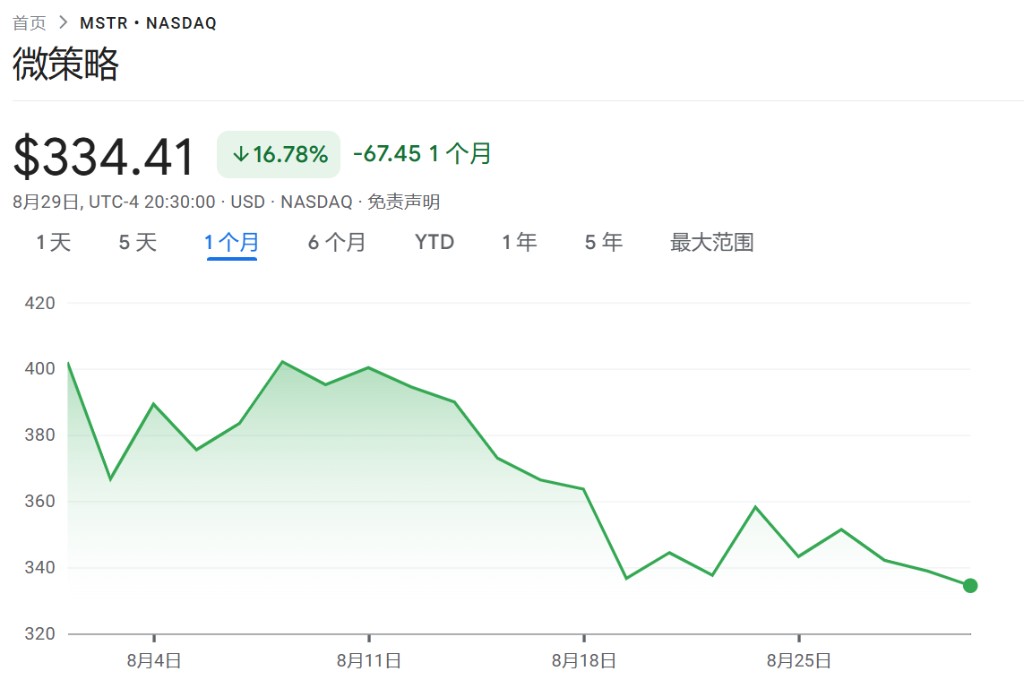
Market concerns primarily stem from the sudden shift in Strategy's financing strategy. The company originally planned to raise funds through preferred stock to purchase Bitcoin, but recently only raised $47 million, far below expectations. To make up for the shortfall, Strategy has restarted its common stock issuance plan, violating its previous commitment to limit dilution.
This strategic reversal has not only undermined investor confidence but also poses a threat to the entire Bitcoin treasury model. Currently, companies emulating the Strategy model collectively hold over $108 billion in Bitcoin, accounting for 4.7% of the total supply. If Strategy's premium advantage collapses, the sustainability of this model will be called into serious question.
Breaking the "Treasury Model"
Strategy's business logic was once seen as an innovative case on Wall Street: financing the purchase of Bitcoin through the issuance of bonds and stocks, and then relying on the premium provided by the market for continuous expansion.
This model, which began in 2020, quickly ignited a trend of corporate financial allocation of digital assets. To date, over a hundred companies worldwide have followed suit, collectively holding about $108 billion in Bitcoin, accounting for 4.7% of the circulating total.
However, this model is now facing headwinds.
At the end of July, Strategy promised not to issue stock unless the Bitcoin holding multiple (mNAV) was above 2.5, except in special circumstances. But just two weeks later, this guideline was relaxed, and on August 25, the company issued nearly 900,000 new shares.
This "breach of promise" has completely triggered a crisis of trust among investors, further depressing the premium.
Strategy's stock price is no longer related to its software business but is anchored to mNAV. In the past, this multiple fluctuated between crises and bull markets due to market volatility, such as a significant contraction during the Terra-Luna crash, while it rebounded to 3.4 times after Trump's re-election. Now, mNAV has dropped to 1.57 times, and the decline is occurring in a still strong Bitcoin market, indicating that market confidence in the "treasury model" itself is wavering.
Analysts point out that when a company chooses to continue issuing shares at a low mNAV, it may trigger a "negative flywheel": falling stock prices weaken the ability to purchase Bitcoin, further eroding market confidence, leading to accelerated compression of the premium.
According to Jake Ostrovskis, chief analyst at Wintermute's OTC trading desk: "The decline in premium is a natural response to competition and alternative ways to gain exposure to digital assets. Additionally, retracting the guidance on not issuing stock below a 2.5x mNAV forces the market to reassess the company's strategy in the short term
The Rise of Bitcoin Spot ETFs, Diversified Asset Drain, and General Pressure on Bitcoin Treasury Companies
Not just Strategy, Bitcoin treasury companies are generally under pressure.
According to data from Capriole Investments, nearly one-third of publicly traded companies that have included Bitcoin on their balance sheets now have stock trading prices below the value of these reserves. Smaller companies are particularly vulnerable: liquidity constraints make stock issuance more painful, while reliance on convertible bonds brings interest burdens and maturity risks.
Charles Edwards, founder of Capriole, stated: “What happens if Bitcoin drops 50%? Enthusiasm for treasury companies will wane, mNAV will compress, and hundreds of companies will begin to question their treasury strategies.”
Another challenge comes from the rise of spot Bitcoin ETFs. Initially, both Strategies and spot ETFs benefited from the rebound in Bitcoin prices following the U.S. elections, but as funds provide exposure to Bitcoin without the risks associated with corporate governance, leverage, or dilution, the relative advantage of Bitcoin treasury companies is increasingly weakened.
At the same time, attention is shifting to other digital assets like Ethereum and Solana, with some believing these assets are better suited for decentralized finance. Treasury focused solely on Ethereum has already invested over $19 billion.
Although Bitcoin itself has retreated from the highs set earlier this month, it remains supported by institutional allocations. Many newer treasury companies bought in above $100,000, and if the market turns, they lack the foundational business to sustain them.
Hilary Allen, a law professor at an American university, pointed out: “Aside from sentiment, there is nothing behind Bitcoin.”
