


Airbus (EPA:AIR) shareholders have earned a 23% CAGR over the last five years

Airbus (EPA:AIR) shareholders have achieved a 23% compound annual growth rate (CAGR) over the past five years, with a remarkable 167% increase in stock price during this period. The company became profitable three years ago, contributing to a 92% share price gain since then. Total shareholder return (TSR) over five years stands at 186%, driven by dividends. Recently, Airbus reported a 46% TSR over the past year, indicating positive sentiment and potential growth in the business.
When you buy shares in a company, it's worth keeping in mind the possibility that it could fail, and you could lose your money. But when you pick a company that is really flourishing, you can make more than 100%. For instance, the price of Airbus SE (EPA:AIR) stock is up an impressive 167% over the last five years. Also pleasing for shareholders was the 11% gain in the last three months.
So let's assess the underlying fundamentals over the last 5 years and see if they've moved in lock-step with shareholder returns.
We've found 21 US stocks that are forecast to pay a dividend yield of over 6% next year. See the full list for free.
To quote Buffett, 'Ships will sail around the world but the Flat Earth Society will flourish. There will continue to be wide discrepancies between price and value in the marketplace...' By comparing earnings per share (EPS) and share price changes over time, we can get a feel for how investor attitudes to a company have morphed over time.
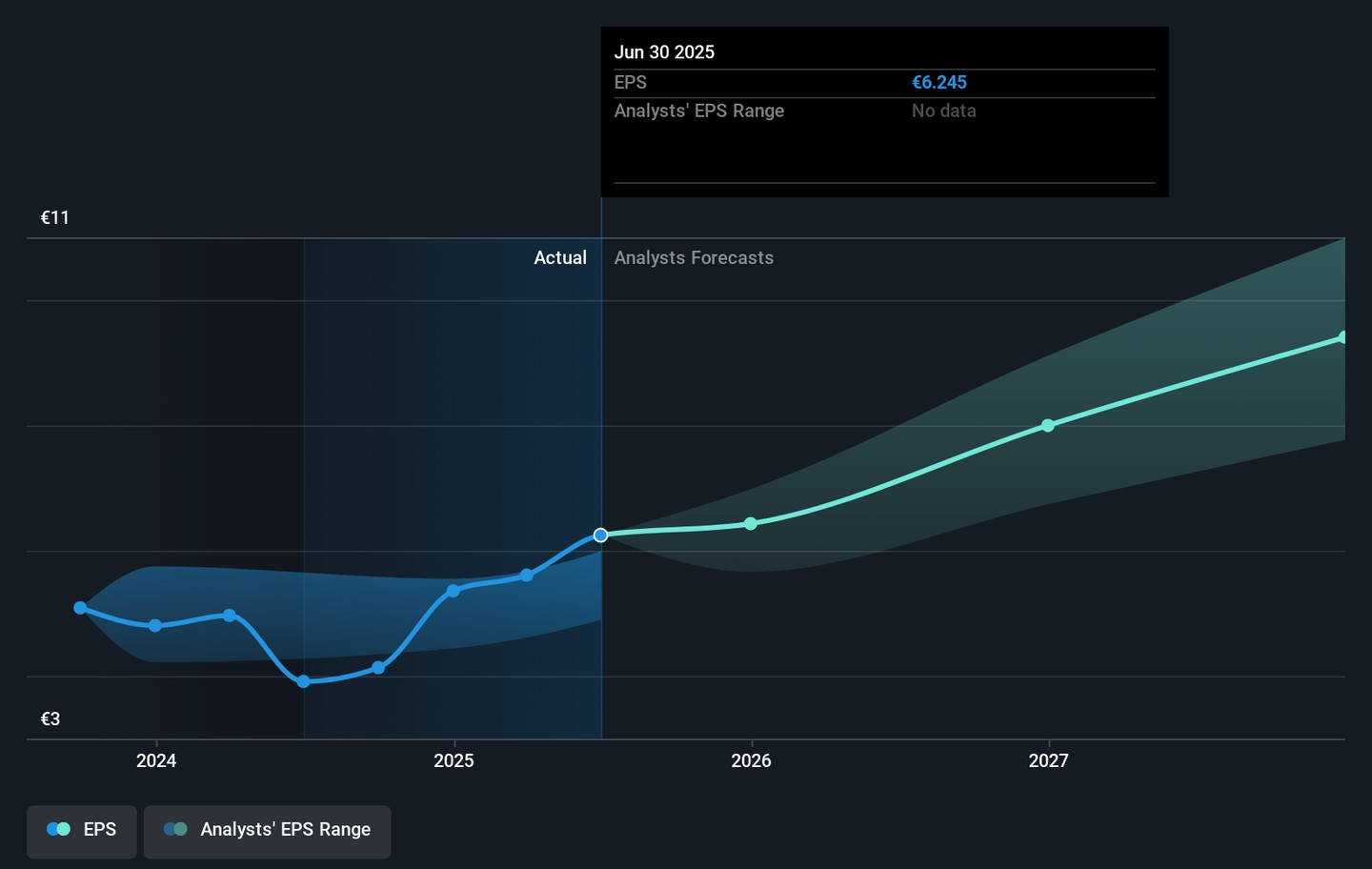
During the last half decade, Airbus became profitable. Sometimes, the start of profitability is a major inflection point that can signal fast earnings growth to come, which in turn justifies very strong share price gains. Given that the company made a profit three years ago, but not five years ago, it is worth looking at the share price returns over the last three years, too. Indeed, the Airbus share price has gained 92% in three years. Meanwhile, EPS is up 8.1% per year. This EPS growth is lower than the 24% average annual increase in the share price over three years. So it's fair to assume the market has a higher opinion of the business than it did three years ago.
The graphic below depicts how EPS has changed over time (unveil the exact values by clicking on the image).
We know that Airbus has improved its bottom line lately, but is it going to grow revenue? If you're interested, you could check this free report showing consensus revenue forecasts.
What About Dividends?
It is important to consider the total shareholder return, as well as the share price return, for any given stock. The TSR is a return calculation that accounts for the value of cash dividends (assuming that any dividend received was reinvested) and the calculated value of any discounted capital raisings and spin-offs. It's fair to say that the TSR gives a more complete picture for stocks that pay a dividend. In the case of Airbus, it has a TSR of 186% for the last 5 years. That exceeds its share price return that we previously mentioned. And there's no prize for guessing that the dividend payments largely explain the divergence!
A Different Perspective
We're pleased to report that Airbus shareholders have received a total shareholder return of 46% over one year. That's including the dividend. That gain is better than the annual TSR over five years, which is 23%. Therefore it seems like sentiment around the company has been positive lately. Someone with an optimistic perspective could view the recent improvement in TSR as indicating that the business itself is getting better with time. Before forming an opinion on Airbus you might want to consider these 3 valuation metrics.
If you would prefer to check out another company -- one with potentially superior financials -- then do not miss this free list of companies that have proven they can grow earnings.
Please note, the market returns quoted in this article reflect the market weighted average returns of stocks that currently trade on French exchanges.
