Growth slowdown, sluggish stock price: Can Adobe shake off the "AI laggard" label with its Q3 financial report?

Adobe's stock price has been sluggish amid the artificial intelligence (AI) boom, and its Q3 financial report is expected to struggle to boost market confidence. Wall Street predicts that Adobe's annual revenue growth rate will be close to 10%, the lowest in over a decade. The widespread adoption of AI applications threatens its core software business, and although Adobe has launched AI products, investors believe it is insufficient to withstand market challenges. Adobe's stock price has fallen more than 20% this year, with its price-to-earnings ratio nearing the lowest level in over a decade. Analysts expect its Q3 financial report to record a revenue growth of 9.3%
For investors who have witnessed Adobe (ADBE.US) lagging behind in the AI boom, the software giant's latest quarterly earnings report may still struggle to instill confidence in the market.
According to Zhitong Finance APP, Wall Street expects Adobe's full-year revenue growth rate to approach 10%—a robust growth rate, yet it will be the lowest level for the company in over a decade. Analysts predict that this growth fatigue will continue into the fiscal year 2028; meanwhile, AI sector "clear winners" like Oracle (ORCL.US), which are expected to achieve accelerated growth in the coming years, are becoming the objects of investor enthusiasm.
The core challenge facing Adobe is that the widespread adoption of AI applications is threatening its core software business aimed at creative professionals. For instance, some AI tools can generate images almost instantaneously based on user instructions. Although Adobe has also launched its own suite of AI products, investors currently believe these products are insufficient to fend off long-term market threats.
"AI image generation technology is replacing stock photography and image editing software, which is the most obvious case of industry disruption we have observed so far," said Brian Barbetta, co-head of the technology team at Wellington Management and co-portfolio manager of global innovation strategies. "The growth rate of AI companies is so rapid that it is clearly at the expense of traditional legacy companies."

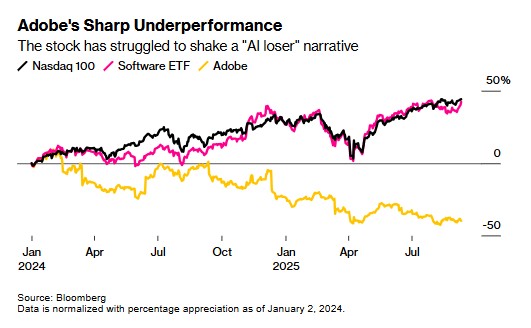
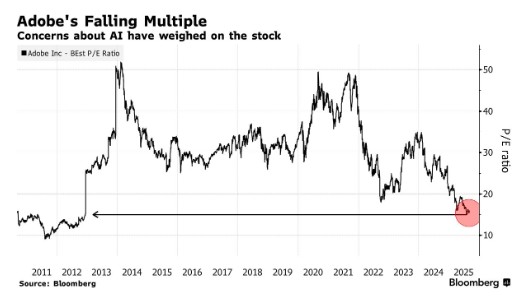
The San Jose-based company has become a typical representative of "traditional software companies facing the risk of AI disruption." Its stock price has fallen over 20% this year, with the decline since the end of 2023 reaching double that figure; meanwhile, the ETF tracking software stocks has risen over 40% during the same period. The continued sluggishness of the stock price has brought Adobe's current price-to-earnings ratio below 16 times, close to its lowest valuation level in over a decade.
Average analyst expectations indicate that Adobe will release its fiscal year 2024 third-quarter earnings report after the market closes on Thursday, with an expected revenue growth of 9.3% and an increase in earnings per share of 7%.
Investors have ample reason to remain cautious about Adobe—its stock price has fallen after the release of each of the past four earnings reports, and its latest performance guidance has further intensified market concerns about its AI business. Adam Crisafulli, founder of market research firm Vital Knowledge, wrote last week that among all large software companies, Adobe "faces the most severe AI survival risk," and the earnings performance of its peers has not alleviated this concern.
Last week, the design software company Figma (FIG.US), which Adobe failed to acquire, saw its stock price plummet due to disappointing performance guidance; meanwhile, another traditional software company facing AI disruption risk, Salesforce (CRM.US), also released earnings that fell short of expectations. These cases indicate that even companies with low valuations and AI strategies are also struggling "To say that Adobe is 'on the verge of decline' may be somewhat exaggerated, but the responsibility to prove its value lies with the company itself," said David Wagner, an investment manager at Aptus Capital Advisors. "Adobe needs to demonstrate its competitiveness and innovation capabilities, and the only way to achieve this is through sustained growth—not just this quarter, but over the next several years. However, it is currently difficult to see how the company can achieve this goal."

However, market sentiment towards Adobe is not entirely pessimistic. Among Wall Street analysts, more than two-thirds still recommend 'buying' its stock, a higher percentage than for Apple (AAPL.US). Currently, Adobe's stock price is over 35% lower than the analysts' average target price, ranking third in implied return among the constituents of the S&P 500 technology sector.
But Wellington's Barbetta warns that investors who view the low valuations of such companies as a 'buying opportunity' may face losses.
"If a company is indeed at risk of being disrupted, its future performance expectations are often distorted—this means that those companies that appear 'cheap' may actually be very expensive because they cannot maintain a technological edge," he explained, noting that competition in the AI field could squeeze Adobe's licensing fees and pricing power, thereby affecting its profit margins and making it difficult to regain accelerated growth.
Other analysts are confident in Adobe's ability to transition smoothly into the AI era. Morgan Stanley analyst Keith Weiss suggested that Snowflake (SNOW.US) might serve as a viable reference model—its recent earnings report successfully alleviated market concerns about its AI risks.
"Rather than looking for the next software company seen as a 'generative AI winner,' it is better to focus on traditional companies that are likely to become the 'next Snowflake': those that can maintain the stability of their core business while innovating quickly enough to expand growth opportunities by enhancing generative AI capabilities on their platforms," Weiss wrote in a report on September 2. "From this perspective, Adobe deserves a serious reevaluation."
Conrad van Tienhoven, a portfolio manager at Riverpark Capital, also agrees with this view. Although Adobe was once one of his largest holdings, he currently holds only a small amount of the company's shares but chooses to maintain his position.
"Adobe can still achieve decent growth, its profit margins are performing well, and its current valuation is very attractive," he stated. "Although the market has concerns about its future, it has already deemed it a loser—and that is precisely where the opportunity lies. If Adobe can make a comeback in the AI field, given its current valuation, it is poised for tremendous success."