BlackRock interprets bond market panic: The surge in yields is not primarily due to a fiscal crisis, but rather a reconstruction of neutral interest rate expectations

BlackRock analyzes the rise in global government bond market yields, believing it reflects market expectations of high interest rates rather than concerns about a fiscal crisis. Despite the significant surge in long-term bond yields, BlackRock points out that the current neutral interest rate is above historical levels, primarily driven by loose fiscal policy and high investment spending. After years of low yields, the bond market is still seeking a new equilibrium, with investor demand remaining strong
According to the Zhitong Finance APP, BlackRock stated that the rise in global government bond market yields reflects expectations that interest rates will remain high, rather than concerns about an impending fiscal crisis.
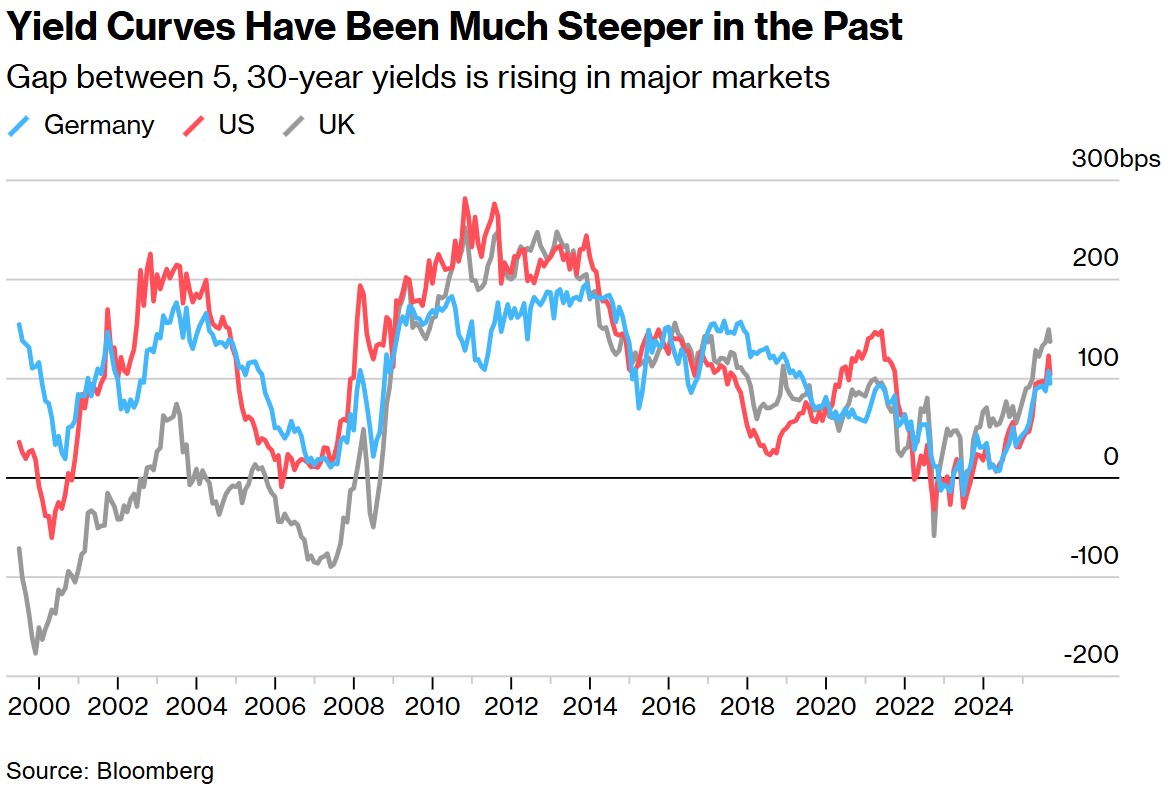
From the United States, the United Kingdom to France and Japan, long-term sovereign bond yields have surged significantly this year, pushing the yield curve to its steepest level in years. Although this repricing is often attributed to massive government borrowing and budget deficits, Alex Brazier, BlackRock's Global Head of Investment and Portfolio Solutions, holds a different view.
In an interview, Brazier stated: "I believe these global market fluctuations do not reflect concerns about fiscal conditions, but rather reflect market expectations of neutral interest rate levels and the premium required to persuade investors to buy long-term bonds instead of short-term bonds."

The gap between 5-year and 30-year bond yields in major markets is widening.
The neutral interest rate refers to the level of monetary policy that neither stimulates nor restricts economic growth. BlackRock believes the current neutral interest rate is above historical levels, partly due to loose fiscal policy and also driven by high investment spending (especially in the field of artificial intelligence).
Brazier pointed out: "All these factors are pushing up the interest rate levels needed to maintain a stable economy."
After years of ultra-low yields during the era of loose monetary policy, the bond market is still seeking a new equilibrium. For example, the yield on Germany's 30-year government bonds was below zero four years ago and has now risen to 3.25%. The UK equivalent yield recently reached its highest level since the late 1990s.
Aside from some volatile phases (such as the reaction to former UK Prime Minister Liz Truss's 2022 "mini-budget"), the yield adjustments have remained orderly overall. In addition, newly issued bonds are still able to attract billions of dollars in subscription orders, highlighting strong investor demand.
Even France (where the Prime Minister resigned earlier this week for failing to win support for budget cuts) has not fallen into a debt issuance predicament. Years of loose public spending have left the country with the largest deficit in the Eurozone, with debt growing at a rate of 5,000 euros (5,840 dollars) per second.
Despite an impending confidence vote in parliament, last week's bond auction in France still saw strong demand, with the yield premium of its 10-year government bonds over German bonds having fallen from a recent high of 83 basis points (the highest since January) to 78 basis points.
Brazier stated that these market movements indicate that investors expect France "will ultimately resolve its budget situation."
While long-term bonds in France and the UK have recently attracted major market attention, similar repricing has unfolded across major government bond markets. Based on historical patterns of steepening global yield curves, the pressure on long-term bonds may persist The company's co-head of fundamental fixed income for Europe, the Middle East, and Africa, Simon Brendle, admitted: "There are really not many areas where we are willing to allocate long-term bonds, including the UK."