The global market value champion in LiDAR, Hesai (02525, returning to Hong Kong), is driven by dual engines of automotive and robotics to unleash long-term growth momentum

Hesai (02525), listed on the Hong Kong Stock Exchange on September 16, became the first global lidar company to go public in Hong Kong. The company's subscription was hot, with the public offering portion oversubscribed by 170 times, raising HKD 388 million. Hesai holds a leading position in the automotive and robotics lidar sectors and is expected to continue to release growth momentum. On its first day of trading, the stock price reached as high as HKD 244, with a market capitalization exceeding HKD 36 billion, demonstrating the market's high recognition of its solid fundamentals and strong growth expectations
If we were to discuss the hottest direction in the global capital markets this year, the technology sector would likely be at the forefront. Take the technology-heavy Nasdaq index, for example, which has frequently set new historical highs this year, driven by the artificial intelligence boom and expectations of interest rate cuts by the Federal Reserve.
In this era where technology stocks are highly regarded, Zhitong Finance has noted that the Hong Kong stock market will welcome another technology company with solid capabilities. On September 16, Hesai (02525, HSAI.US), the first global lidar company to return to Hong Kong for listing, officially listed on the main board of the Hong Kong Stock Exchange.
As a leading global lidar company, Hesai's leading position and rarity have been highly recognized by top international institutions and investors both domestically and abroad. The company's subscription was extremely popular, with the public offering portion oversubscribed by 170 times, involving funds of HKD 66.9 billion; the margin financing accumulated approximately HKD 46.8 billion, and with the public offering portion raising HKD 388 million, the margin financing was oversubscribed nearly 120 times. At the same time, Hesai also introduced six cornerstone investors, including Hillhouse Capital, WT Asset Management, and Taikang Life, gathering international long-term funds and industrial capital. On its first day of trading, the stock reached a high of HKD 244.0 per share, with a market capitalization exceeding HKD 36 billion.
The reason why various funds are competing to participate in Hesai's return to Hong Kong is fundamentally due to the company's solid fundamentals and strong growth expectations. Looking at the company's past financial reports, Hesai not only leads the industry in scale but also achieved profitability ahead of others; what’s more, beyond its traditional stronghold in automotive lidar, Hesai's advanced layout in the robotics lidar sector is also entering a period of intensive harvest, with the potential of the company's second growth curve beginning to emerge, and it is expected to continue contributing considerable performance increments.
The New Journey of the Global Lidar Leader
Founded in 2014, Hesai made its debut on the US stock market in February 2023, bearing the title of "China's first lidar stock." More than two years later, Hesai's return to Hong Kong can be described as even more "versatile."
Firstly, in terms of financial performance, Hesai achieved revenue of HKD 710 million in the second quarter of this year, an increase of 53.9% year-on-year, marking the company's fifth consecutive quarter of positive year-on-year revenue growth. At the same time as its scale continues to grow significantly, Hesai's profitability has also exceeded expectations, with a net profit of HKD 44.1 million in the second quarter, a significant improvement from a net loss of HKD 72.1 million in the same period last year.
If we extend the timeline, Hesai's impressive performance has long been anticipated. By 2024, Hesai had already achieved revenue of HKD 2.08 billion, becoming the world's first and only publicly listed lidar company to achieve profitability for the entire year. In that year, Hesai's operating cash flow and net cash flow reached HKD 63 million and HKD 1.3 billion, respectively, showcasing its potential for self-sustaining growth.
Behind the impressive financial data is the rapid increase in Hesai's market influence in the lidar field. In the second quarter of 2025, the total delivery volume of Hesai's lidar increased by 306.9% year-on-year to 352,100 units, of which the delivery volume of ADAS lidar was 303,600 units, an increase of 275.8%; the delivery volume of lidar in the robotics sector was 48,500 units, with an astonishing growth rate of 743.6% In the entire first half of the year, Hesai's total delivery of lidar units reached 547,900, a figure that has already surpassed the total scale for the entire year of 2024.
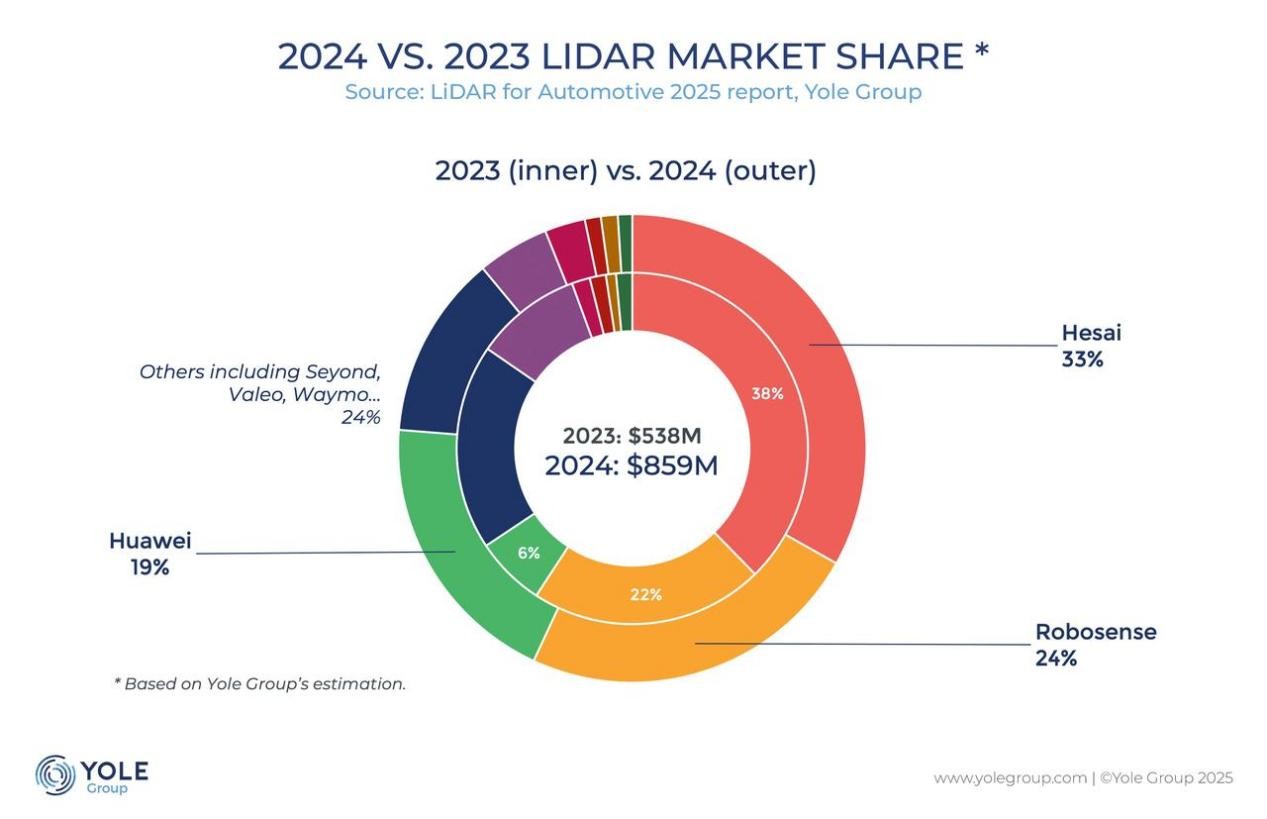
From a global perspective, according to the "2025 Global Automotive Lidar Market Report," Hesai's market share in the global automotive lidar market for 2024 is approximately 33%, ranking first in the world. It is worth mentioning that this is also the fourth consecutive year that Hesai has topped the list.

Hesai's competitive advantage in the L4 autonomous driving lidar market is even more pronounced, with a global market share of 61% based on revenue generated from related products in 2024. In this sub-sector, Hesai has also maintained its top position for four consecutive years.
While amplifying its competitive advantages in its main business, it should not be overlooked that Hesai is also strategically investing in the robotics lidar field and has achieved impressive interim results. Based on public information, as of now, Hesai's cumulative sales of robotics lidar rank first in the world, with over 2,000 customers spread across multiple countries. The reason Hesai can "lead" the robotics lidar track is closely related to the company's strong product cycle. For example, the JT series, which was launched earlier this year for lawn mowing robots, has delivered over 100,000 units by the end of June, making it the fastest lidar product to reach this key milestone in the global robotics field.
With Hesai successfully listing in Hong Kong, this fundraising has injected new capital momentum into the company. Additionally, as Hong Kong serves as an important international financial center with a unique bridge advantage connecting the mainland and overseas markets, it is expected that Hesai's growth prospects will become even more optimistic.
Gathering Multiple Growth Logics for a Broad Development Outlook
Standing at the new starting point of being listed in both the Hong Kong and U.S. stock markets, Hesai's global expansion is expected to continue deepening. So far, among the top 10 international automotive manufacturers with the highest global revenue on the Fortune Global 500 list, 7 manufacturers or their joint venture partners have established mass production cooperation relationships with Hesai. Furthermore, among the top ten Robotaxi companies globally, eight have chosen Hesai as their lidar supplier.
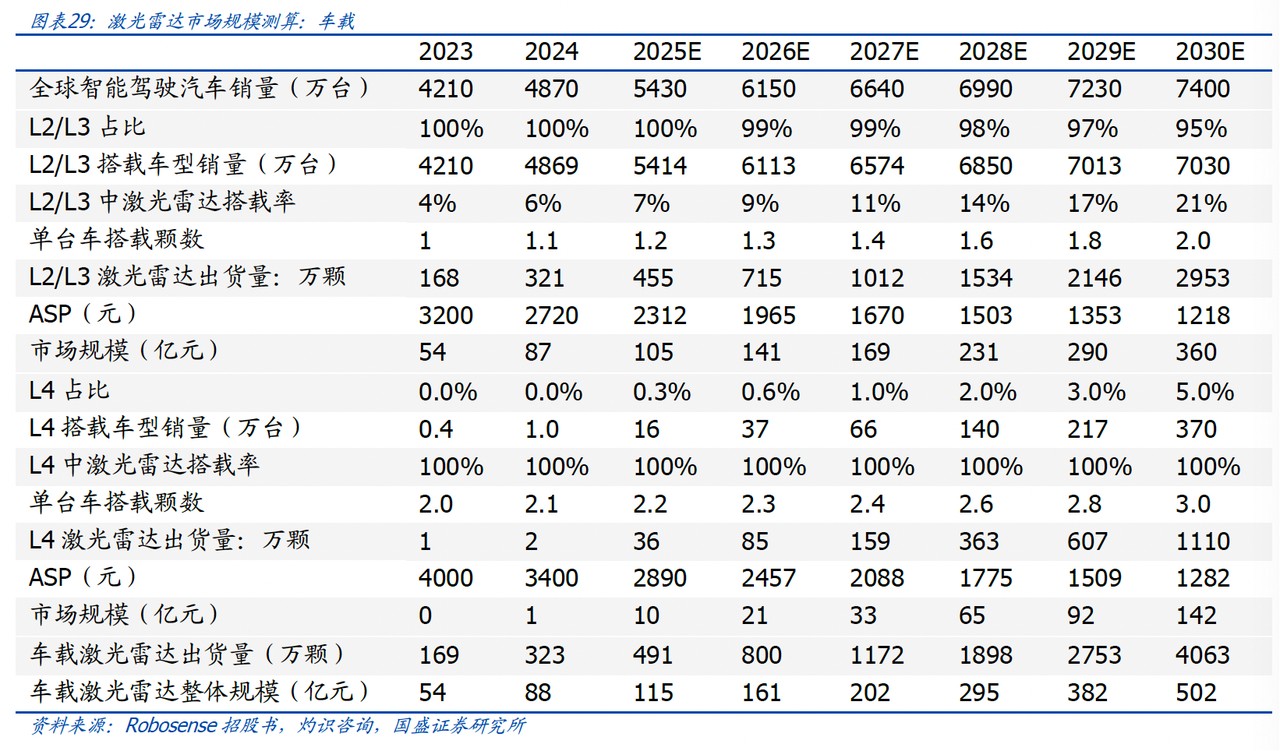
Combining industry development trends, it can be inferred that Hesai's global influence will further expand. Firstly, in the automotive sector, driven by the increasing demand for intelligent driving, users' demand for smart driving has led to a continuous increase in penetration rates; simultaneously, on the supply side, as prices decrease, lidar is becoming an increasingly cost-effective choice for intelligent driving sensors. Driven by both supply and demand, the automotive lidar market is expected to maintain a high growth trend. According to analysts from Guosheng Securities, the global automotive lidar market size is expected to reach 50 billion yuan by 2030

Being in the midst of it, Hesai, as an industry leader, continues to iterate and innovate in performance breakthroughs and cost reduction. The company now has a high-performance lidar product matrix. For example, the ETX is the world's highest line count and longest range automotive-grade ultra-long-distance lidar, specifically designed for L3 and L4 autonomous driving; while the FTX product launched by Hesai boasts the world's widest field of view among pure solid-state automotive-grade blind-spot lidar. Additionally, in the L2 assisted driving sector, Hesai's ATX product has become the "standard configuration king" for popular models due to its high performance, compact size, and all-weather capabilities. With its first-mover advantage, technological edge, and comprehensive product matrix, Hesai is likely to maintain a "leading" position in the rapidly expanding automotive lidar industry.
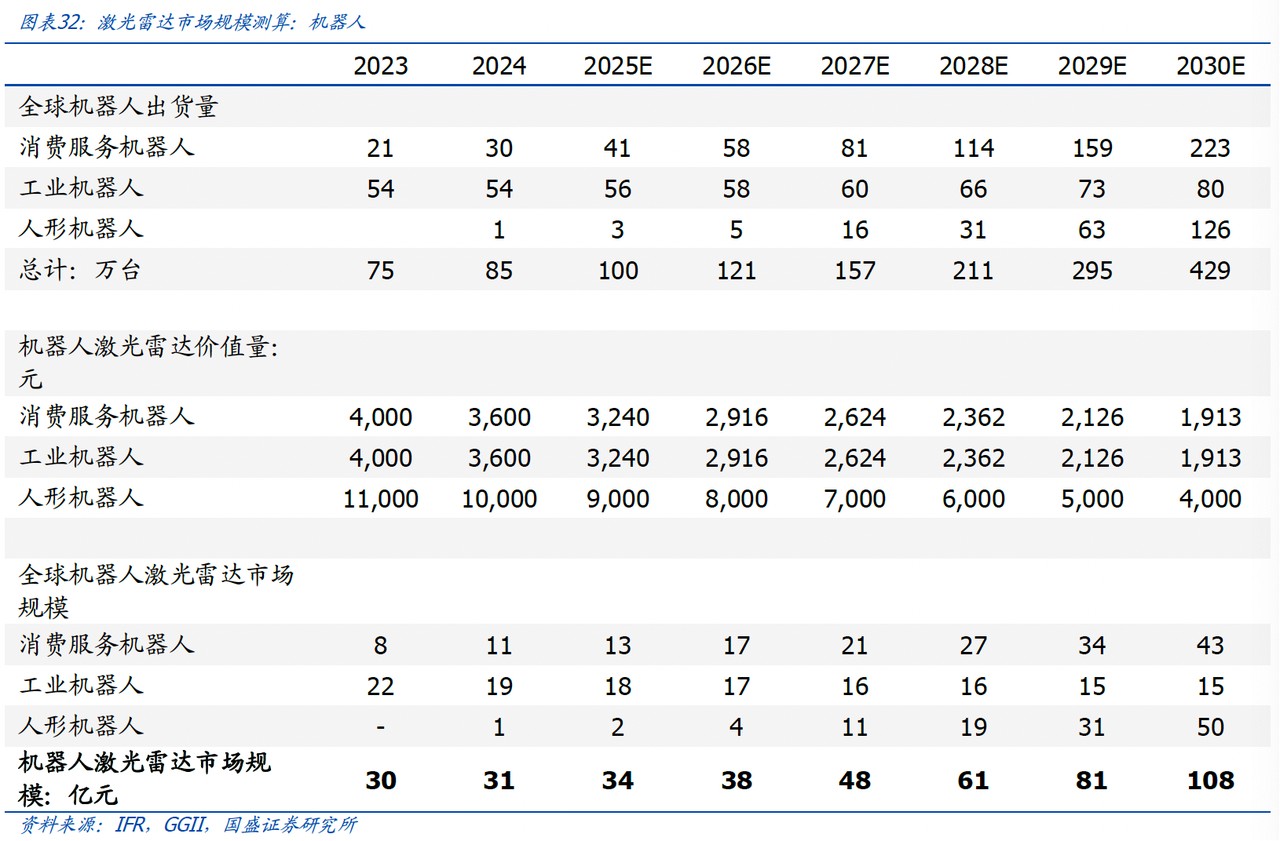
The growth prospects for Hesai in the promising field of robotic lidar should not be underestimated. Currently, there is a significant increase in shipments in industrial scenarios, consumer service scenarios, and humanoid robots. For consumer robots, industrial robots, and even the evolving humanoid robots, the visual system is the core component of perception. According to analysts from Guosheng Securities, the market size for robotic lidar is expected to soar to the level of 10 billion RMB by 2030.

Facing the upcoming robotic era, Hesai is also entering the market as a pioneer. In the field of lawn-mowing robots, Hesai will provide 300,000 JT series lidars to Keting Technology in the coming year. In terms of quadruped and humanoid robots, last month, Hesai reached a deep cooperation with Vbot, the first consumer-grade embodied intelligence company in China; in the same month, Hesai also collaborated with the Tsinghua University-affiliated embodied intelligence startup, Xingdong Jiyuan. Furthermore, in the mobile and commercial robot sector, Hesai has established deep cooperative relationships with several industry-leading companies. For instance, its products have been scaled up for use in New Stone Age unmanned vehicles, supporting deployment in over 30 cities worldwide and 9 overseas countries, with nearly 1,000 units delivered and over 1.3 million kilometers safely driven.
Conclusion
At this current juncture, whether in the U.S. stock market or the Chinese capital market, the investment enthusiasm for "hard technology" has reached an unprecedented height. This is fundamentally due to the profound changes occurring in the global macroeconomic and industrial landscape. Hard technology is not only seen as the core engine driving future economic growth but also as a key element for countries to achieve technological strategic autonomy Against this backdrop, Hesai, whose growth momentum in its traditional advantageous business has yet to be fully unleashed, is also strongly building a second growth curve through robotic lidar. It is no wonder that Hesai's return to the Hong Kong stock market has garnered significant attention from various funds. Looking ahead, it is foreseeable that as Hesai's multiple growth logics gradually materialize, the stock price trend of the company in the Hong Kong market will be very optimistic