


Cui Dongshu: From January to August, China’s automobile exports reached 4.94 million units, showing a generally strong year-on-year trend

Cui Dongshu pointed out that from January to August 2023, China's automobile exports reached 4.94 million units, a year-on-year increase of 21%. The main driving force is the improvement in the competitiveness of Chinese products and a slight growth in global southern markets. In August 2025, exports are expected to reach 764,000 units, with the top 10 export countries including Russia, the UAE, Mexico, and others. In terms of new energy vehicle exports, countries such as Belgium, the Philippines, and the UK performed outstandingly
According to Zhitong Finance APP, Cui Dongshu stated that in August 2025, China's automobile exports reached 764,000 units, a year-on-year increase of 25% and a month-on-month increase of 12%; from January to August, China's automobile exports totaled 4.94 million units, a year-on-year growth rate of 21% compared to January to August 2024, with an overall strong trend. The main driving force this year remains the improvement in the competitiveness of Chinese products and slight growth in markets of global southern countries.
The top 10 countries for China's automobile exports in August 2025 are: Russia 58,707 units, UAE 46,616 units, Mexico 38,994 units, Australia 31,020 units, the UK 28,821 units, Belgium 28,289 units, Saudi Arabia 28,012 units, the Philippines 26,025 units, Algeria 22,265 units, Kazakhstan 21,064 units. Among these, the top five countries with the largest increase compared to the same period last year are: Australia 21,468 units, Algeria 21,386 units, UAE 18,069 units, the UK 16,018 units, the Philippines 11,430 units.
The top 10 countries for cumulative complete vehicle exports in 2025 are: Mexico 362,103 units, UAE 320,096 units, Russia 288,582 units, Belgium 211,923 units, Australia 198,903 units, Saudi Arabia 197,955 units, the UK 197,023 units, Brazil 193,844 units, the Philippines 176,571 units, Kazakhstan 130,204 units. Among these, the top five countries with the largest increase compared to the same period last year are: UAE 117,178 units, Australia 79,881 units, the Philippines 71,889 units, Kazakhstan 61,180 units, the UK 58,928 units.
The top 10 countries for China's new energy vehicle exports in August 2025 are: Belgium 27,247 units, the Philippines 21,957 units, the UK 19,435 units, South Korea 15,500 units, UAE 15,424 units, Australia 15,017 units, Germany 14,289 units, India 12,444 units, Thailand 11,308 units, Spain 10,545 units. Among these, the top five countries with the largest increase compared to the same period last year are: the UK 13,808 units, the Philippines 12,612 units, South Korea 12,016 units, Australia 11,825 units, UAE 10,001 units.
From January to August 2025, the top 10 countries for China's new energy vehicle exports are: Belgium 202,663 units, the Philippines 137,374 units, the UK 133,744 units, Brazil 129,946 units, Mexico 125,651 units, Australia 99,750 units, Thailand 84,806 units, UAE 71,925 units, Turkey 67,805 units, India 66,213 units. Among these, the top five countries with the largest increase compared to the same period last year are: the Philippines 67,405 units, Mexico 64,069 units, Australia 47,971 units, the UK 44,951 units, Turkey 44,738 units.
China's new energy vehicle exports from January to August 2025 performed better than expected, mainly due to plug-in hybrids and hybrids replacing pure electric vehicles as new growth points for exports, especially the strong performance of plug-in hybrid pickups, which have become a highlight in the export of commercial new energy vehicles. China's new energy vehicle exports are showing high-quality development towards the Middle East and developed country markets, mainly exporting to Western Europe and Asian markets I. Overall Trend of China's Automobile Exports
1. Historical Trends of Automobile Exports
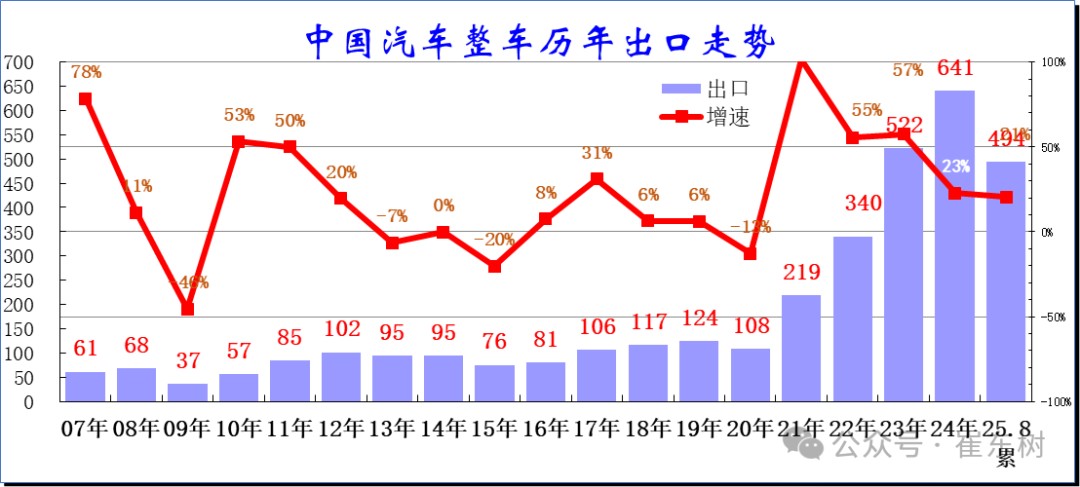
China's automobile exports, after years of hovering around the million-unit mark, finally began to break through in 2021. Following a sharp decline during the global economic downturn from 2013 to 2016, the export growth rate gradually stabilized and improved from 2017 to 2020, maintaining an annual export volume of around 1 million units. Exports in 2020 reached 1.08 million units, a year-on-year decrease of 13%, and then entered a high growth period starting in 2021.
In 2021, growth was 102%, with growth exceeding 50% in 2022-2023, and a growth rate of around 20% expected in 2024-2025. From January to August 2025, China achieved exports of 4.94 million vehicles, with an export growth rate of 21%. Recently, China's automobile exports have experienced rapid growth, and as long as there is a stable market environment internationally, it is expected that there is still significant room for development in China's automobile exports.
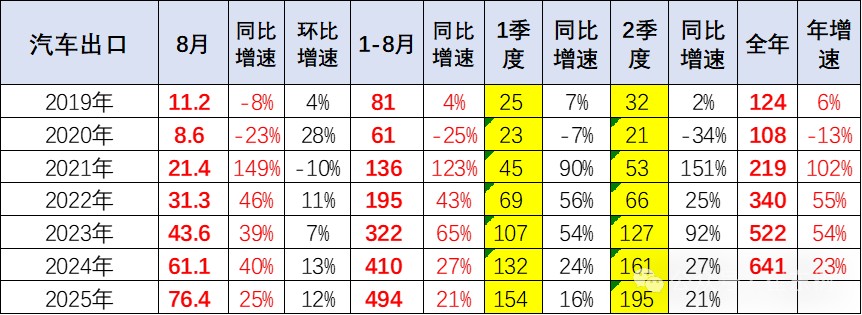
From January to August 2025, China achieved exports of 4.94 million vehicles, a year-on-year growth rate of 21% compared to January to August 2024. In August, China exported 764,000 vehicles, a year-on-year increase of 25% and a month-on-month increase of 12%, showing a generally strong year-on-year trend. The main driving force this year remains the improvement in the competitiveness of Chinese products and slight growth in markets of global southern countries.
2. Monthly Trends of Complete Vehicle Exports
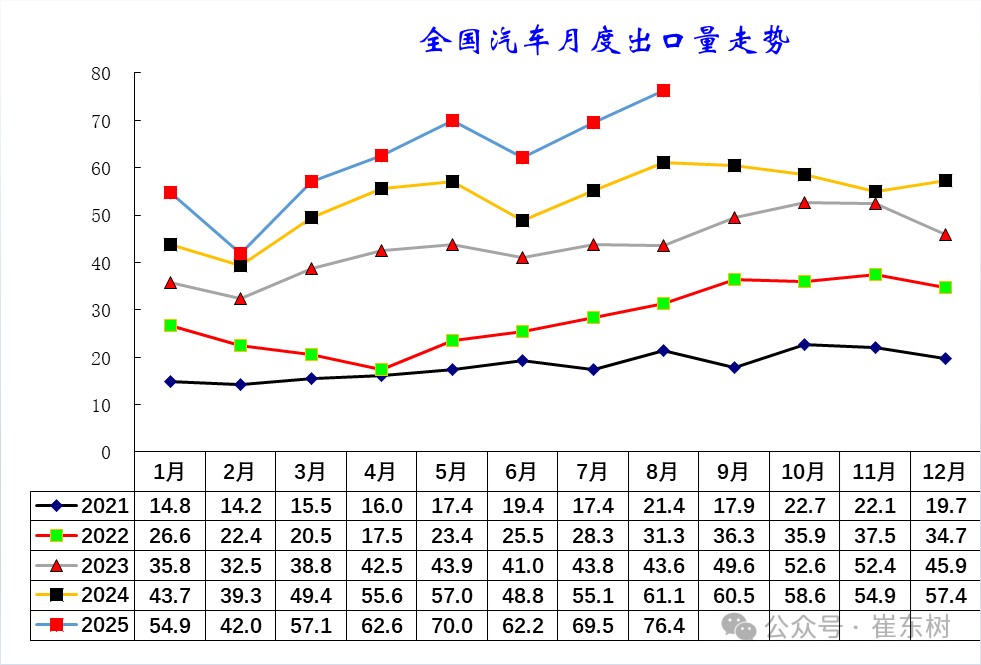
From a monthly perspective, China's automobile exports in recent years still show seasonal characteristics, with a tendency to rise in summer contrasting with domestic trends.
In January 2025, the export growth rate was relatively strong, but due to the interference of tariffs imposed by Trump, there was a downturn from February to April, followed by a recovery in growth from May to August. Due to market diversification, the growth rate of China's automobile exports is less affected by external environments.
3. Structural Characteristics of Complete Vehicle Exports
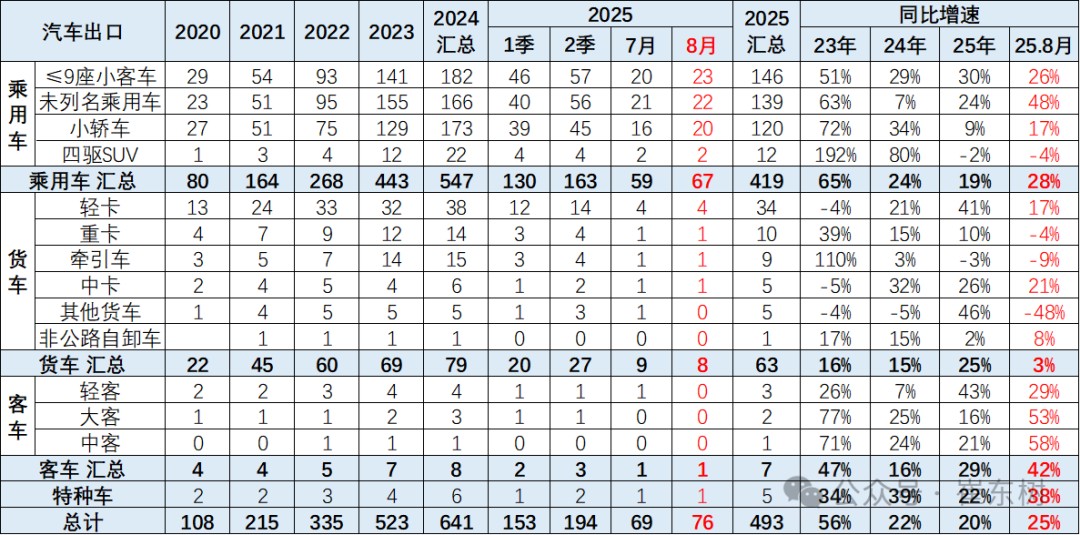
Before 2020, China's automobile exports remained at the million-unit scale. Subsequently, they continued to grow rapidly, reaching 6.41 million units by 2024. Exports of passenger vehicles have continued to strengthen, while exports of trucks and buses have also shown good growth From January to August this year, the growth rates of various vehicle types at customs showed differentiation, with trucks and buses performing better than in 2024. In particular, truck exports increased by 25% and bus exports grew by 29%. Compared to the sluggish domestic fuel truck market, recent exports of light trucks and medium trucks have been good, and pickup truck exports have surged.
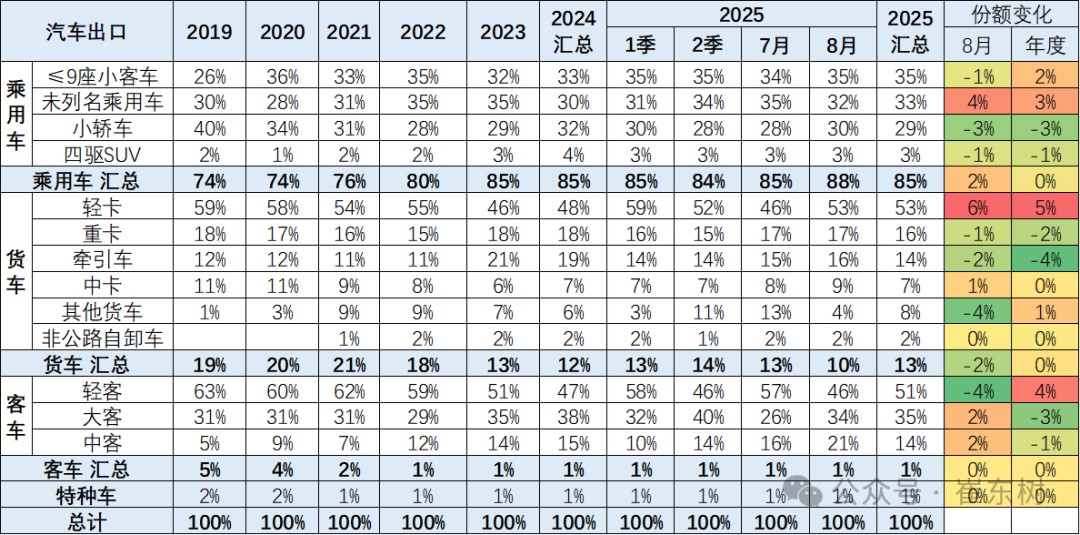
In terms of structure, the export share of passenger cars has continuously increased to 85% in 2023, remaining relatively stable thereafter. The export shares of trucks and buses have continued to decline to a low level. As passenger cars are the focus of trade, the proportion of exported trucks and buses is still slightly higher than that of domestic commercial vehicles.
The performance of several main types of passenger cars is relatively balanced, with the export of unnamed passenger cars improving in 2025. Although the decline in Tesla's exports has a significant impact, the growth of domestic micro electric vehicles is quite good. In 2025, the share of buses with fewer than 9 seats is 35%, reaching 35% in August.
Truck performance in August was average, with pickup truck growth slowing down and heavy truck exports declining. The performance of medium and large buses was generally average, while light bus exports were slightly stronger.
4. Characteristics of Export Power Structure
The export growth rate of passenger cars in 2025 has significantly declined, with the export growth rates of gasoline vehicles remaining low, continuing negative growth in August. This year, the export of hybrid passenger cars has been strong, with plug-in hybrids showing the strongest growth. This year, truck and bus exports have remained stable, while the fluctuations in passenger car exports to Russia and Europe are the core volatile variables.
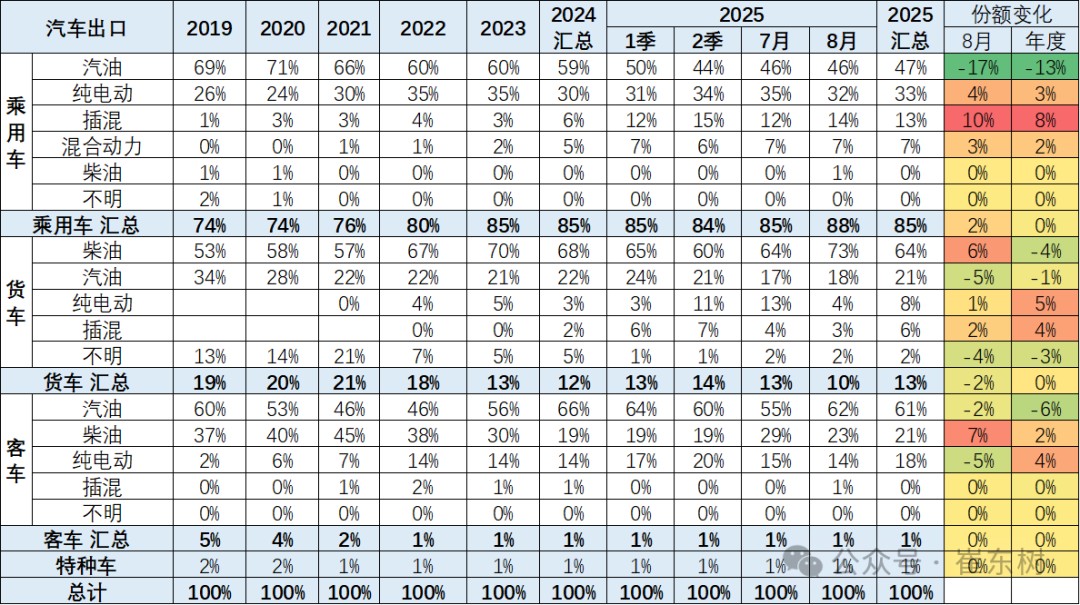
From January to August 2025, the share of pure electric passenger cars has rebounded, while the exports of gasoline passenger cars, diesel trucks, and gasoline buses have significantly declined. In August, the exports of plug-in hybrid passenger cars, plug-in pickups, and hybrid passenger cars showed good growth.
II. Automotive Export Market Structure
1. Export Manufacturers' Domestic Regional Characteristics
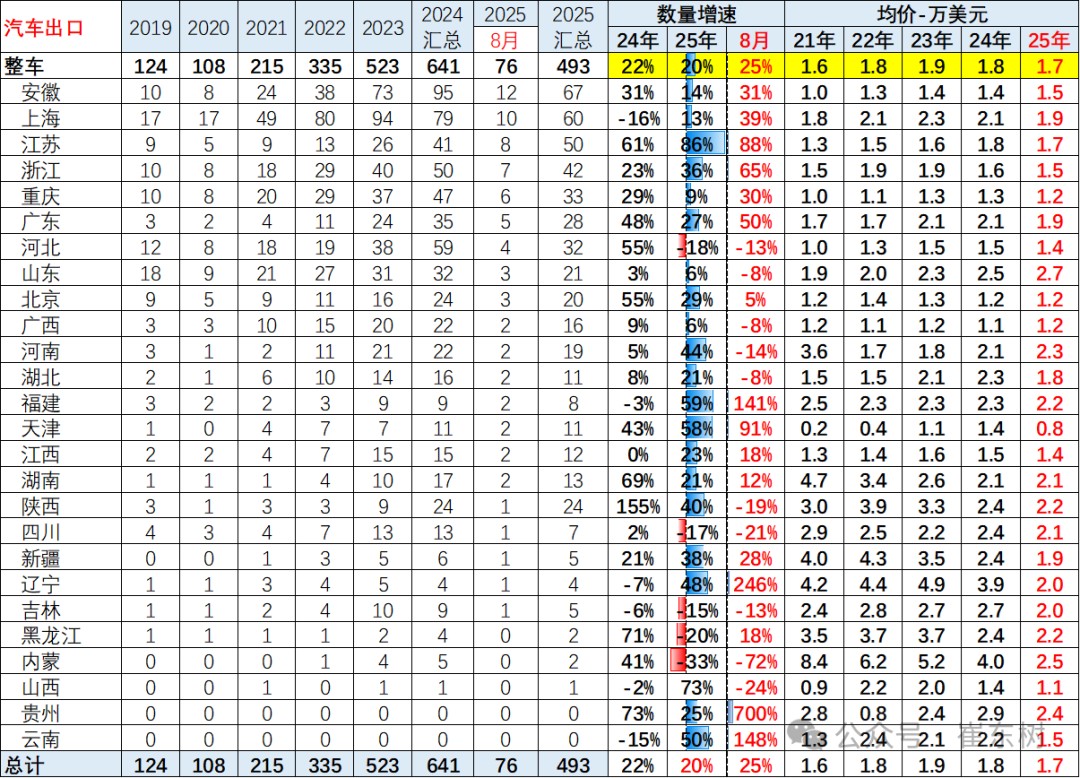
In 2024, Shanghai's leading position in national automotive exports was replaced by Anhui, which maintained its first position in exports in 2025. The significance of Shanghai's exports to China is extremely evident. From January to August 2025, Anhui's automotive exports reached 670,000 units, mainly due to the relatively strong local enterprises in Anhui, while Shanghai's enterprises have high export standards, with SAIC Motor and Tesla both experiencing a decline in recent export prices In the past two years, Anhui's export performance has been relatively strong, mainly due to the strong export performance of Chery (09973) and Jianghuai (600418.SH), with good diversification in Anhui's exports. The contribution of automobile exports from Jiangsu and Henan is expected to rise significantly by 2025.
2. Export Regional Characteristics
China's overall automobile export performance is strong, with relatively excellent exports to the Middle East, Africa, and Oceania.
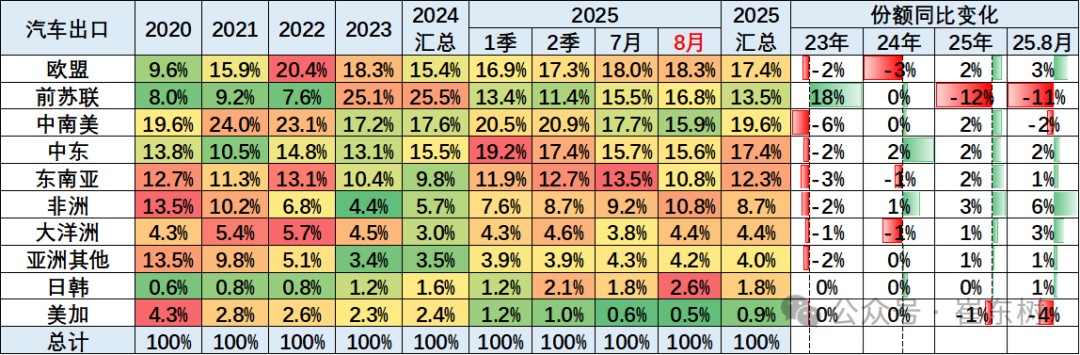
Previously, China's automobile exports had a high proportion in Central and South America and performed strongly in Southeast Asia and other regions of South Asia. Currently, there is a gradual shift towards stronger performance in Central and South America and Europe. Especially recently, the Middle East and Central and South America have shown relatively strong performance compared to last year.
3. Analysis of Export Trends by Region
The surge in exports in 2025 is also the result of continuous exploration of markets in Australia, the European Union, and others.
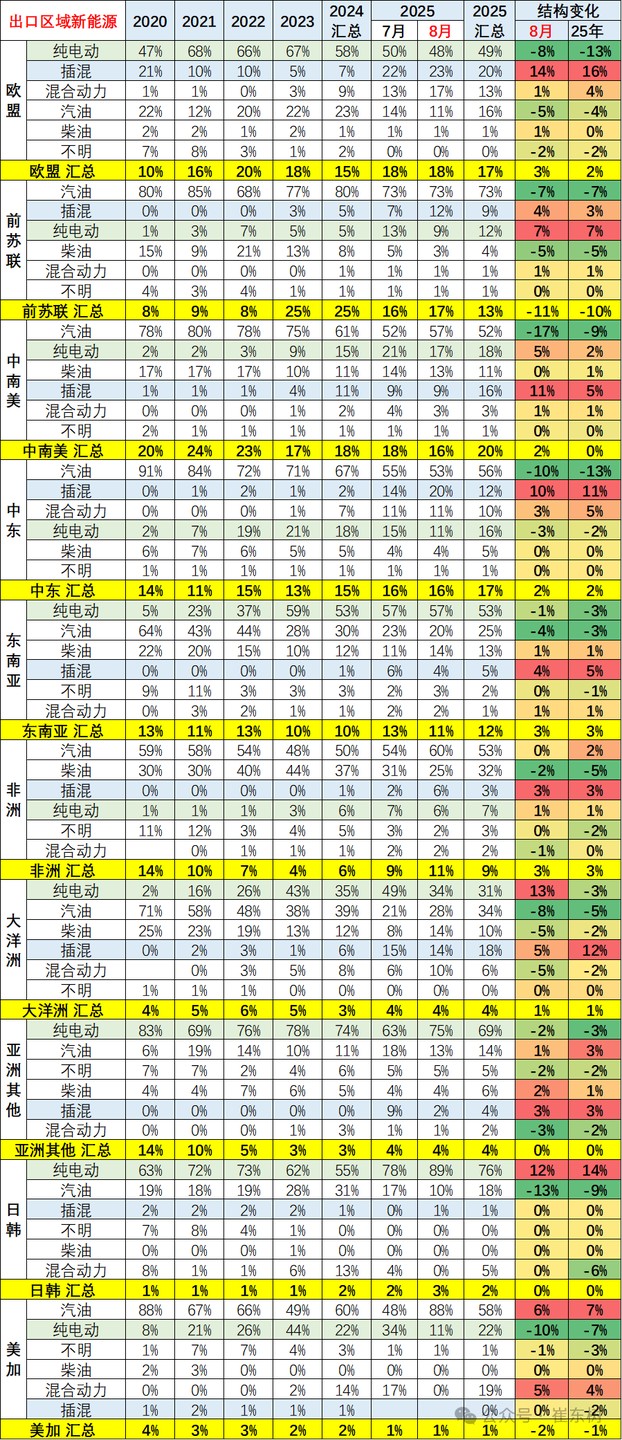
From the sales perspective, exports from 2017 to 2022 showed a gradual recovery, mainly due to contributions from Europe. The Russian market is expected to see significant growth from 2022 to 2024, becoming a core increment. By 2025, the proportion of exports to Russia will decline, while exports to the European Union, Central and South America, and the Middle East will increase.
Recently, the market for Russia is expected to decline sharply, while there will be a slight decrease in the developed North American market, with performance in developed countries showing divergence. The performance of new energy exports in South America is highly volatile. Export demand from impoverished and underdeveloped regions of the world is unstable. China's automotive competition continues to increase, and growth is expected to continue in the future.
4. Analysis of Complete Vehicle Exports by Country
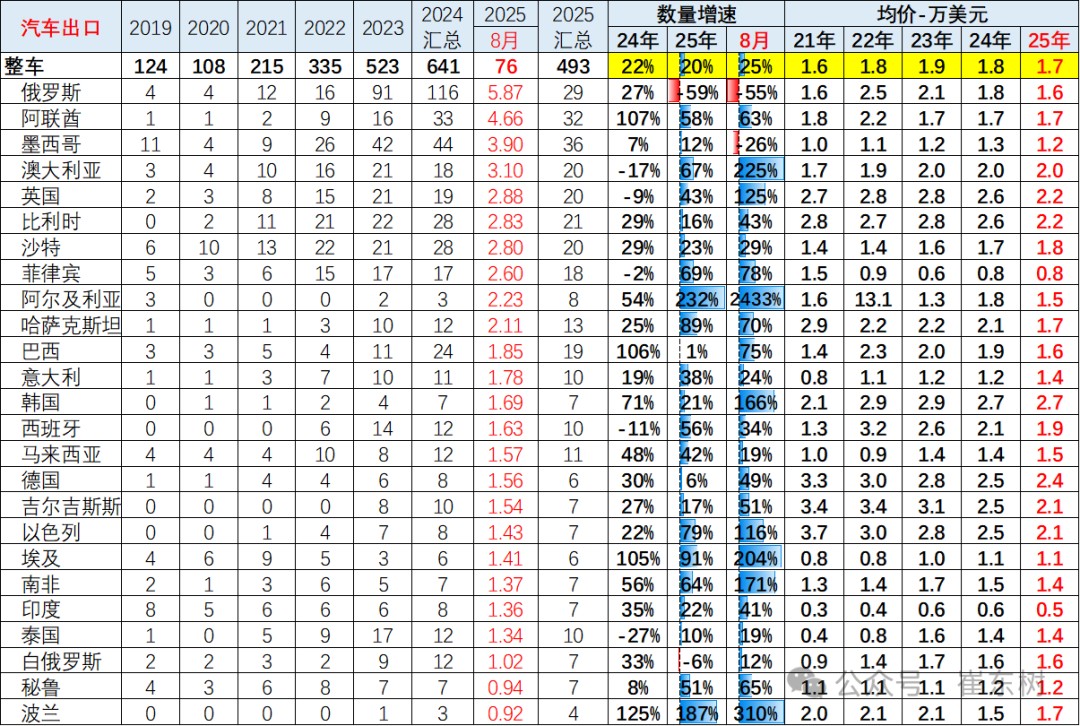
In 2021, the average export price was $16,000; in 2022, the average export price for automobiles was $18,000; in 2023, it rose to $19,000, showing a continuous upward trend; in 2024, the average export price is expected to be $18,000; and in 2025, it will be $17,000 The average export price continues to decline, and Tesla's decreasing export proportion has led to a drop in the average price per vehicle.
In the early stage, there were significant changes in the Russian market, with other foreign investments withdrawing. Therefore, since 2023, China's exports to Russia have increased significantly, and Chinese car companies are expected to perform strongly in Russia in 2024, with this year focusing on destocking and returning to full competition. Last year, exports were mainly to Belgium, while this year, with improved relations in Europe, export performance has also improved.
Recently, the Mexican market has performed strongly, affected by the tax increases in Europe and the United States in August. The car markets in Chile, Peru, Thailand, and others experienced a sharp decline earlier but have recovered this year. Asia still sees good performance in the Saudi and UAE markets.
5. Monthly Export Volume Trends of Complete Vehicles
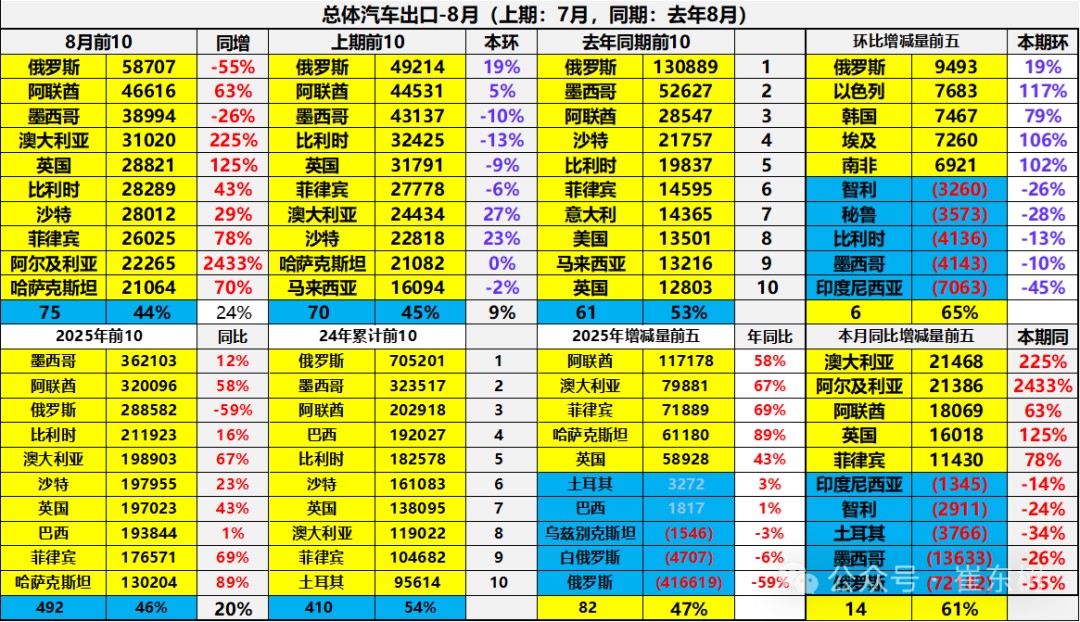
In August 2025, the top 10 countries for China's total vehicle exports were: Russia 58,707 units, UAE 46,616 units, Mexico 38,994 units, Australia 31,020 units, the UK 28,821 units, Belgium 28,289 units, Saudi Arabia 28,012 units, the Philippines 26,025 units, Algeria 22,265 units, Kazakhstan 21,064 units. Among these, the top five countries with the largest increase compared to the same period last year were: Australia 21,468 units, Algeria 21,386 units, UAE 18,069 units, the UK 16,018 units, the Philippines 11,430 units.
The cumulative total vehicle exports from January to August 2025 for the top 10 countries were: Mexico 362,103 units, UAE 320,096 units, Russia 288,582 units, Belgium 211,923 units, Australia 198,903 units, Saudi Arabia 197,955 units, the UK 197,023 units, Brazil 193,844 units, the Philippines 176,571 units, Kazakhstan 130,204 units. Among these, the top five countries with the largest increase compared to the same period last year were: UAE 117,178 units, Australia 79,881 units, the Philippines 71,889 units, Kazakhstan 61,180 units, the UK 58,928 units.
6. Analysis of Changes in Major Export Countries Over the Years

The previous overseas bases for automobile exports did not yield ideal results, with significant fluctuations in the main markets. From 2023 to 2024, the main markets for automobile exports are expected to come from Russia, Mexico, Belgium, Australia, Saudi Arabia, the UK, and other countries, with strong trends in the European and American markets. Recently, developed countries such as Australia, the UAE, and the UK have shown improved performance.
In the export structure from January to August 2025, Mexico has risen to the top export position, with exports from the UAE also increasing. In August, exports to Russia rebounded to the first position, with good exports to Australia, while exports to Brazil decreased year-on-year 7. Analysis of Changes in Exports to Russia
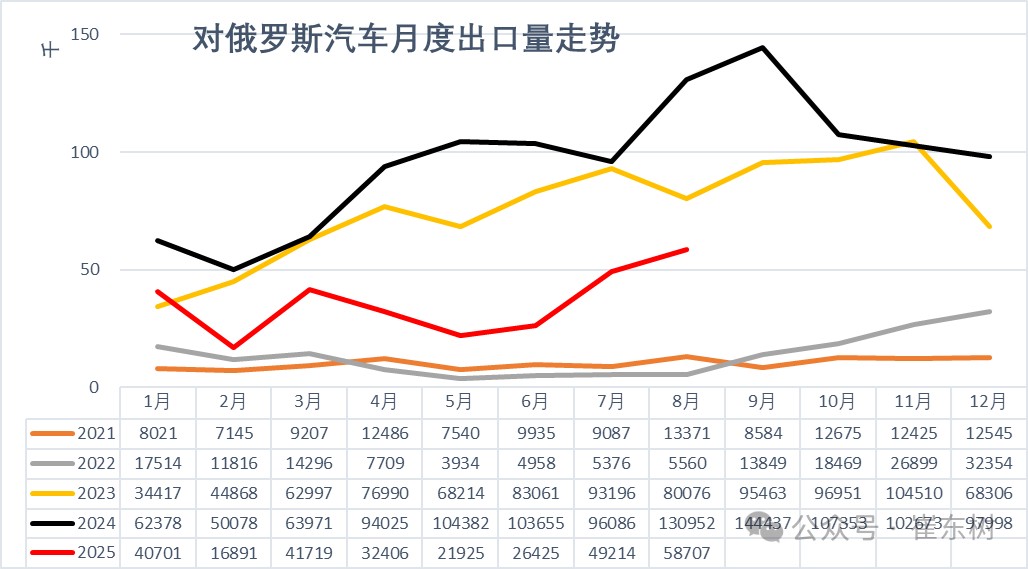
Recently, due to the withdrawal of automotive companies from other countries, Chinese automotive companies quickly ensured the supply demand for vehicles in Russia in 2023. The Chinese automotive companies that entered Russia earlier should be temporarily safe.
Russia's import rules are constantly adjusted based on supply and demand. In 2024, Russia's automobile sales have reached the highest level in recent years, so a decline in 2025 is inevitable. Since 2024, China's exports of new energy vehicles to Russia have fluctuated sharply. From January to August this year, domestic demand in Russia has gradually stabilized, and China's automobile exports are gradually recovering.
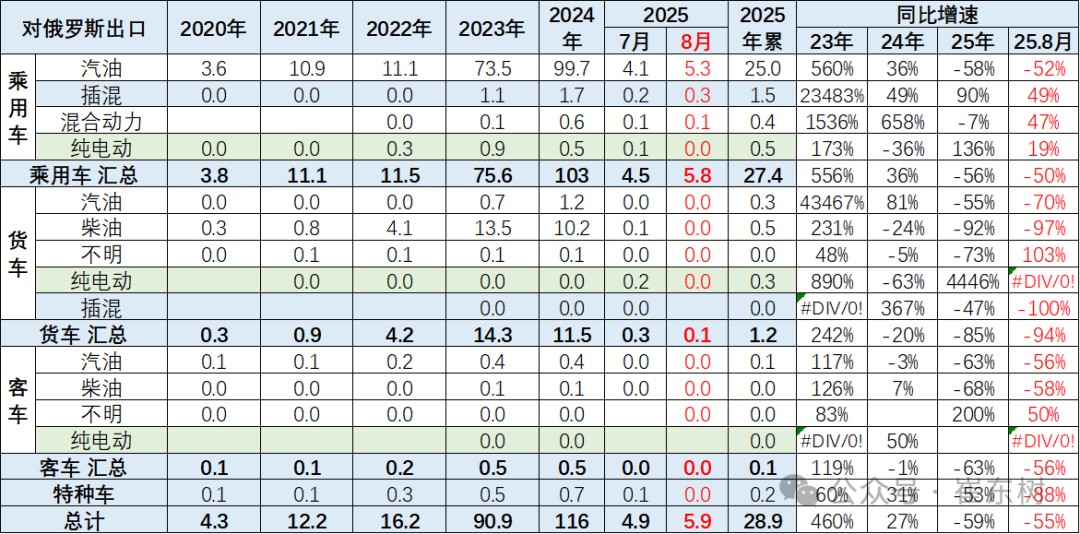
Since 2023, Russia has suddenly become China's largest automobile export market, marking another significant change in Chinese automobile exports after 15 years. In 2008, Chinese independent brands performed well in the Russian market, but with Russia's imposition of hefty tariffs on Chinese automobiles, many Chinese automotive companies withdrew from Russia that year. The decline in the first half of this year is somewhat similar to the trend in 2009, but there is currently improvement.
3. Trends in New Energy Vehicle Exports
1. Characteristics of New Energy Vehicle Exports Over the Years
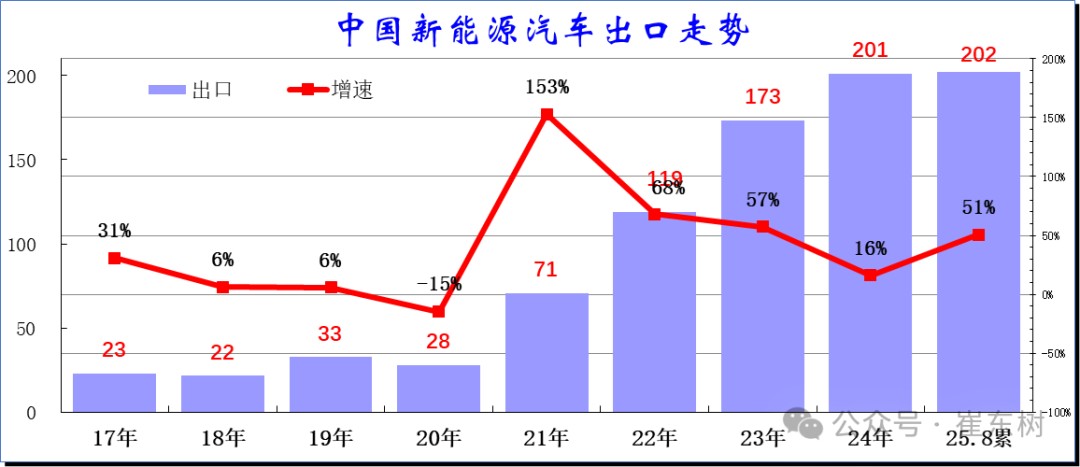
As China's domestic new energy vehicle market transitions from subsidy-driven to market-driven, the market competitiveness of Chinese new energy vehicles has significantly increased. China's new energy vehicle exports experienced explosive growth in 2021, followed by a sustained high growth period. Although the export policies of new energy vehicles to the European Union may interfere in 2024, China's new energy vehicle exports are still expected to reach 2.01 million units for the whole year, a year-on-year increase of 16%. From January to August 2025, the export of new energy vehicles reached 2 million units, representing a 51% increase, which is considered good performance.

In January of this year, the surge in new energy vehicle exports was exceptionally strong, followed by a downturn in February and March. From April to August, new energy vehicle exports remained at historically high levels, laying a foundation for sustained growth in 2025.
 After continuous high growth, the cumulative export volume of new energy vehicles in 2024 reached 2.01 million units, a year-on-year increase of 16%.
In August 2025, China's new energy vehicle exports reached 315,000 units, an increase of 83%, which is also a strong performance; from January to August 2025, the export volume of new energy vehicles was 2.02 million units, a year-on-year increase of 51%, significantly higher than the 24% growth rate from January to August 2024.
2. Changes in the Export Structure of Complete Vehicles

In August 2025, China's plug-in hybrid vehicle exports reached 100,000 units, an increase of 304%, accounting for 10% of total vehicle exports, an increase of 8 percentage points compared to the plug-in hybrid export share in August 2024. In August 2025, pure electric vehicle exports reached 220,000 units, an increase of 48%, accounting for 31% of total vehicle exports, an increase of 3 percentage points compared to the share in August 2024.
From January to August 2025, plug-in hybrid vehicle exports totaled 590,000 units, a year-on-year increase of 198%, with a growth rate significantly higher than that of January to August 2024, accounting for 12% of total vehicle exports, an increase of 7 percentage points compared to the new energy export share from January to August 2024.
3. Structural Characteristics of New Energy Vehicle Exports

Before 2019, the export volume of new energy vehicles was large, but passenger vehicles were mainly micro low-speed electric vehicles, with a limited number of mainstream new energy models. Recently, the export structure and quantity of new energy passenger vehicles have shown improvement.
In 2025, 70% of pure electric vehicles are products from mainstream manufacturers. Low-speed micro electric vehicles also have a good market.
From January to August 2025, the export of new energy vehicles reached 2.03 million units, a year-on-year increase of 52%; among them, the export of new energy passenger vehicles accounted for 95% of the total new energy vehicle exports, while commercial vehicle exports accounted for 5%. Recently, the export of new energy buses and special vehicles has slightly recovered, but due to weak product demand, the short-term overseas demand potential is limited.
4. Analysis of Changes in New Energy Export Regions

With Tesla entering China, the export pattern of Chinese automobiles has changed, with Shanghai being the long-term leader in previous years. As domestic vehicles rise, self-owned brands have become the core of new energy exports. Recently, Shanghai's exports have fluctuated significantly, while Jiangsu's new energy exports performed well in August.
In 2025, the regions with strong new energy vehicle exports include Jiangsu, Shanghai, Zhejiang, and Anhui. Tianjin and Beijing have lower average export prices, likely dominated by vehicles without VIN codes 5. Characteristics of Export Countries for New Energy Passenger Vehicles Over the Years

In 2025, the year-on-year growth of new energy vehicle exports shows differentiation. The main export markets for new energy vehicles are Europe and Asia, with the Asian market also having good low-end demand.
This year, the main markets for new energy vehicle exports have generally shown good growth, with only a few markets in Southeast Asia performing poorly. The Indonesian market for new energy vehicles is also strong, becoming a growth point for new energy in Southeast Asia.
6. Analysis of Changes in New Energy Vehicle Exports in 2025

In August 2025, the top 10 countries for China's new energy vehicle exports were: Belgium 27,247 units, Philippines 21,957 units, United Kingdom 19,435 units, South Korea 15,500 units, UAE 15,424 units, Australia 15,017 units, Germany 14,289 units, India 12,444 units, Thailand 11,308 units, Spain 10,545 units. Among these, the top five countries with significant year-on-year increases were: United Kingdom 13,808 units, Philippines 12,612 units, South Korea 12,016 units, Australia 11,825 units, UAE 10,001 units.
From January to August 2025, the top 10 countries for China's new energy vehicle exports were: Belgium 202,663 units, Philippines 137,374 units, United Kingdom 133,744 units, Brazil 129,946 units, Mexico 125,651 units, Australia 99,750 units, Thailand 84,806 units, UAE 71,925 units, Turkey 67,805 units, India 66,213 units. Among these, the top five countries with significant year-on-year increases were: Philippines 67,405 units, Mexico 64,069 units, Australia 47,971 units, United Kingdom 44,951 units, Turkey 44,738 units.
In 2025, the main export directions include Brazil, Belgium, and the Philippines in Southeast Asia. Recently, exports to markets such as Brazil, around Russia, and Canada have been weak. Markets like Mexico and the Philippines have performed strongly.
7. Analysis of Changes in Exports by Power Type in 2025

In 2024, the total export of gasoline vehicles from China was 3.48 million units, an increase of 22%; from January to August 2025, the export of gasoline vehicles was 2.12 million units, a decrease of 3%. This year, the fuel vehicle markets in Russia, the United States, Japan, and South Korea have seen significant declines, while other markets are generally performing well, especially in Africa, the Middle East, and Southeast Asia, where fuel vehicle exports are high, and the characteristics of joint venture exports are evident

This year, the export of diesel vehicles has outperformed that of gasoline vehicles, achieving strong growth for diesel vehicles in Africa, Central and South America, and Southeast Asia.

This year, the incremental growth of hybrid vehicles in the Middle East and Europe has been exceptionally strong, reflecting a comprehensive enhancement of the competitiveness of Chinese passenger cars. The performance of hybrids in the former Soviet Union region has been robust.
8. Analysis of Changes in Pure Electric Vehicle Exports in 2025

In 2024, the total export of pure electric vehicles from China is expected to reach 1.68 million units, an increase of 6%; from January to August 2025, the export of pure electric vehicles from China is projected to be 1.44 million units, an increase of 27%, indicating an acceleration in export growth compared to 2024.
Currently, the EU market for pure electric vehicles remains the absolute main market, while the demand in Southeast Asia and the Middle East is relatively volatile. Especially with the slowdown in the development of new energy, coupled with China's excessive pursuit of high-end features and large sizes, there is a lack of good products in the small electric vehicle segment, leading to significant export pressure for pure electric vehicles.

From January to August 2025, the export of plug-in hybrid vehicles from China reached 590,000 units, an increase of 198%, with 97,000 units exported in August alone, marking a 304% increase. While the demand for plug-in hybrids in regions like the former Soviet Union and North America has declined rapidly, the performance of Chinese plug-in hybrids in other regions has been outstanding. The demand for Chinese plug-in hybrids in the EU region has grown, and exports to countries like Turkey in the Middle East have become new growth highlights.
IV. Export Trends of Passenger Cars by Category
1. Export of Passenger Cars by Engine Displacement

The export of passenger cars is primarily concentrated in the 1.0 to 1.5-liter displacement range, which represents the comprehensive advantages of Chinese self-owned passenger car products. The 1.5 to 2.5-liter models are expected to see a sharp decline in 2025. The earlier rapid growth in the export of 1.5 to 2.0-liter models indicates a higher demand for China's high-end, high-priced SUV models in markets like Russia, but with market saturation in Russia, the pressure on high-end models is expected to increase The differentiation of product levels in electric vehicle models has improved significantly for high-end electric vehicle exports, while entry-level plug-in hybrid exports have also seen good growth.
2. Characteristics of Passenger Vehicle Export Structure

In August 2025, the largest export scale of Chinese fuel passenger vehicles was to Russia with 53,183 units, Mexico with 24,446 units, Saudi Arabia with 23,418 units, Algeria with 20,771 units, the UAE with 19,628 units, Kazakhstan with 14,410 units, Kyrgyzstan with 11,220 units, Egypt with 10,815 units, Australia with 9,664 units, and Malaysia with 8,837 units. Among these, the top five with the largest increase compared to the same period last year are: Algeria with 20,453 units, Egypt with 7,142 units, Saudi Arabia with 6,927 units, Australia with 5,695 units, and Kazakhstan with 5,516 units.
From January to August 2025, the largest export scale of Chinese fuel passenger vehicles was to Russia with 250,760 units, Mexico with 176,752 units, the UAE with 164,739 units, Saudi Arabia with 156,500 units, Kazakhstan with 95,402 units, Malaysia with 73,995 units, Australia with 71,406 units, Algeria with 69,311 units, Belarus with 53,518 units, and Chile with 51,307 units. Among these, the top five with the largest increase compared to the same period last year are: Algeria with 54,609 units, the UAE with 46,717 units, Kazakhstan with 44,871 units, Saudi Arabia with 30,890 units, and Australia with 26,227 units.

In August 2025, the main exports of Chinese pure electric passenger vehicles were to the Philippines with 20,508 units, Belgium with 18,481 units, South Korea with 15,267 units, the UK with 14,717 units, India with 12,340 units, Australia with 10,726 units, Thailand with 10,676 units, Germany with 9,672 units, Bangladesh with 6,344 units, and Spain with 5,793 units. Among these, the top five with the largest increase compared to the same period last year are: South Korea with 11,988 units, the Philippines with 11,456 units, the UK with 10,811 units, Australia with 8,795 units, and Germany with 5,452 units.
From January to August 2025, the main exports of Chinese pure electric passenger vehicles were to Belgium with 144,648 units, the Philippines with 117,060 units, the UK with 88,362 units, Thailand with 80,524 units, India with 65,870 units, Australia with 63,812 units, Mexico with 63,479 units, Indonesia with 54,774 units, South Korea with 52,083 units, and Turkey with 50,389 units. Among these, the top five with the largest increase compared to the same period last year are: the Philippines with 48,715 units, Turkey with 33,648 units, Mexico with 30,296 units, South Korea with 19,824 units, and Indonesia with 19,471 units

In August 2025, the main exports of plug-in hybrid passenger vehicles were 11,025 units to the UAE, 8,440 units to Belgium, 7,398 units to Israel, 6,318 units to Azerbaijan, 4,684 units to Italy, 4,679 units to Spain, 4,599 units to Germany, 4,509 units to the UK, 4,230 units to Mexico, and 3,436 units to Australia. The top five countries with the largest increase compared to the same period last year were: UAE 10,297 units, Belgium 7,808 units, Israel 7,398 units, Azerbaijan 6,318 units, and Italy 4,280 units.
From January to August 2025, the main exports of plug-in hybrid passenger vehicles were 83,383 units to Brazil, 55,438 units to Mexico, 54,669 units to Belgium, 42,680 units to the UK, 39,666 units to Israel, 35,137 units to the UAE, 28,788 units to Spain, 17,518 units to Italy, 16,984 units to Turkey, and 16,980 units to Australia. The top five countries with the largest increase compared to the same period last year were: Belgium 47,795 units, Israel 39,561 units, the UK 33,273 units, the UAE 32,078 units, and Mexico 31,235 units.

In August 2025, the main exports of conventional hybrid vehicles were 9,461 units to the UAE, 6,581 units to the UK, 4,197 units to Italy, 3,382 units to Spain, 3,243 units to Israel, 2,918 units to Australia, 2,463 units to the Netherlands, 2,106 units to Poland, 1,336 units to France, and 1,236 units to Slovenia. The top five countries with the largest increase compared to the same period last year were: the UK 4,669 units, the UAE 4,548 units, Israel 3,234 units, Italy 3,155 units, and the Netherlands 2,430 units.
From January to August 2025, the main exports of conventional hybrid vehicles were 65,491 units to the UAE, 31,856 units to the UK, 20,438 units to Spain, 20,202 units to Italy, 11,935 units to Brazil, 11,284 units to Australia, 10,946 units to France, 10,877 units to Mexico, 9,622 units to Israel, and 8,028 units to the United States. The top five countries with the largest increase compared to the same period last year were: the UAE 38,316 units, Italy 14,597 units, the UK 13,993 units, Spain 13,018 units, and Israel 9,603 units.
5. Truck Export Trends by Category
1. Truck Exports
 The growth rate of the truck market exports has not been strong in recent years, and its share in the automotive export market has been continuously shrinking slightly. However, in 2025, the performance of pure electric and plug-in hybrid vehicles is expected to be strong.
The mainstay of the truck market is gasoline and diesel trucks under 5 tons, while there is also strong demand for diesel heavy-duty trucks over 20 tons.
2. Changes in the Truck Export Market

The top few markets in the truck export market have shown overall stability. In August 2025, the main export markets were Vietnam (5,258 units), Mexico (3,724 units), Argentina (3,372 units), Ecuador (3,328 units), Australia (3,230 units), Nigeria (3,136 units), the Philippines (2,421 units), Chile (2,341 units), Saudi Arabia (2,194 units), and South Africa (2,192 units). Among these, the top five markets with the largest increase compared to the same period last year were Argentina (3,267 units), Vietnam (2,701 units), Australia (2,232 units), Ecuador (2,193 units), and Nigeria (2,015 units).
From January to August 2025, the main export markets were Mexico (46,568 units), Vietnam (43,644 units), Chile (23,520 units), Saudi Arabia (23,150 units), the Philippines (18,387 units), Ecuador (17,325 units), Australia (15,642 units), Nigeria (15,471 units), South Africa (15,302 units), and Peru (14,793 units). The top five markets with the largest increase compared to the same period last year were Vietnam (19,878 units), Argentina (13,872 units), Ecuador (9,035 units), Nigeria (8,188 units), and Guinea (6,189 units).

The export market for plug-in hybrid trucks has recently surged, mainly due to the significant increase in the passenger car attributes of pickups, which have formed a strong scene convenience and cost advantage for plug-in hybrids in overseas markets.
Currently, in August, exports included 848 units to Australia, 431 units to South Africa, 430 units to Chile, 347 units to Indonesia, 260 units to Turkey, 240 units to Thailand, 228 units to Brazil, 225 units to Belgium, 202 units to Uruguay, and 190 units to Malaysia. Among these, the top five markets with the largest increase compared to the same period last year were Australia (785 units), South Africa (424 units), Chile (367 units), Indonesia (247 units), and Malaysia (189 units).
From January to August, the cumulative exports included 18,859 units to Australia, 6,570 units to Mexico, 5,468 units to the Philippines, 4,646 units to Uzbekistan, 3,125 units to Belgium, 2,965 units to Russia, 2,627 units to the United States, 2,505 units to Germany, 2,180 units to the United Kingdom, and 1,948 units to Thailand. The top five markets with the largest increase compared to the same period last year were Australia (18,240 units), the Philippines (5,026 units), Uzbekistan (4,581 units), Russia (2,881 units), and Mexico (2,809 units) 6. Export Trends of Buses by Category
1. Overall Bus Exports

Recently, global demand for buses has seen a certain decline, leading to a continuous shrinkage in China's bus exports over the past two years, dropping from 64,000 units in 2019 to 48,000 units in 2022.
With the recovery of global demand since 2023, China's bus exports are expected to reach 82,000 units in 2024, an increase of 16%.
From January to August 2025, the export of pure electric buses grew by 97%, showing good performance, while diesel bus exports also increased significantly, and gasoline light bus exports remained strong.
2. Characteristics of Changes in Bus Export Markets

China's bus export markets are relatively dispersed, primarily consisting of underdeveloped countries, making the market complex and difficult to conduct exports in an orderly and sustained manner.
In August of this year, the main export destinations were: Egypt 909 units, Peru 842 units, Vietnam 445 units, Mexico 423 units, Saudi Arabia 360 units, UAE 335 units, Chile 291 units, Burkina Faso 275 units, Algeria 269 units, and Turkmenistan 255 units. Among these, the top five countries with the largest increase compared to the same period last year were: Egypt 591 units, Peru 474 units, Burkina Faso 271 units, Mexico 261 units, and Turkmenistan 255 units.

The export market for new energy buses is relatively small, with significant data fluctuations. In August of this year, the main export destinations were: Pakistan 291 units, the UK 133 units, Belgium 101 units, Mexico 97 units, South Korea 68 units, the Netherlands 53 units, Romania 52 units, the Philippines 51 units, Italy 49 units, and Israel 46 units. Among these, the top five countries with the largest increase compared to the same period last year were: Pakistan 234 units, Belgium 99 units, the UK 87 units, the Philippines 51 units, and South Africa 41 units
