


Should You Be Impressed By GeoPark Limited's (NYSE:GPRK) ROE?

GeoPark Limited (NYSE:GPRK) has a Return on Equity (ROE) of 21%, outperforming the Oil and Gas industry average of 11%. While a high ROE indicates effective capital reinvestment, GeoPark's high debt-to-equity ratio of 3.08 raises concerns about the sustainability of its returns. Investors should consider the risks associated with high debt levels and explore other companies with high ROE and low debt for potentially better investment opportunities.
Many investors are still learning about the various metrics that can be useful when analysing a stock. This article is for those who would like to learn about Return On Equity (ROE). To keep the lesson grounded in practicality, we'll use ROE to better understand GeoPark Limited (NYSE:GPRK).
Return on equity or ROE is an important factor to be considered by a shareholder because it tells them how effectively their capital is being reinvested. In other words, it is a profitability ratio which measures the rate of return on the capital provided by the company's shareholders.
Trump has pledged to "unleash" American oil and gas and these 15 US stocks have developments that are poised to benefit.
How To Calculate Return On Equity?
Return on equity can be calculated by using the formula:
Return on Equity = Net Profit (from continuing operations) ÷ Shareholders' Equity
So, based on the above formula, the ROE for GeoPark is:
21% = US$43m ÷ US$203m (Based on the trailing twelve months to June 2025).
The 'return' is the profit over the last twelve months. That means that for every $1 worth of shareholders' equity, the company generated $0.21 in profit.
Check out our latest analysis for GeoPark
Does GeoPark Have A Good ROE?
By comparing a company's ROE with its industry average, we can get a quick measure of how good it is. However, this method is only useful as a rough check, because companies do differ quite a bit within the same industry classification. As you can see in the graphic below, GeoPark has a higher ROE than the average (11%) in the Oil and Gas industry.
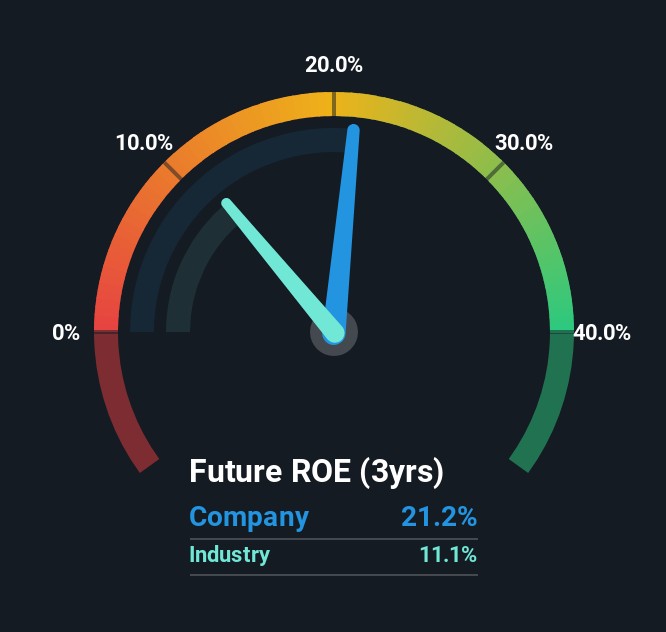
That's what we like to see. However, bear in mind that a high ROE doesn’t necessarily indicate efficient profit generation. A higher proportion of debt in a company's capital structure may also result in a high ROE, where the high debt levels could be a huge risk . Our risks dashboardshould have the 5 risks we have identified for GeoPark.
The Importance Of Debt To Return On Equity
Companies usually need to invest money to grow their profits. The cash for investment can come from prior year profits (retained earnings), issuing new shares, or borrowing. In the first two cases, the ROE will capture this use of capital to grow. In the latter case, the use of debt will improve the returns, but will not change the equity. Thus the use of debt can improve ROE, albeit along with extra risk in the case of stormy weather, metaphorically speaking.
GeoPark's Debt And Its 21% ROE
It appears that GeoPark makes extensive use of debt to improve its returns, because it has an alarmingly high debt to equity ratio of 3.08. Its ROE is pretty good, but given the impact of the debt, we're less than enthused, overall.
Summary
Return on equity is useful for comparing the quality of different businesses. In our books, the highest quality companies have high return on equity, despite low debt. All else being equal, a higher ROE is better.
But when a business is high quality, the market often bids it up to a price that reflects this. Profit growth rates, versus the expectations reflected in the price of the stock, are a particularly important to consider. So you might want to take a peek at this data-rich interactive graph of forecasts for the company.
But note: GeoPark may not be the best stock to buy. So take a peek at this free list of interesting companies with high ROE and low debt.
