


BREAKINGVIEWS-EU M&A rules morph from growth catalyst to weapon

Ursula von der Leyen is revamping EU merger regulations to promote growth-enhancing acquisitions while potentially complicating deals for U.S. companies. The European Commission's review may lower revenue thresholds for intervention and empower member states to challenge acquisitions. This shift aims to address concerns over "killer acquisitions" in tech, particularly in AI. Despite the push for growth, U.S. Big Tech firms may face increased scrutiny and hurdles in pursuing European targets.
(The author is a Reuters Breakingviews columnist. The opinions expressed are her own.)
By Jennifer Johnson
LONDON, Oct 3 (Reuters Breakingviews) - Ursula von der Leyen is overhauling the way Brussels thinks about mergers. The European Commission president decreed last month that a review of M&A rules overseen by her deputy, Teresa Ribera, required fast-tracking. A big part of this involves making the European Union more receptive to growth enhancing acquisitions – think telecom groups merging to offset meagre returns and enable greater capital investment. But another likely upshot is that big U.S. companies find it harder to do their deals of their own.
On the face of it, Brussels already has the powers it needs to robustly regulate the likes of Meta Platforms (META.O) and Google-owner Alphabet (GOOGL.O) , which source around a quarter of their revenues from Europe. The Digital Markets Act (DMA), which went live in 2024, had seemed a candidate for a watering down amid the wrangling over U.S. tariffs – but it’s still in place. Last month the European Commission hit Alphabet with a $3.5 billion fine for anticompetitive behaviour via a conventional antitrust case.
Even so, von der Leyen has a problem. Big Tech groups like Meta didn’t bulk up by doing horizontal combinations like Siemens-Alstom, which was famously blocked in 2019. Instead they often targeted smaller gems: when Meta bought Instagram in 2014, the EU didn’t even review the transaction because the photo-sharing platform’s revenue was below its revenue threshold for examination.
Worse, the EU’s efforts to constrain these “killer acquisitions” - an even bigger threat in the rapidly changing sphere of artificial intelligence - have thus far backfired. In 2021 it deployed Article 22 of its merger rules to prevent U.S. pharma group Illumina (ILMN.O) acquiring Grail (GRAL.O) , a group developing tests for cancer screening which had minimal revenue. But in September 2024 the European Court of Justice rejected Brussels’ approach. Still, if Meta’s Mark Zuckerberg and peers feel they can now hoover up what they like, they should think again. Ribera’s M&A review may slash revenue thresholds for intervening on deals. And egged on by Brussels, EU states that previously lacked “call-in” powers at a national level – allowing them to refer an otherwise unproblematic acquisition back to Brussels – are now adopting them. Last year Italy’s competition authority became the first to refer such a case, flagging Nvidia’s (NVDA.O) takeover of AI software developer Run:ai. The merger itself was ultimately waved through. But Nvidia’s separate challenge to Rome’s right to refer the case is currently pending – and if the EU wins it could mean many more challenges. The risk for foreign buyers is that member states use these call-in powers, along with tougher new strictures on inward foreign direct investment, and on bidders benefitting from foreign subsidies, to clip their M&A wings. Given Brussels’ imperative to drive growth and innovation, the pushback may only go so far. But U.S. Big Tech suitors eyeing European targets may soon find life appreciably tougher. Follow Jennifer Johnson on Bluesky and LinkedIn.
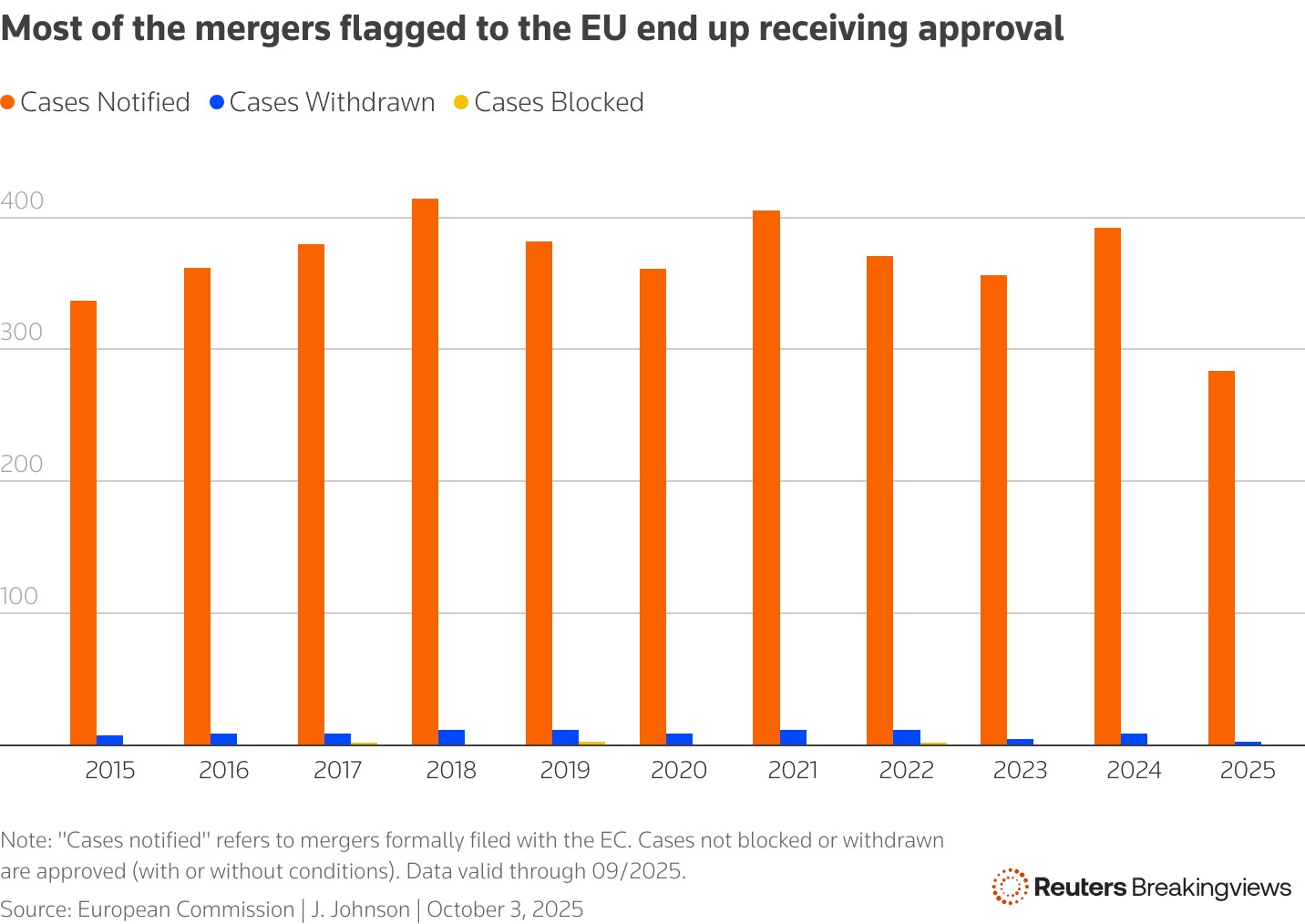
Most of the mergers flagged to the EU end up receiving approval
(Editing by George Hay; Production by Streisand Neto)
