


The "core contradiction" of the American economy: strong AI vs weak employment
U.S. consumer spending and AI capital expenditures performed strongly, with consumer spending growth approaching 3% in the third quarter, driven by significant wealth growth among high-income households. However, the labor market has noticeably slowed, with rising unemployment rates and stagnant labor income growth. Morgan Stanley warns that this "schizophrenic" data situation is posing significant challenges to asset pricing
The current U.S. economy is sending completely different signals, with strong consumer spending and AI investment contrasting sharply with a weak job market.
Morgan Stanley's chief economist Seth Carpenter pointed out in a recent report that the ultimate direction of these "contradictory signals" will determine the fate of asset prices, as the market stands at a critical crossroads.
On one hand, consumer spending data shows that the economy remains robust, with third-quarter consumer spending growth close to 3%; on the other hand, signals of weakness in the job market are continuously accumulating.
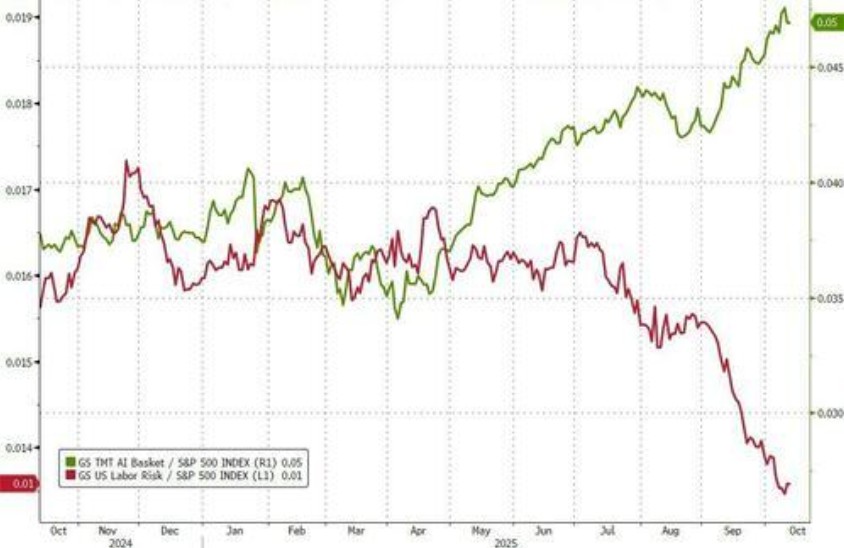
Goldman's latest research further confirms this contradiction. The bank noted that the two main themes in the U.S. stock market have remained largely unchanged: the ongoing development of artificial intelligence is driving the performance of the AI stock basket (GSTMTAIP), while persistent concerns about the labor market are reflected in the poor performance of the labor-sensitive basket (GSXULABR).
"Something always has to give," Carpenter said.
Consumer Spending and AI Investment Show Resilience
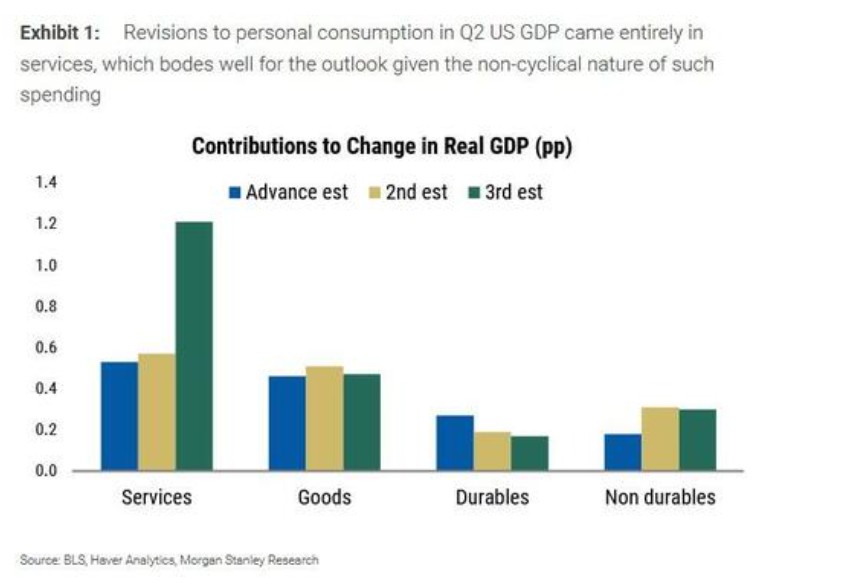
According to Morgan Stanley data, economic growth ultimately depends on spending, and the latest spending data shows that the economy is robust, even strong. Although the second-quarter GDP data is relatively outdated, it indicates a rebound in household service spending, with third-quarter consumer spending growth close to 3% based on existing data.
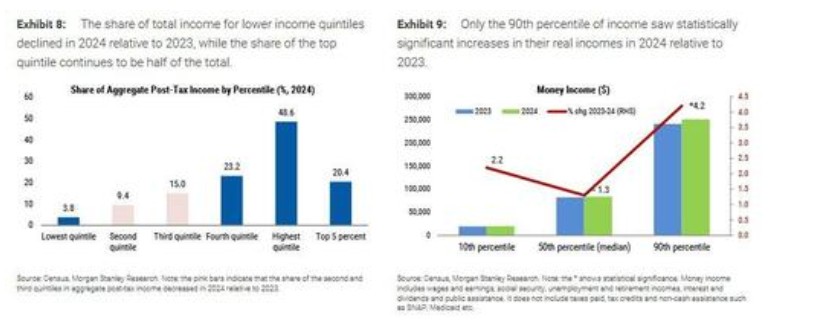
Carpenter pointed out that high-income and high-wealth households account for an disproportionately large share of total consumer spending, and wealth has recently surged significantly.
In addition to consumer spending, AI-related capital expenditures are also significant, as these investments are relatively insensitive to short-term cyclical fluctuations, being a multi-year investment theme.
Signs of Weakness in the Job Market
However, evidence pointing to an economic slowdown is equally compelling. According to Morgan Stanley's analysis, job creation has clearly slowed this year. Immigration restrictions have slowed labor growth, but the unemployment rate has risen with no wage pressure, indicating that the slowdown in labor demand is at least equally severe.
As a result, labor income growth has slowed, remaining flat or negative on an inflation-adjusted basis in the last quarter. Carpenter noted that most consumer spending is concentrated on automobiles, with electric vehicle tax credits driving purchases forward, along with preemptive buying due to tariffs. This increased spending should see a pullback in the coming months.
Regarding the impact of tariffs, experiences from 2018-19 indicate that tariffs had a significant negative impact on U.S. domestic manufacturing, lasting over a year, but the onset of this drag had about a two-quarter lag Morgan Stanley analyst Michael Gapen pointed out in a recent study that there is evidence suggesting that the tariffs imposed so far effectively amount to a tax on production.
Significant Divergence in Federal Reserve Policy Path
For the Federal Reserve, the policy paths are starkly different under two scenarios. With the unemployment rate close to its full employment estimate and inflation exceeding the target for more than four consecutive years, economic resilience or accelerated growth calls for restrictive policies, thus requiring little to no further rate cuts.
In contrast, if the economy slows significantly, the unemployment rate rises, and growth approaches stagnation, more rate cuts than currently priced in by the market will be necessary.
Carpenter summarized: “There must be trade-offs—if the economy is strong, the market's expectations for rate cuts are excessive; if the economy is weak, corporate earnings may not be as optimistic as expected. Sometimes, the best forecast is the average of various possible scenarios.”
