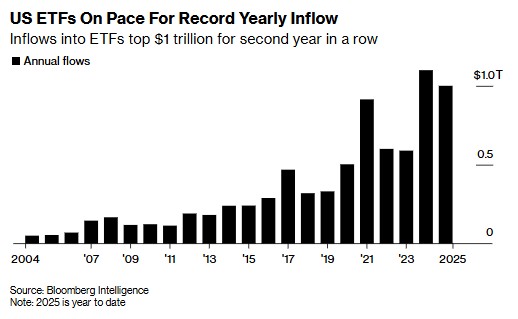
Over 1 trillion! U.S. ETFs are attracting capital at the "fastest rate in history."

As of September, the inflow of funds into U.S. ETFs has surpassed $1 trillion, setting a record for the fastest absorption rate in the industry. The monthly inflow is approximately 3.5 times the regular seasonal average, and analysts predict that the total inflow for the entire year of 2025 could reach $1.25 trillion. The growing preference for ETFs among investors is mainly due to their trading convenience and tax advantages, leading to a shift of funds from mutual funds to ETFs
According to Zhitong Finance APP, every market turmoil this year—from the tariff panic in April to the tech stock pullback in September—has triggered the same reflex on Wall Street: increasing ETF purchases. This collective impulse has now pushed the inflow of U.S. ETFs to surpass $1 trillion, setting a record for the fastest asset absorption rate in the industry's history.
Originally designed for stable and diversified investment, this financial instrument has now become the loudest declaration of confidence in the market and is seen as the "pulse" of the bull market in 2025. The speed of capital inflow has broken all records in the 30-year history of the industry, indicating that traders' optimistic attitude towards this tax-efficient investment tool has solidified into an instinctive response. The Vanguard S&P 500 Index tracking ETF alone has absorbed about $93 billion; funds related to Bitcoin, gold, and leveraged trading have also attracted billions of dollars in inflows.
The ETF structure, originally used for robust asset allocation, has now evolved into a real-time market sentiment "barometer"—both the engine of this self-reinforcing upward trend and its resonant echo.
Data compiled as of September shows that the inflow momentum for ETFs this year has been extremely strong, with monthly inflows approximately 3.5 times the conventional seasonal average. Analysts predict that the total ETF inflow for the entire year of 2025 could reach around $1.25 trillion.

"Whether it's Bitcoin, alternative assets, or the broader stock market, ETF capital flows always closely follow market trends," said Roxanna Islam, head of industry and sector research at ETF firm TMX VettaFi. "ETFs have also become the preferred tool for investors, creating excellent conditions for the expansion of assets in the ETF industry."
At the same time, investors continue to withdraw funds from mutual funds, favoring ETFs instead—primarily due to the advantages of ease of trading and tax efficiency.
Wave of Fund Issuance
Capital inflow is not the only indicator worth noting in the ETF industry: the annual issuance of new ETFs in 2025 is also expected to reach a historical high. Compiled data shows that more than 800 new ETFs have been launched by issuing institutions this year, surpassing last year's issuance record.
Statistics indicate that over 115 new ETFs were launched in September alone, setting a monthly issuance record. Institutions predict that if the issuance pace of 77 new ETFs per month is maintained in the fourth quarter, the ETF industry will achieve a breakthrough of adding 1,000 new ETFs in a single year for the first time.
Issuing institutions are leveraging various popular market trends to launch leveraged ETFs and income-oriented funds at an astonishing speed. Data shows that nearly one-third of the newly issued ETFs this year contain leveraged components.
Following two recent regulatory developments, analysts expect more ETFs to flood the market: the U.S. Securities and Exchange Commission (SEC) has indicated plans to allow Dimensional Fund Advisors—potentially covering other issuing institutions in the future—to launch ETFs as share classes of mutual funds; In addition, the SEC has approved a rule amendment that allows exchanges to provide a fast-track listing process for commodity ETFs (including ETFs related to specific cryptocurrencies).
The approval of the "multiple share class" rule is expected to add thousands of ETFs to the market and break down the barriers that previously excluded ETFs from the U.S. retirement system.
"The record expansion rate of the ETF industry highlights both the vitality of the sector and the intensity of competition," ETF analyst Eric Balchunas stated in a report. "As product saturation continues to rise, issuers will increasingly need to achieve differentiated competition through lower costs and more innovative strategies."