


Unexpected Joy Under Tariff Clouds: General Motors Q3 Performance Exceeds Expectations, Price Increases Pass on Costs, Full-Year Profit Guidance Raised

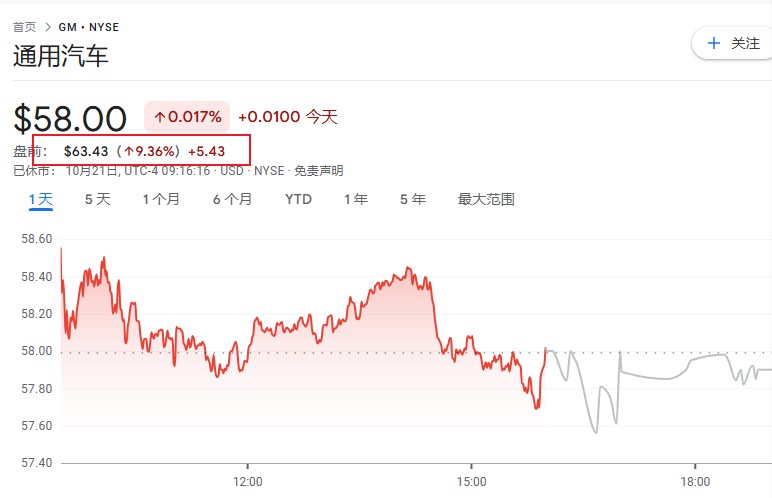
General Motors' adjusted EBITDA for Q3 was $3.4 billion, a year-on-year decrease of 18%, but higher than the analysts' average expectation of $2.7 billion. The impact of U.S. tariffs is expected to reach $4.5 billion, lower than the previous forecast of $5 billion. At the same time, the full-year profit expectation has been raised to $12 billion to $13 billion, higher than the previous expectation of $10 billion to $12.5 billion. After the earnings report was released, General Motors' U.S. stock rose over 9% in pre-market trading
General Motors has lowered its expectations for tariff impacts while raising its full-year profit guidance, planning to pass on cost pressures to consumers through price increases.
On Tuesday, General Motors released its third-quarter financial report, showing adjusted earnings before interest and taxes of $3.4 billion, a year-on-year decrease of 18%, but higher than the average analyst expectation of $2.7 billion, with revenue remaining flat at $49 billion.
In terms of performance guidance, the expected impact of U.S. tariffs is projected to reach $4.5 billion, down from a previous forecast of $5 billion, while the full-year adjusted operating profit expectation has been raised to between $12 billion and $13 billion, up from the previous expectation of $10 billion to $12.5 billion. The company stated that it will pass more costs onto consumers through price increases, with vehicle prices in North America expected to rise by up to 1% year-on-year.
Following the earnings report, General Motors' U.S. stock rose over 9% in pre-market trading.
Although Trump-era tariffs still pose a threat to General Motors, the company stated that the government’s announced relief measures for the automotive industry will alleviate some of the tariff burdens. General Motors has a significant manufacturing base in South Korea, Mexico, and Canada, with vehicles produced in these plants sold in the U.S. market.
This positive news partially offsets the $1.6 billion impairment warning issued by the company last week, which is related to the reduction of electric vehicle production capacity following the U.S. cancellation of electric vehicle purchase tax credits.
Tariff Impact Lower Than Expected, Price Increase Strategy to Address Cost Pressure
General Motors has reduced its tariff impact expectation from $5 billion to $4.5 billion, mainly due to the tariff relief measures provided by the Trump administration for the automotive industry.
Despite the company having a large manufacturing network in South Korea, Mexico, and Canada, where vehicles are produced for the U.S. market, it still faces trade risk exposure, but policy adjustments have provided some breathing room.
To address the remaining tariff pressures, General Motors has clearly stated that it will adopt a price increase strategy, raising vehicle prices in the North American market by up to 1% year-on-year. This move will help the company pass on cost pressures to consumers, supporting its revised full-year profit expectations.
The third-quarter financial report shows that General Motors' adjusted earnings before interest and taxes were $3.4 billion, a year-on-year decrease of 18%, but higher than the average analyst expectation of $2.7 billion, with revenue remaining flat at $49 billion.
Electric Vehicle Strategy Adjustment, Short-Term Sales Surge Cannot Hide Long-Term Concerns
Additionally, General Motors is reevaluating its electric vehicle production capacity and manufacturing layout.
CEO Mary Barra stated in a letter to investors that, given the expected slowdown in the adoption of electric vehicles, the company is adjusting its related strategy. She added, "By swiftly and decisively addressing the issue of overcapacity, we expect to reduce losses in the electric vehicle business in 2026 and beyond."
This strategic adjustment stems from the U.S. cancellation of electric vehicle purchase tax credits and proposals to relax automotive emissions regulations. Last week, General Motors warned that it would incur $1.6 billion in costs to reduce electric vehicle production capacity Despite this, the rush of consumers buying electric vehicles before the tax credit expires on September 30 has driven General Motors' electric vehicle sales to double, reaching a quarterly record of 66,501 units. However, several automakers, including Ford, expect electric vehicle sales to slow sharply as the tax credit expires
