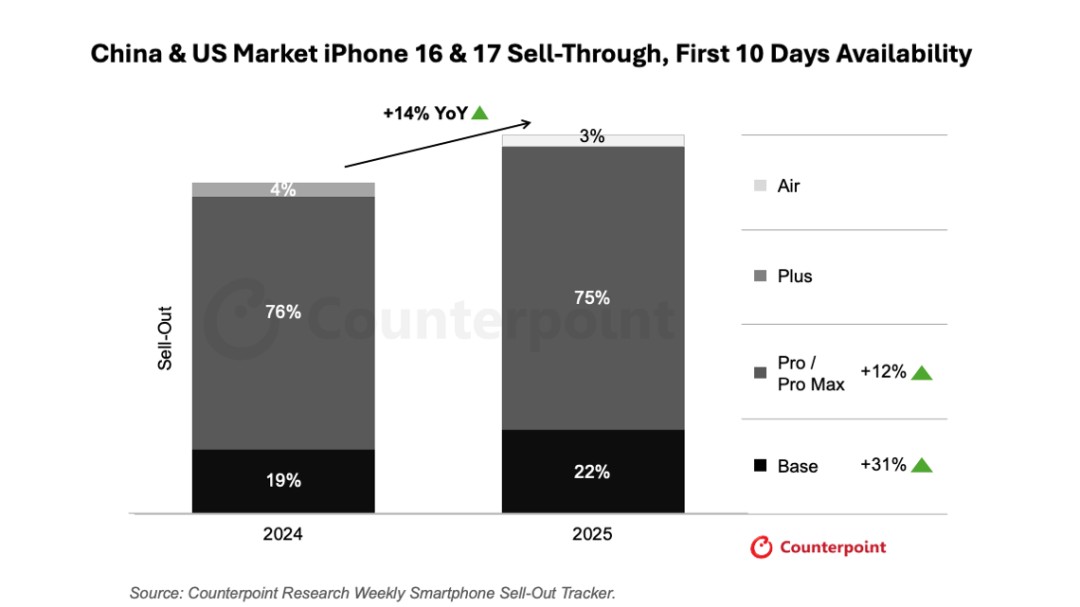
Counterpoint Research: The sales of the iPhone 17 in the first 10 days of its launch in China and the United States are 14% higher than that of the iPhone 16 series

Counterpoint Research's report shows that the sales of the iPhone 17 series in the first 10 days after its launch in China and the United States increased by 14% compared to the iPhone 16 series. China and the United States are the main markets for Apple's iPhone. The standard version of the iPhone 17 is highly sought after by consumers due to its cost-effectiveness, especially in China. In the U.S. market, the demand for the iPhone 17 Pro Max has also significantly increased due to carriers raising subsidies, reflecting a market shift towards ultra-high-end customers
According to the "Q3 2025 Weekly Smartphone Sales Tracking Report for China and the United States" released by Counterpoint Research, the sales of the iPhone 17 series in the first 10 days after its launch in China and the United States increased by 14% compared to the iPhone 16 series. China and the United States are Apple's two core markets for iPhone global sales, accounting for the vast majority of its overall shipments.

Data Source: Counterpoint Research Weekly Smartphone Sell-Out Tracking Report
Among the four iPhone models, this year's standard iPhone 17 performed well, especially in China, where consumers responded enthusiastically to its outstanding cost-performance ratio. Senior Analyst Mengmeng Zhang stated, "The standard iPhone 17 is very attractive to consumers and offers great value for money. With a stronger chip, better display, larger base storage, and upgraded front-facing camera—at the same price as last year's iPhone 16. Especially when considering channel discounts and coupons, purchasing this model is almost a no-brainer. In short, it offers extremely high cost-performance, and Chinese consumers are providing feedback to Apple through their actual purchases."
In the United States, as the three major carriers increased their maximum subsidies by 10% (i.e., $100), the market demand for the iPhone 17 Pro Max surged the most, reflecting a strategic shift in the U.S. market towards ultra-high-end customers. Senior Analyst Maurice Klaehne commented, "Carriers are trying to convert high device subsidies into higher monthly service revenue over 24 or 36-month installment contracts to maximize customer lifetime value. The focus on Pro Max discounts makes this ultra-high-end Apple model more accessible to consumers, reinforcing the trend towards premium products and further solidifying the stickiness between high-value users and the Apple ecosystem."
The eSIM-only iPhone Air performed slightly better than the iPhone 16 Plus; with the official announcement of pre-sales starting on October 17 in China, questions about its availability in the market have been resolved. Senior Analyst Ivan Lam stated, "This is not only an important milestone for Apple but also significant for the broader eSIM ecosystem. However, due to a shorter pre-sale period and higher pricing, while the standard iPhone 17 is more balanced in specifications and features, and offers better cost-performance, the iPhone Air is expected to maintain a relatively niche positioning in the early stages."