ROBOSENSE founder Qiu Chunxin: LiDAR is a fundamental necessity for autonomous driving safety

Zhitong
2025.10.28 03:10
portai
I'm PortAI, I can summarize articles.

RoboSense founder Qiu Chunxin stated at the Future China Global Forum in Singapore that LiDAR is a necessity for the safety of autonomous vehicles. He pointed out that multi-sensor systems are superior and safer than pure vision systems, and it is expected that manufacturers relying solely on vision will shift to LiDAR. According to a report by market research firm Yole Group, RoboSense will hold the largest global share in the passenger car LiDAR market in 2024. Qiu Chunxin emphasized that high-level autonomous driving cannot be achieved solely with vision systems

According to the Zhitong Finance APP, in September, at the Future China Global Forum held in Singapore, Business Insider interviewed Qiu Chunxin, the founder of the Chinese robotics technology company RoboSense (02498). A report released by the market research firm Yole Group in March showed that RoboSense, established in 2014, holds the largest global market share in the passenger car LiDAR system market in 2024.

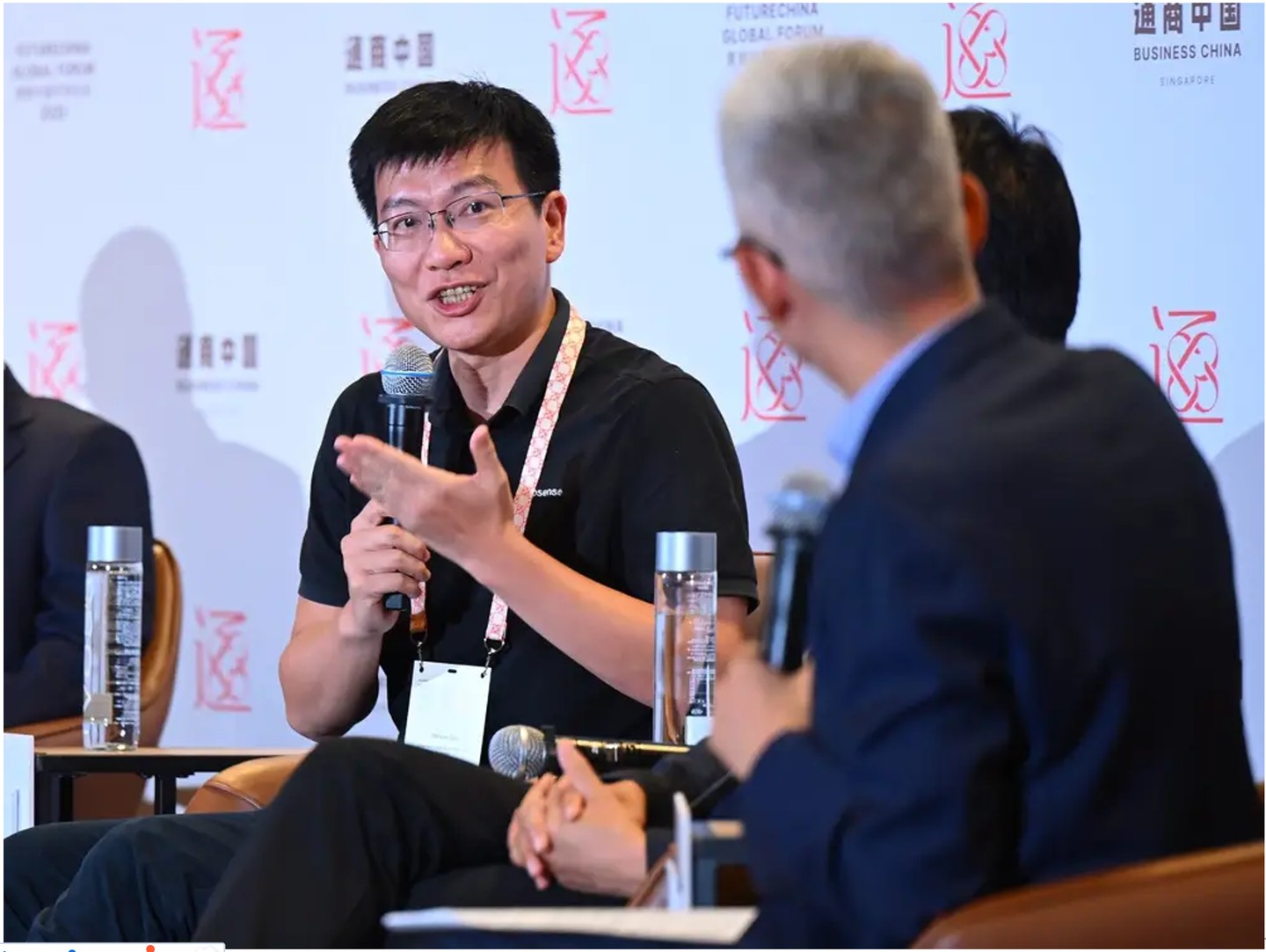
Qiu Chunxin (Steven Qiu) founded RoboSense in 2014. Singapore, Future China Global Forum

Qiu Chunxin stated that for autonomous vehicles, multi-sensor systems are superior and safer than pure vision systems. Manufacturers relying solely on vision will shift their approach.

LiDAR, which stands for Light Detection and Ranging, is a sensor that scans the surrounding environment by emitting laser beams and measuring the time it takes for the return signals. LiDAR can be found in consumer products such as Waymo's self-driving taxis, sweeping robots, and smartphone cameras.

"For about the past 10 years, there has been much debate about whether pure vision systems or multi-sensor systems are better for autonomous vehicles," Qiu Chunxin told Business Insider during a break at the Future China Global Forum in Singapore in September.

"But so far, it is clear that everyone understands that relying solely on vision is not safe enough. Vision-only systems cannot handle many extreme situations," he added.

Qiu Chunxin told Business Insider that with a vision-only system, vehicles cannot achieve Level 3 or Level 4 driving automation capabilities. He also stated that to achieve this goal, other sensors, including LiDAR, need to be integrated into the system.

The standards organization SAE International categorizes automation systems into levels one to five. Level one systems can only provide basic assistance, such as automatic braking and lane keeping, while level five systems can drive vehicles in all situations. Tesla's full self-driving software requires human supervision and is classified as a level two system.

"Imagine you are driving on the highway. If there is a white car stopped in front of you, it is difficult for a vision-only system to determine whether it is a car or a white cloud in the sky," Qiu Chunxin said.

"Similarly, if you are approaching a tunnel, the system may not be able to determine whether there is a black car driving ahead," he added.

Musk believes LiDAR is "both expensive and unnecessary," but faces opposition from global peers

Musk has long criticized LiDAR systems, with his most recent comments made in August. In April 2019, during Tesla's "Autonomy Day" event, Musk stated that automakers would eventually stop using LiDAR technology in autonomous vehicles "I have to point out that I actually don't sound as hateful towards LiDAR," Musk said, adding that SpaceX's Dragon spacecraft uses LiDAR for navigation and docking with the International Space Station.

"On cars, it's just downright stupid. It's both expensive and unnecessary," he continued, "Once you solve the visual perception problem, it's worthless. So you have expensive yet worthless hardware installed in your car."

Qiu Chunxin stated that the cost of LiDAR systems has significantly decreased over the past few years, from about $70,000 per vehicle to around a few hundred dollars. He also added that as costs continue to decline, the performance of LiDAR systems has improved.

Musk's views on LiDAR seem to be in the minority among automotive executives. Ford CEO Jim Farley stated at the Aspen Ideas Festival in June that his company believes LiDAR is "essential."

"For example, when the rear lights of a truck are reflecting or the sun is directly hitting the camera, causing the camera to fail completely, the LiDAR system can see clearly," Farley said.

Opposing Musk is RJ Scaringe, CEO of American electric vehicle startup Rivian, who stated in a recent interview that LiDAR is "absolutely beneficial." Rivian's sensor strategy is centered on building autonomous driving foundational models as quickly as possible. He explained that the early industry controversy over LiDAR stemmed from technological limitations—at that time, computational models struggled to effectively process input data from different sensors and cameras, leading to obstacles in multi-sensor collaboration. But now, technology has fundamentally changed, "We no longer use past models; modern AI-driven systems can benefit from more front-end information," which clears the technical barriers for LiDAR to integrate into multi-sensor systems.

Li Xiang, CEO of Chinese electric vehicle manufacturer Li Auto, stated at the company's "AI Dialogue" event last year that Musk's inability to see the value of LiDAR is due to the vastly different traffic conditions in China and the U.S.

He said, "If you drive in China at night, you often see trucks with broken tail lights, or even trucks with no tail lights just parked on the road." He also added that existing camera systems cannot identify these trucks from a distance.

He further stated, "I believe that if Musk were in China, driving on various highways late at night, he would also choose to be equipped with LiDAR."

In China, Miao Wei, former Minister of Industry and Information Technology, a member of the Standing Committee of the 14th National Committee of the Chinese People's Political Consultative Conference, and Vice Chairman of the Economic Committee, candidly mentioned at the "2025 World Intelligent Connected Vehicle Conference" that in terms of perception, hardware safety redundancy should be ensured. He noted that a few companies only use image perception, while most companies still adopt the "camera + millimeter-wave radar + LiDAR" approach. According to the principle of first principles, human vision can also be unclear in extremely bright or dim light, and adding radar can greatly enhance visibility