


"The October Rising Myth" Shattered! Bitcoin fell nearly 5% this month, marking the first October decline in six years

Bitcoin fell nearly 5% in October, ending its record of gains in October since 2018. Influenced by Trump's tariff threats, Bitcoin plummeted from its historical high of $126,000 to $104,000 in just a few days in mid-October, triggering the largest liquidation event in history. Analysts point out that under the impact of market uncertainty, investors have not returned to Bitcoin on a large scale, and asset volatility remains high
Bitcoin breaks the record of rising in October for seven consecutive years.
The world's largest cryptocurrency fell nearly 5% this month, ending the October rising myth that had persisted since 2018.
This month, the cryptocurrency market experienced the largest liquidation event in history. According to a previous article by Wall Street Insight, influenced by Trump's tariff threats, the cryptocurrency market plummeted, with Bitcoin crashing from its historical high of over $126,000 set on October 6, dropping to around $104,000 during the period from October 10 to 11.
Adam McCarthy, a senior research analyst at digital market data provider Kaiko, stated, When uncertainty truly hit the market for the first time this year, investors did not massively flow back into Bitcoin. This crash serves as a reminder that this asset class remains very narrow, with Bitcoin and Ethereum potentially experiencing a 10% pullback within 15 to 20 minutes.
Despite the decline this month, Bitcoin is still up over 16% year-to-date. The cryptocurrency market received a boost this year as Trump embraced digital assets, withdrew multiple lawsuits against well-known crypto platforms, and pushed financial regulators to establish specific rules for digital assets.
End of Seven-Year Rising Record
Bitcoin opened this month at $114,000, continuing the bullish sentiment from September's 5% increase. This optimism drove Bitcoin to first break through $126,000 on October 6, setting a new historical high.
However, the bullish momentum quickly cooled, and Bitcoin soon fell below $120,000. By mid-month, Bitcoin experienced a flash crash, with prices dropping to $104,000. By the end of October, Bitcoin consolidated around $110,000.
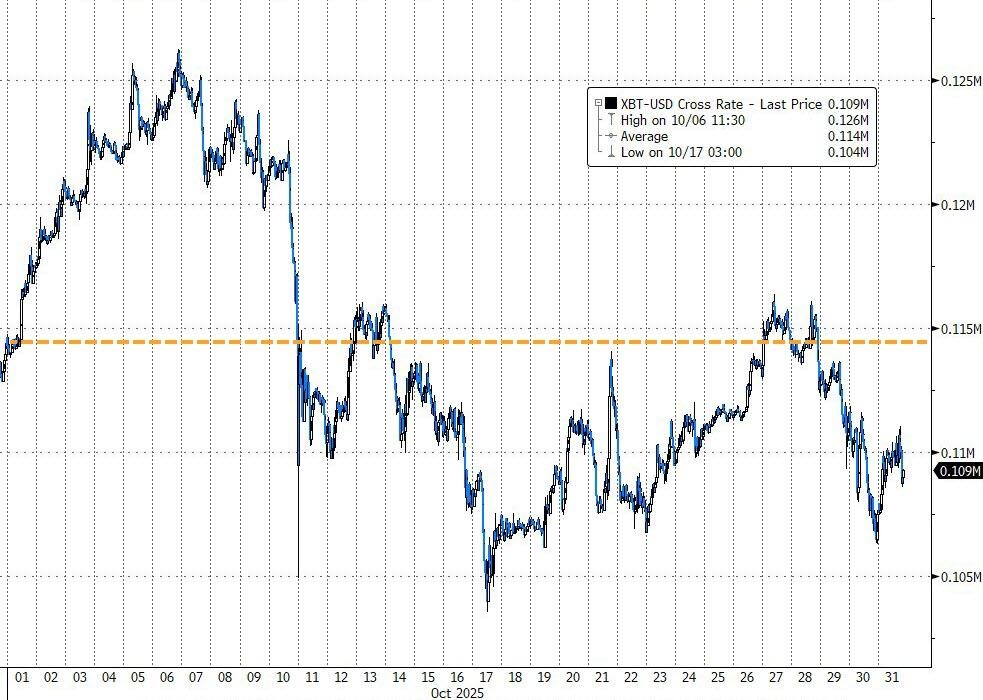
(October Bitcoin trend)
October holds a special place in Bitcoin's history. For the past seven years, Bitcoin has closed with a profit every October, a consecutive record unmatched in all months of its history, leading the cryptocurrency community to refer to October as "Uptober."
Notably, the last time Bitcoin closed down in October was in 2018, when it closed at $6,303, down about 4% from the $6,958 at the beginning of the month.
Largest Liquidation Event in History
October witnessed the largest liquidation event in cryptocurrency history. Influenced by Trump's tariff threats, Bitcoin plummeted over 20% from its historical high in just a few days.
Jake Ostrovskis, head of Wintermute's over-the-counter trading department, stated, Market participants remain hesitant, as they are digesting this unprecedented liquidation event. This cautious attitude persists amid ongoing speculation about specific vulnerabilities that may still exist in the system McCarthy pointed out that cryptocurrencies tracked gold and stocks closely to historical highs in early October, but when uncertainty truly hit investors for the first time this year, they did not return to Bitcoin on a large scale. This significant pullback serves as a reminder that this asset class remains very narrow, and even Bitcoin and Ethereum can experience a 10% pullback within 15 to 20 minutes.
Institutional Support Remains Strong
Despite this, the current market structure differs significantly from that of 2018.
After a decline in October 2018, Bitcoin faced its worst monthly drop in history in November, plummeting 36.4%. At that time, it was the peak of a prolonged bear market cycle, and the cryptocurrency market was struggling to recover from the surge in 2017.
Unlike in 2018, Bitcoin's current market structure is supported by several bullish fundamentals. Institutional interest through spot Bitcoin ETFs, outflows from exchanges, and on-chain data indicate that long-term holders are not selling off in large quantities.
Analysts point out that even if prices consolidate around $110,000, volatility is lower than during previous market peaks, suggesting a potential cooling phase before another breakout, with Bitcoin continuing to maintain its dominance and attract capital inflows.
Michael Saylor, co-founder of Strategy, still expects Bitcoin to reach $150,000 by the end of 2025, and this 12-month period could become the best 12 months in (Bitcoin) industry history
