


As peers fall into the "AI cash-burning competition," Apple has become a safe haven in the tech sector
When Wall Street questions the return on investment in AI by tech giants, Apple becomes a safe haven due to its low capital expenditures. In the second half of this year, its stock price rose by 31%, far exceeding the broader market and most tech giants. Strong cash flow and a solid balance sheet make it a defensive investment choice in the tech sector, but there are also voices questioning whether it is merely a "lagging stock" rather than a true hedging tool
When Wall Street began to question the astronomical investments of tech giants in artificial intelligence, Apple, which had previously been criticized for insufficient AI investment, suddenly became a safe haven in the eyes of investors. The iPhone manufacturer demonstrated unique defensive value amid the severe fluctuations in the tech sector, thanks to its low capital expenditure and ample cash.
On November 11, reports indicated that investors were scrutinizing the massive spending of companies like OpenAI, Meta, and Microsoft in the AI field, leading to significant volatility in some of the strongest tech stocks in years. Meanwhile, Apple's strategic positioning is being reassessed—it can provide AI capabilities to millions of users by accessing models from other companies without incurring the massive investments required to develop its own capabilities.
Last week, as tech stocks faced pressure due to concerns over AI spending, Apple showed notable resilience. While other tech stocks were deep in decline, Apple remained nearly flat over five trading days. In fact, since the second half of this year, Apple's stock price has risen by 31%, far exceeding the S&P 500 index, Nasdaq 100 index, and most of its tech giant competitors.
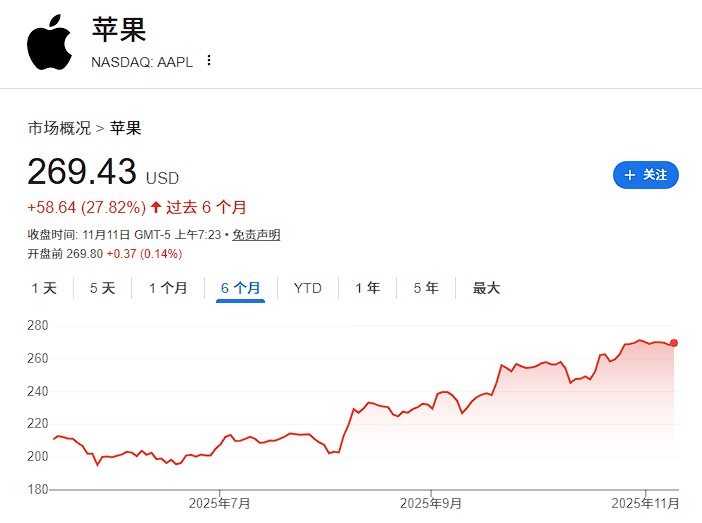
This divergence was particularly evident in the latest earnings season. Despite mixed results from Apple and an unexpected decline in revenue from the Chinese market, its stock price still rose nearly 3% the day after the earnings report was released. In contrast, members of the "seven giants" like Meta and Microsoft were sold off due to massive capital expenditures and disappointing revenue outlooks, with Meta's stock plummeting over 11% on October 30, marking the largest single-day drop in three years.
The Huge Gap in Capital Expenditure
Capital expenditure data clearly outlines the differences between Apple and its peers.
It is estimated that Apple's capital expenditure for the fiscal year ending September 2026 will be about $14 billion. In contrast, Microsoft's capital expenditure for the fiscal year ending in June is expected to exceed $94 billion, while Meta, which is only half the size of Apple, is projected to have capital expenditures exceeding $70 billion in 2025.
"The hedge logic is that it is still a tech company, but not an AI company," said Brian Mulberry, a client portfolio manager at Zacks Investment Management. "The market has a positive feeling about Apple, believing it does not have to answer the big questions that other companies face: What is your return on investment in all these areas?"
Brian Pollak, a portfolio manager at Evercore and head of the Investment Policy Committee, pointed out:
"Among the 'seven giants,' Apple has the lowest exposure and leverage in AI spending. It indeed has the potential to be a beneficiary of AI without having to invest all its capital like its peers."
Performance Divergence Highlights Defensive Attributes
This strategic difference is directly reflected in stock performance.
In the AI-driven enthusiasm of 2025, Apple was the worst performer among Bloomberg's "seven giants" index, rising only 7.6%, while Google's parent company Alphabet soared 53% and Nvidia rose 48% Even the performance of the S&P 500 Index and the Nasdaq 100 Index this year has easily surpassed Apple.
However, this "lag" has become an advantage. Pollak stated:
"It has such a strong balance sheet, such strong cash flow, and such a wide business moat. All of this makes it more defensive than those companies that are investing heavily in AI and are more reliant on AI."
Investor Disagreement, Hedge Value in Doubt
Although Apple's defensive attributes are recognized, investors remain divided on its role in an AI-dominated market. Supporters argue that Apple's strong balance sheet, robust cash flow, and business moat make it more defensive than companies that are heavily investing in AI.
However, there are also voices questioning Apple's hedge value. First New York portfolio manager Vikram Rai bluntly stated:
"I don't think Apple is a hedge tool; it's just a lagging stock. I don't believe it can provide the alpha returns you want in your portfolio."
Bank of America analyst Vivek Arya stated in a research report on November 10 that while the general skepticism about AI capital expenditures is understandable, it may be exaggerated, "the widespread skepticism may actually be a contrarian positive factor that helps reduce overcrowding."
As investors begin to worry about the level of AI investment and hope to see returns from these investments, Apple's relatively restrained strategy may demonstrate more value amid market volatility
