Massive "AI Bonds" Stir Global Markets

Technology companies are investing in artificial intelligence (AI) and flooding into the bond market. Since early September, companies such as Amazon, Alphabet, Meta, and Oracle have issued nearly $90 billion in investment-grade bonds, while lower-rated AI data center developers have issued over $7 billion in speculative-grade bonds. The surge in bond supply has led to a decline in the prices of newly issued bonds, with some issuers paying higher-than-expected interest rates. Market tension has spread to the stock market, with investors feeling anxious about the high valuations of AI concept stocks. Meta and Oracle bond yields are high, while Alphabet, Amazon, and Microsoft are less affected
To fund the massive investments in artificial intelligence (AI), technology companies are flooding into the bond market on an unprecedented scale.
According to The Wall Street Journal on November 23, so-called "AI hyperscalers," including Amazon, Alphabet, Meta, and Oracle, have issued nearly $90 billion in investment-grade bonds since early September this year.
Data from Dealogic shows that this amount exceeds the total issuance of these companies over the previous 40 months. Meanwhile, lower-rated AI data center developers have also issued more than $7 billion in speculative-grade bonds.
This surge in bond supply has caught investors off guard, with the direct consequence being a general decline in the prices of newly issued bonds, forcing some issuers to pay higher-than-expected interest rates to attract buyers. The market's tense sentiment has quickly spread, with signs of weakness in the bond market, coupled with concerns over the deterioration of credit metrics for related companies, transmitting to the stock market and exacerbating investors' anxiety over the high valuations of AI concept stocks.
"The current market is highly correlated," said John Lloyd, global multi-sector credit head at Janus Henderson Investors. "If AI stocks are sold off, the credit market will struggle to perform well, and vice versa." This negative feedback between the bond and stock markets is becoming a new risk point that investors must pay attention to.
Meta's corporate bond prices continue to decline, Oracle's bond yields remain high
In this wave of AI financing, not all companies face equal pressure. Alphabet, Amazon, and Microsoft, with their massive cash flows generated each quarter, can internally fund most of their AI expenditures, thus being relatively less affected by bond market fluctuations.
However, the situation for other companies is more nuanced. Although Meta is also a tech giant, its cash reserves are relatively weaker, and the market generally believes it needs more debt to support its grand AI vision. Reports indicate that when Meta issued $30 billion in bonds at the end of October, the yields offered were significantly higher than those of the company's existing bonds. After issuance, some bonds continued to decline in price in the secondary market, with yields rising further, causing the yields on its double-A rated bonds to be roughly equivalent to those of lower-rated IBM bonds.
Oracle's situation is even more challenging. The company is in a cash-consuming state and plans to continue investing tens of billions of dollars over the next few years to transform from a software giant to an AI cloud computing giant.
Currently, its rating is only two notches above speculative grade, and its bond yields are higher than almost all of its investment-grade tech peers. Jordan Chalfin, a senior analyst at research firm CreditSights, pointed out that Oracle may need to issue about $65 billion in bonds over the next three years, and maintaining its investment-grade rating is crucial for it, as the financing scale in the speculative-grade market is far from sufficient to support its needs
Warning Signals for Speculative Grade Bonds: Risks are Overflowing into the Stock Market
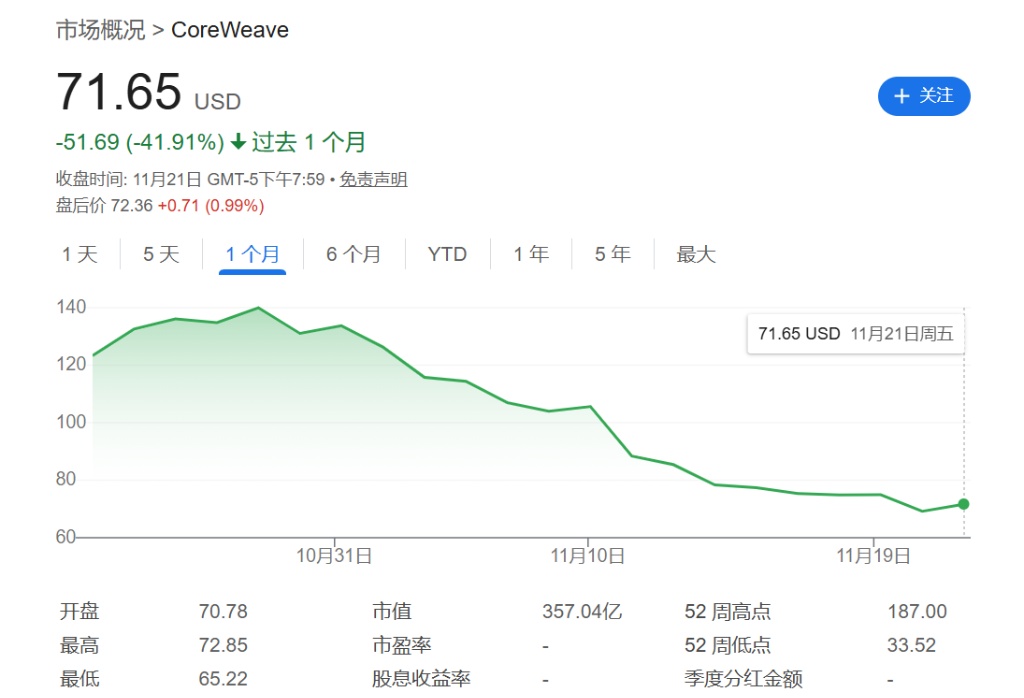
In the higher-risk speculative grade market, warning signals are more pronounced. As one of the few major AI cloud service providers with sub-investment grade bonds, CoreWeave's situation is quite representative.
Reports indicate that the bonds maturing in 2031 issued by the company in July have recently traded at 92 cents on the dollar, corresponding to a yield of about 11%, comparable to the average level of the lowest-rated CCC bonds.
Investors point out that CoreWeave faces capital demands similar to those of the giants but lacks the strong traditional business of the latter as a buffer. Recent news about delays in its data center construction has led to a 41% drop in its stock price this month. This indicates that the market's concerns about execution risks and financing capabilities for such companies are significantly intensifying.

Pressure in the bond market is affecting market sentiment through various channels. For instance, the recent increase in trading volume of Oracle's credit default swaps (CDS) has drawn widespread attention on Wall Street and is considered one of the factors leading to a 24% drop in its stock price this month.
Most investors believe that the bond market sell-off alone is not enough to slow down the AI development plans of large tech companies, as funding is not an issue for them. However, for speculative-grade tech companies, the rising cost of financing may ultimately impact their investment decisions. Will Smith, credit director at AllianceBernstein, stated, "Investors are generally demanding higher risk premiums, which means the growth curve may not be a straight line." He believes that the market will require financing only for those "wise projects" that are well-structured and have appropriate capital costs.
Wall Street expects that the bond issuance scale for such companies next year may range between $20 billion and $60 billion. If financing costs continue to rise, the final issuance volume may fall at the lower end of that range.
Risk Warning and Disclaimer
The market has risks, and investment should be cautious. This article does not constitute personal investment advice and does not take into account the specific investment goals, financial situation, or needs of individual users. Users should consider whether any opinions, views, or conclusions in this article are suitable for their specific circumstances. Investment based on this is at one's own risk