


JP Morgan significantly raised its target price for Baidu: the market severely underestimates the speed of AI transformation, and Kunlun chip sales may soar 6 times next year, driving cloud business growth of 61%
JP Morgan significantly raised the target price for Baidu to $188. Analysts believe that Baidu's investment narrative is undergoing a fundamental shift: the company is transforming from a traditional search advertising company to an AI infrastructure provider. It is expected that sales of Kunlun chips and demand for GPU computing will significantly boost revenue growth, with cloud business revenue projected to grow by 61% in 2026. However, JP Morgan is relatively cautious about the outlook for Baidu's advertising business, with analysts emphasizing that the catalysts for the upgrade will come from cloud/AI infrastructure growth rather than a rebound in traditional advertising business
JP Morgan upgraded Baidu's rating and target price. Analysts believe that the market has severely underestimated the speed and scale of Baidu's AI transformation. Thanks to the growth in sales of Kunlun chips, the company's cloud business revenue is expected to grow by 61% in 2026.
According to information from the Chasing Wind Trading Desk, JP Morgan stated in a report on November 23 that Baidu's investment narrative is undergoing a fundamental shift: the company is transforming from a traditional search advertising company into an AI infrastructure provider, with sales of Kunlun chips and demand for GPU computing expected to significantly boost revenue growth.
Kunlun Chip Sales Will See Significant Growth
JP Morgan expects that Baidu's Kunlun chip revenue will soar from approximately RMB 1.3 billion in 2025 to RMB 8.3 billion in 2026, an increase of 6 times.
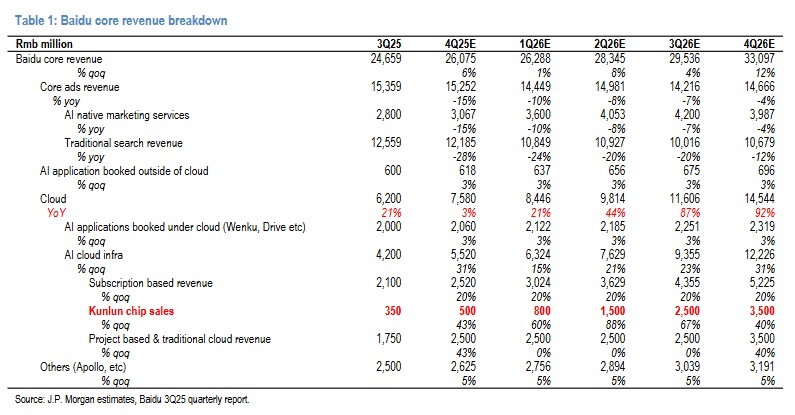
This forecast is based on the structural shift of leading Chinese cloud service providers accelerating the procurement of domestic AI accelerators: Starting in 2025, major hyperscale cloud service providers in China, including Baidu, Alibaba, Tencent, and ByteDance, will accelerate the procurement and deployment of domestic AI accelerators, shifting from pilot applications to large-scale multi-vendor procurement.
The Baidu Kunlun project has become a core validation case for scaled domestic demand. In April, Baidu disclosed a training cluster of 30,000 P800 chips, and more critically, the solution has gained external adoption from Bank of China and internet companies, confirming that Kunlun chips are not only feasible internally but also winning enterprise-level workloads.
GPU Computing Revenue Will Continue Triple-Digit Growth
JP Morgan expects Baidu's GPU computing revenue (based on subscription AI cloud infrastructure revenue) to double in 2026. Q3 GPU leasing subscription revenue grew by 128% year-on-year, further accelerating from about 50% growth in the previous quarter.
Analysts stated that starting in 2025, Baidu's cloud business has clearly shifted to an AI-first, GPU-intensive growth phase. AI cloud revenue grew by 26% year-on-year in Q4, accelerating to 42% in Q1, and maintaining strong growth of 27% and 21% in Q2 and Q3, respectively. During this period, AI cloud has grown to account for about a quarter of Baidu's core revenue, becoming a major growth engine.
In the Q1 large model bidding market, Baidu Intelligent Cloud ranked first with 19 projects won and a bid amount of approximately RMB 450 million, leading other major model suppliers. These contracts typically involve multi-year projects to deploy generative AI applications on Baidu AI Cloud, securing future revenue streams from GPU and accelerator usage.
Traditional Advertising Business Faces Structural Adjustment
Although AI marketing services are expanding rapidly, JP Morgan is relatively cautious about the outlook for Baidu's advertising business.
JP Morgan expects that revenue from AI-native marketing services will grow by 55% year-on-year in 2026, but traditional search advertising revenue continues to suffer from double-digit year-on-year declines Analysts indicate that traditional search and information flow advertising revenue declined by approximately 30% in Q3. AI-native marketing services achieved a 262% year-on-year revenue growth in Q3, accounting for 18% of Baidu's core advertising revenue, but these AI-native formats are eroding traditional search advertising revenue.
JP Morgan expects Baidu's core advertising revenue to decline by 7% year-on-year in 2026. The report emphasizes that the catalyst for the re-rating will come from growth in cloud/AI infrastructure rather than a rebound in traditional advertising business.
Asset impairment will significantly enhance profitability
JP Morgan believes that the asset impairment of RMB 16 billion in Q3 will have a direct and substantial positive impact on Baidu's core profitability in 2026-27.
Based on the assumption of a two-year remaining useful life for impaired hardware/CPUs, analysts expect annual depreciation expenses to decrease by approximately RMB 8 billion each year in 2026-27, correspondingly enhancing adjusted operating profit by RMB 8 billion.
This will increase the adjusted operating profit margin at the group level by 5 percentage points in 2026, and Baidu's core adjusted operating profit margin by 7 percentage points.
Analysts believe that the impairment is part of a strategic effort to align the company's asset base with its revenue-generating capabilities, specifically by disposing of traditional CPU equipment to focus on high-performance computing assets such as GPUs.
Given the more promising outlook for Baidu AI Cloud and its early monetization stage, JP Morgan has shifted its valuation approach from a blended price-to-earnings ratio at the group level to a sum-of-the-parts (SOTP) valuation. The report values the total advertising business at $12 billion or $37 per share based on a 5x 2026 price-to-earnings multiple.
The valuation for Baidu Cloud business is $34 billion or $100 per share, based on a 6x 2026 revenue multiple for the cloud business (excluding Kunlun chip sales) and a 15x 2026 revenue multiple for Kunlun chips. This valuation framework yields a December target price of $188 (70% upside potential).
