


Analysis of the Impact of Hang Seng and Stock Connect Adjustments in the Third Quarter
The Hang Seng Index will adjust in the third quarter to include INNOVENT BIO and other targets, while the Hong Kong Stock Connect will simultaneously add 4 individual stocks including CHERY AUTO, effective December 8. This adjustment is expected to bring a passive capital inflow equivalent to 5.7 days of trading volume for Leapmotor, while excluded targets like ASMPT will face capital outflow pressure. The weight of the healthcare sector in the Hang Seng Index will increase to 4.0%
Hang Seng series index adjustment: The Hang Seng Index includes INNOVENT BIO; the Hang Seng China Enterprises Index includes Yum China, INNOVENT BIO, and China Hongqiao, but excludes New Energy, New Oriental-S, and Haidilao; the Hang Seng Tech Index includes Leapmotor, but excludes ASMPT.
Capital flow estimation: Focus on the positive impact on INNOVENT BIO, Yum China, China Hongqiao, and Leapmotor; negative impact on ASMPT, New Energy, New Oriental-S, etc.
Adjustment of Hong Kong Stock Connect targets: We expect CHERY AUTO (9973.HK), FWD Group (1828.HK), AUX Group (2580.HK), and YINNUO PHARMACEUTICAL-B (2591.HK) to meet the inclusion criteria for Hong Kong Stock Connect.
Adjustment timetable: The results of the above index adjustments will officially take effect on December 8 (Monday), and passive funds will choose to adjust their positions on the trading day before the effective date (i.e., December 5) to minimize tracking errors.
Main text:
After the market close on November 21, 2025, the Hang Seng Index Company announced its regular quarterly index adjustment results (the review date for this adjustment was as of September 30, 2025, and is generally announced within 8 weeks after the review date). This adjustment covers major flagship indices of Hong Kong stocks such as the Hang Seng Index, the China Enterprises Index, and the Hang Seng Tech Index. In addition, there are partial adjustments to the Hang Seng Composite Index, which directly determines the investable range for Hong Kong Stock Connect. We provide a comprehensive analysis for investors' reference.
Hang Seng series index adjustment: The Hang Seng Index includes INNOVENT BIO; the Hang Seng China Enterprises Index includes Yum China, INNOVENT BIO, and China Hongqiao; the Hang Seng Tech Index includes Leapmotor
► Component stock changes: INNOVENT BIO is included in the Hang Seng Index; Yum China, INNOVENT BIO, and China Hongqiao are included in the Hang Seng China Enterprises Index, and Leapmotor is included in the Hang Seng Tech Index.
-
Hang Seng Index: This adjustment includes INNOVENT BIO with a weight of 0.91%; no component stocks were excluded, and the number of component stocks increased to 89.
-
Hang Seng China Enterprises Index: This adjustment includes INNOVENT BIO, Yum China, and China Hongqiao, with inclusion weights of 1.30%, 1.21%, and 0.91%, respectively; New Energy, New Oriental-S, and Haidilao were excluded, with weights before exclusion of 0.49%, 0.28%, and 0.24%, respectively. The number of component stocks remains unchanged at 50.
-
Hang Seng Tech Index: This adjustment includes Leapmotor with an inclusion weight of 0.98%; ASMPT was excluded, with a weight before exclusion of 0.66%. The number of component stocks remains unchanged at 30.
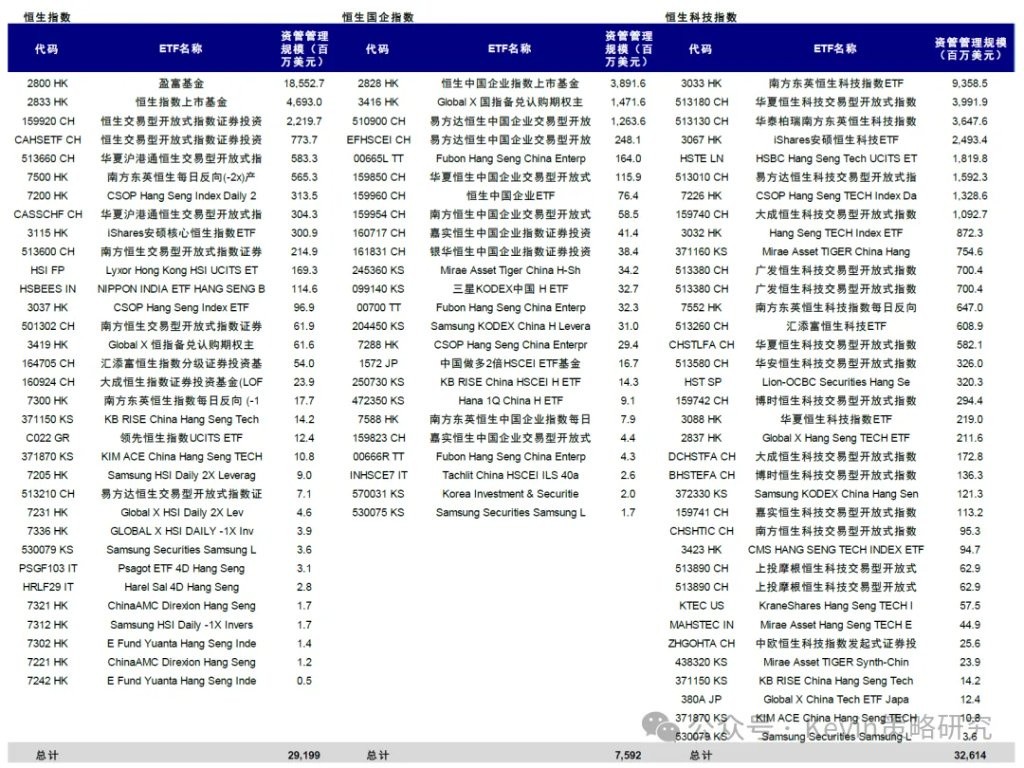
► Capital flow estimation: Focus on the positive impact on INNOVENT BIO, Yum China, China Hongqiao, and Leapmotor; negative impact on ASMPT, New Energy, New Oriental-S, etc. Based on Bloomberg's summary, the total assets under management for ETFs tracking the Hang Seng Index is approximately USD 29.2 billion, while the ETFs tracking the China Enterprises and Hang Seng Tech indices are approximately USD 7.59 billion and USD 32.61 billion, respectively. Combining the above component and weight changes, as well as the average daily trading volume of individual stocks over the past three months, we estimate the potential impact of changes in passive funds:
-
Hang Seng Index: The stock that requires the most time for passive fund inflow is INNOVENT BIO, which we expect will bring in approximately USD 266 million, with an estimated trading time of about 1.3 days In the context of capital outflows, due to changes in index weights, the potential passive capital outflows from HSBC Holdings and China Construction Bank may reach USD 155 million and USD 146 million, with outflow times of approximately 0.7 days and 0.6 days, respectively.
-
Hang Seng China Enterprises Index: The stocks that require the most time for passive capital inflows from this inclusion are Yum China, INNOVENT BIO, and China Hongqiao, which we expect to bring in USD 91.86 million, USD 98.70 million, and USD 69.09 million, with inflow times of approximately 3.0 days, 0.5 days, and 0.4 days, respectively. In terms of capital outflows, the existing weights of ENN Energy, New Oriental Education & Technology Group, and Haidilao at 0.49%, 0.28%, and 0.24% will bring about USD 37.20 million, USD 21.26 million, and USD 18.22 million in passive capital outflows, with outflow times of approximately 1.2 days, 0.7 days, and 0.4 days, respectively.
-
Hang Seng Tech Index: The stock that requires the most time for passive capital inflows from this inclusion is Leapmotor, which we expect to bring in USD 320 million, with an inflow time of approximately 5.7 days. In terms of capital outflows, ASMPT's existing weight of 0.66% will bring about USD 220 million in passive capital outflows, with an outflow time of approximately 7.2 days.
Adjustment of Hong Kong Stock Connect Targets: Expected 4 Stocks Meet Inclusion Criteria for Shanghai-Hong Kong Stock Connect
Since this is a quarterly index adjustment, only stocks that meet the rapid inclusion mechanism will be considered for the Hang Seng Composite Index, which adjusts semi-annually. Based on the current adjustment of the Hang Seng Composite Index and the additional requirements for inclusion in the Hong Kong Stock Connect, we expect that 4 stocks may meet the inclusion criteria. Meanwhile, Hesai Technology (2525.HK) and ZEEKR (2590.HK), which also enter the Hang Seng Composite Index, need to meet the additional conditions of being listed for at least 6 months and having 20 trading days due to their dual-class share structure, and therefore will not enter the Hong Kong Stock Connect in this December adjustment. If they subsequently meet the market capitalization and trading volume requirements, they will be included in the Hong Kong Stock Connect next year.
Post-Adjustment Index Characteristics: Increased Proportion of Healthcare and Industrial Sectors, but Decreased Proportion of Financial and Consumer Sectors
► Index Expansion: The number of constituent stocks in the Hang Seng Index has increased to 89. According to the consultation results released by the Hang Seng Index Company in March 2021[1], the number of constituent stocks in the Hang Seng Index is expected to increase to 80 by mid-2022, ultimately fixed at 100, and is currently still expanding towards this goal, but the overall progress is slower than expected.
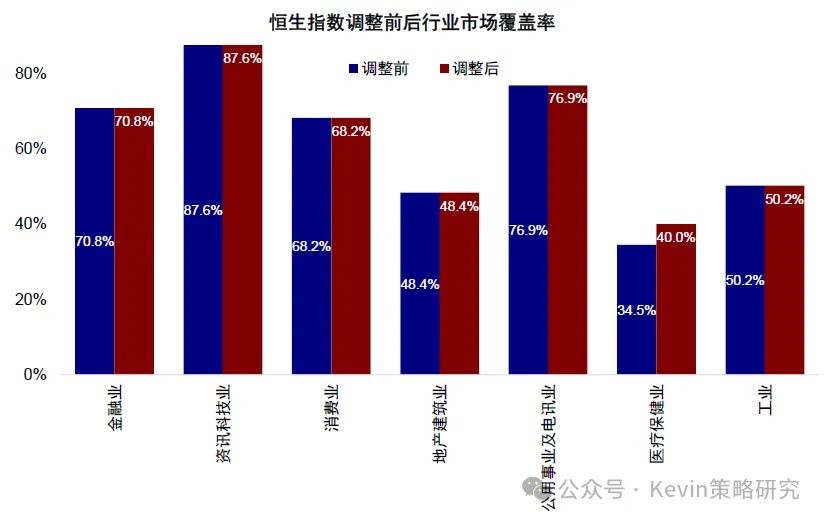
► Industry Coverage and Representation: The market coverage of the healthcare sector has improved. Referring to the industry classification by the Hang Seng Index Company (i.e., 7 industry classifications), the coverage of the healthcare sector has increased from 34.5% to 40.0% after this adjustment.
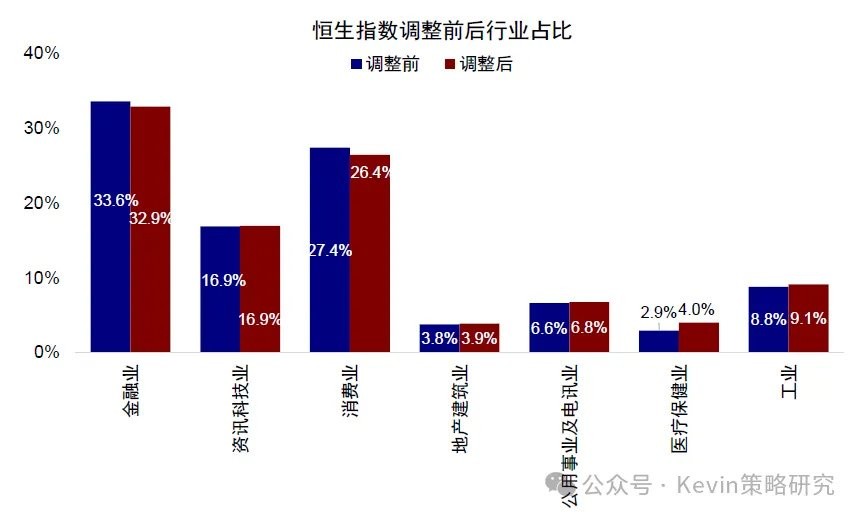
► Industry Proportions: The proportions of healthcare and industrial sectors have increased, while the proportions of financial and consumer sectors have decreased. After this adjustment, the market capitalization proportion of the new economy in the Hang Seng Index has slightly increased from the current 51.3% to 51.5%, remaining basically stable. At the industry level, the proportions of healthcare and industrial sectors have increased from the current 2.9% and 8.8% to 4.0% and 9.1%, respectively, while the proportions of the financial and consumer sectors have decreased from the current 33.6% and 27.4% to 32.9% and 26.4%
Adjustment Schedule: Effective December 8
The above index adjustment results will officially take effect on December 8 (Monday). During this period, some active funds may still engage in certain arbitrage operations based on the announced adjustment results, but passive funds will choose to adjust their positions on the trading day before the effective date (i.e., December 5) to minimize tracking errors. We expect that related stocks may experience significantly higher than usual "abnormal trading volume," especially towards the market close.
Chart 1: After this adjustment, the Hang Seng Index's coverage of the healthcare sector has increased.
Source: Wind, CICC Research Department
Chart 2: In terms of industry share, the proportions of healthcare and industrial sectors have increased, while finance and consumer sectors have declined.
Source: Wind, CICC Research Department
Chart 3: ETF fund sizes tracking the Hang Seng Index, Hang Seng China Enterprises Index, and Hang Seng Tech Index.
Note: Data as of November 21, 2025
Source: Bloomberg, Wind, CICC Research Department
Source: Kevin Strategy Research Institute
