"Federal Reserve News Agency": Allies "pave the way" for interest rate cuts next month, Powell will decide between "hawkish rate cuts" or "dovish pause"

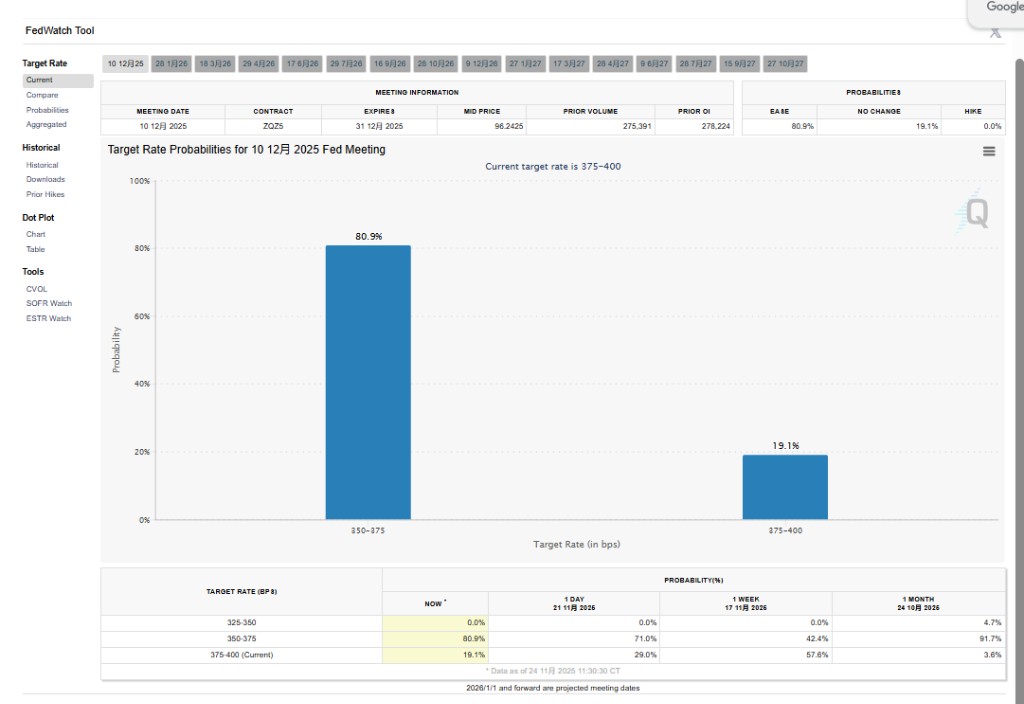
The "New Federal Reserve News Agency" pointed out that Powell's core allies, Williams and Daly, have publicly spoken out to pave the way for a rate cut in December, with market expectations for a rate cut soaring to 80%. However, there are serious divisions within the Federal Reserve, and Powell faces a difficult choice: on one hand, "hawkish rate cut," cutting rates in December but signaling a pause afterward; on the other hand, choosing "dovish pause," holding steady and waiting for data. However, Bank of America believes that forcing a "hawkish rate cut" may backfire, and "dovish pause" may be a better option
As the December interest rate meeting approaches, Federal Reserve Chairman Jerome Powell is facing one of the most challenging policy decisions of his tenure. Amid a series of conflicting economic signals, he must make a difficult trade-off between pushing for a rate cut that could trigger internal divisions and choosing to pause, which may prolong public disagreements.
The latest development is that several key allies of Powell on the Federal Open Market Committee (FOMC) have publicly opened the door to the possibility of another rate cut next month. According to Nick Timiraos, a reporter for the Wall Street Journal, often referred to as the "new Fed communications agency," New York Fed President John Williams and San Francisco Fed President Mary Daly have both expressed concerns about risks in the labor market, suggesting support for preemptive easing measures.
Williams stated last Friday that he still believes "there is room for further adjustments in the short term... to bring the policy stance closer to the neutral range." He emphasized that "it is equally important to avoid undue risks to the labor market" while restoring inflation to the 2% target. Timiraos analyzed that Williams' wording, especially the phrase "in the short term," has been interpreted by the market as a clear signal that supporting a rate cut is the path of least resistance.
Daly was more straightforward in an interview on Monday. She expressed support for a rate cut in December, as she believes that a sudden deterioration in the labor market poses a "greater and more difficult-to-manage risk" compared to a resurgence of inflation. Daly believes that if cost pressures rise, the Fed has the capacity to respond, but regarding the labor market, "if layoffs begin to increase slightly, they could increase significantly," making it difficult for the Fed to "stay ahead."
These statements had an immediate impact on the market. After Williams' remarks, the implied probability of a rate cut in December surged from 40% to around 70%. This indicates that after several weeks of hawkish officials dominating the narrative, investors have shifted their balance back toward a dovish stance and are beginning to price in the Fed's third rate cut of the year. Currently, the market's expectations for a rate cut have further risen to about 80%.

However, the road ahead is not smooth. There are significant divisions within the Fed, and Powell's ultimate choice will be a difficult balancing act.
"Hawkish Rate Cut" vs "Dovish Pause": Powell's Dilemma
Faced with a rare split within the Fed, Nick Timiraos analyzes that Powell is weighing two strategies, each with its pros and cons, to bridge the divide.
Timiraos points out that the first strategy is a "hawkish rate cut." This refers to implementing a rate cut in December to meet market expectations and guard against economic downturn risks, while simultaneously setting a higher threshold for future rate cuts through carefully worded post-meeting statements.
He wrote: "This approach is similar to Powell's strategy at the end of 2019, when three consecutive rate cuts also faced resistance from some colleagues." He analyzes that while this move may provoke opposition from those who do not support any rate cuts, it is expected to build a new consensus that "if recent conditions persist, further rate cuts will not be necessary." To end the "soap opera" of public disagreements among officials.
And another option is a "dovish pause." That is, to maintain interest rates in December and reassess in January next year. By then, the employment and inflation data interrupted by the government shutdown will be more complete. However, the cost of this approach is that it "may extend the current public discord by seven weeks and does not guarantee that new data will resolve the fundamental disagreements among officials regarding economic judgments."
Internal Disagreements Intensify: At an All-Time High During Powell's Tenure?
Timiraos pointed out in the article that the current level of disagreement within the Federal Reserve is unprecedented during Powell's nearly eight-year tenure. He believes the root cause lies in the economy presenting complex cross signals: employment growth is stagnating, while inflation remains stubbornly high at nearly 3%, which has led economists to sense a hint of "stagflation." Richmond Fed President Tom Barkin accurately described this dilemma in an interview last week: "It's hard for either side to declare victory."
The concerns of hawkish officials cannot be ignored. After the second rate cut in October, four voting Fed presidents have expressed concerns about further rate cuts. They believe that price pressures are spreading from tariff-affected goods to domestic services, indicating that the inflationary base is widening.
They worry that if inflation is not under control, the Fed's rapid move to lower rates towards neutral levels could undermine the necessary policy restrictions. Timiraos cited the change in attitude of Boston Fed President Susan Collins as a typical example; although she voted in favor of the October rate cut, she expressed "hesitation" about further cuts last Saturday, believing that the current "moderately restrictive" interest rate level may be necessary to control inflation.
Is a "Dovish Pause" Better than a "Hawkish Rate Cut"?
Wall Street Journal reported that Bank of America believes that recent dovish voices do not represent a consensus within the committee, and there is serious division within the Fed regarding the December decision.
Fed Governor Barr stated that caution is needed, Chicago Fed President Goolsbee focused on the risks of rising inflation, and Dallas Fed President Logan explicitly opposed a rate cut in December.
The bank believes that forcing a "hawkish rate cut" could backfire, and waiting for more employment and inflation data to emerge, a "dovish pause" in December may be a better option.
Powell's Leadership Facing Challenges
Timiraos noted that procedurally, any interest rate decision requires a simple majority of 7 votes from the 12 voting members to pass. However, since 1992, the Fed has never had a rate decision with more than three dissenting votes, highlighting the high value placed on internal consensus. Currently, the support for a December rate cut is already weak; at the September meeting, only a slim majority of the 19 participants believed that rate cuts in October and December were appropriate.
Former Dallas Fed President and current Goldman Sachs employee Robert Kaplan stated in an interview that officials opposing rate cuts have their reasons, as policy choices are asymmetric when rates are close to neutral. If the economy is weaker than expected, the Fed can cut rates at any time; However, if inflation is a greater concern, excessively low interest rates may not provide sufficient restraint.
Nevertheless, Kaplan also added that in cases of minor disagreements, officials typically tend to support the chairman's decisions to maintain unity. Timiraos summarized that this makes the December meeting not only a test of economic data but also the ultimate test of Powell's leadership and his ability to build consensus within a divided committee