


Weekend private letter "point by point" rebuttal to the "big short," posting on Tuesday to "prove" leading Google, is NVIDIA a bit anxious?
NVIDIA's defensive actions did not meet expectations, and some analysts believe these responses instead exposed its "lack of direction." As a giant at the peak of the industry, it should not need to respond to every question raised outside of earnings reports; truly confident leaders let their products and performance speak for themselves. NVIDIA's recent actions may have instead ignited existing concerns from the outside
NVIDIA is responding to the dual pressures of market competition and short-seller rhetoric with a series of rare public and private actions. However, these defensive measures have not alleviated investors' concerns; instead, they have exposed the giant's lack of confidence.
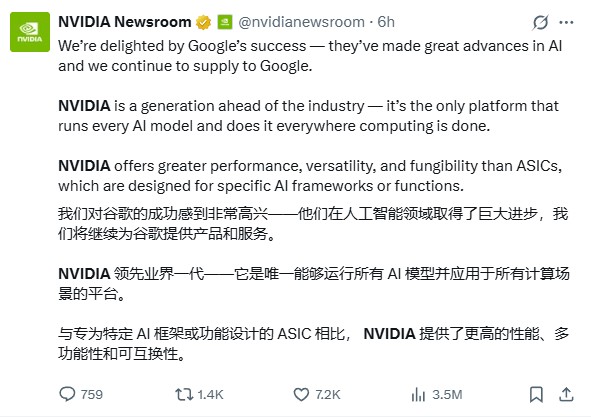
On Tuesday, Eastern Time, after its stock price plunged more than 7% during trading, NVIDIA unusually posted on the social media platform X, publicly declaring that its GPU technology is "a generation ahead of the industry," directly countering market worries about its dominance potentially being challenged by Google.
NVIDIA's stock ultimately closed down about 2.6% that day, marking a new closing low in over two months, while its competitor, Google's parent company Alphabet, saw its stock rise 1.6%, hitting a record high for the third consecutive trading day, with a market capitalization approaching $4 trillion.
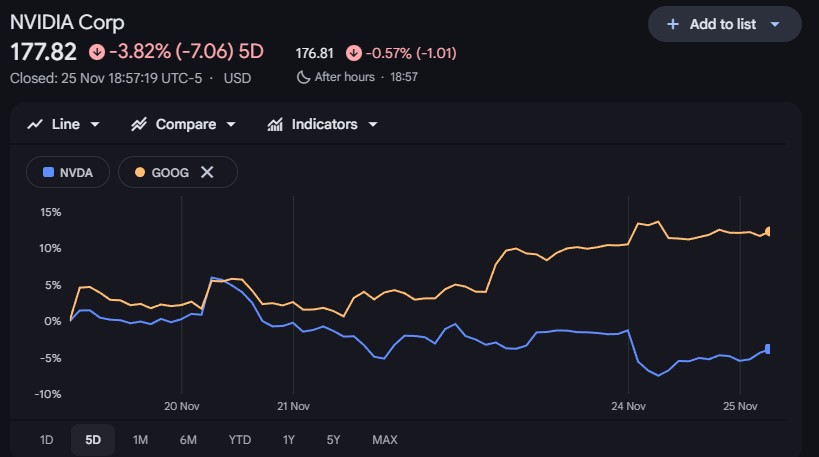
(Comparison of NVIDIA vs. Google stock performance over the past five days)
Prior to this, NVIDIA secretly distributed a seven-page memorandum to Wall Street analysts over the past weekend. According to reports from the Wall Street Journal and other media, the document aimed to "refute point by point" accusations of accounting fraud, circular financing, and AI bubbles raised by critics, including Michael Burry, the prototype character from the movie "The Big Short."
However, a series of urgent communications seem to have not achieved the desired effect. Some analysts pointed out that these actions have made NVIDIA appear "at a loss." A giant at the top of the industry should not need to respond to every market noise; its unusual reactions are interpreted as signals of inner turmoil.
Behind this perception of being "at a loss" is the immense pressure NVIDIA is facing. Wall Street Insight previously mentioned that CEO Jensen Huang admitted in an internal meeting last week that the company is caught in a "no-win situation": outstanding performance would be accused of fueling the AI bubble, while poor performance would be seen as evidence of the bubble bursting.
Tuesday's Public Statement: "We are a generation ahead of Google"
Wall Street Insight previously mentioned that NVIDIA's statement on social platform X on Tuesday is widely viewed as a direct response to a significant news report. Earlier, media reported that NVIDIA's key customer Meta is considering the large-scale adoption of Google's self-developed AI chips—Tensor Processing Units (TPUs)—in its data centers.
"We are pleased with Google's success," NVIDIA wrote in the post, "NVIDIA is currently a generation ahead of the industry—we are the only platform capable of running all AI models and is versatile across various computing scenarios." The company emphasized that its GPUs provide "higher performance, versatility, and interchangeability" compared to Google's TPUs and other application-specific integrated circuit (ASIC) chips
Google's TPU directly challenges NVIDIA's market share of over 90% in the AI chip market. The market is concerned that if large-scale customers like Meta start to turn to Google, it would indicate a crack in NVIDIA's seemingly impenetrable moat.
A Google spokesperson stated in a statement that the demand for both its custom TPUs and NVIDIA GPUs is accelerating and will continue to support both. This statement highlights the strategy of large tech companies seeking diversified suppliers for AI infrastructure, which is one of the trends that NVIDIA investors are most worried about.
Weekend Private Memo: Point-by-Point Rebuttal to the "Big Short"
Before publicly addressing competitive threats, NVIDIA has privately taken action to try to defuse another storm. Notable investor Michael Burry recently published a series of articles comparing the current AI craze to the internet bubble of the late 1990s, likening NVIDIA to Cisco, whose stock price plummeted after the bubble burst.
Burry's core arguments include that tech giants are artificially inflating profits by extending the depreciation period of AI chips, that there is a catastrophic "supply-side binge" in the industry, and questioning NVIDIA's alleged "circular financing."
According to reports from CNBC and The Wall Street Journal, NVIDIA detailed its rebuttals to these accusations in a memo distributed to analysts. The memo explicitly mentioned Michael Burry and clarified the core points of contention:
Accounting Treatment: NVIDIA emphasized in the document, "NVIDIA is not similar to historical accounting fraud cases because our underlying business is economically sound, and our reporting is complete and transparent." The company stated that it does not use special purpose entities (SPVs) for financing.
Equipment Depreciation: In response to Burry's claim that the actual lifespan of AI chips is only 2-3 years, NVIDIA replied that its customers typically set the depreciation period for GPUs at 4 to 6 years, which aligns with the actual usage lifespan and patterns of the equipment. The company pointed out that even older models like the A100, released in 2020, are still operating at high utilization rates.
Circular Financing: Regarding the widely circulated allegations of massive "circular financing," NVIDIA clarified that its strategic investments in the third quarter amounted to only $3.7 billion, a small portion of its revenue, and that the startups it invests in primarily raise funds from third parties, making the claims of circular financing baseless.
Market Reaction: Giants' Actions Criticized as "Caught in a Dilemma"
Despite NVIDIA's attempts to alleviate concerns through detailed explanations, its communication approach has raised new questions. D.A. Davidson analyst Gil Luria noted in his evaluation of the memo that this move could backfire.
"The memo itself makes NVIDIA appear very passive, while not publicly sharing it makes the situation look worse," Luria stated, "We agree with many of the answers they provided, but such a large company does not need to respond to every question raised during non-earnings periods." This viewpoint has been validated by the market. Analysts believe that a confident leader typically lets performance and products speak for themselves, rather than rushing to justify. NVIDIA's "hesitant" actions have precisely "touched upon existing fears," namely concerns about uncontrolled investment in the AI field, intensified competition, and the so-called "circular financing."
Dan Morgan, Senior Portfolio Manager at Synovus Trust, commented: "Google indeed has considerable strength; they are not just sidelined players." Google's most powerful AI model, Gemini 3, was entirely trained on its own TPUs, and the large-scale adoption of TPUs by top AI companies like Anthropic has enhanced its credibility as a viable alternative to NVIDIA's products.
Although NVIDIA CEO Jensen Huang insisted during the earnings call that he has not seen an "AI bubble," the company's series of unusual communication strategies, combined with the market's sensitive reaction to changes in the competitive landscape, seem to point to a conclusion: the throne of the AI king may not be as secure as previously imagined.
