


"AI New King" Google's market value approaches 4 trillion, Morgan Stanley predicts: by 2027 "exports" will reach 1 million TPU!
Morgan Stanley's report indicates that Google may sell 1 million TPU units, shifting its status from a cost center to a profit center, directly challenging NVIDIA's hardware monopoly. As giants like Meta plan large-scale purchases, market expectations for the monetization of its "AI models + self-developed chips" collaborative ecosystem continue to heat up, becoming the core driving force behind its market value approaching $4 trillion
Alphabet is challenging Nvidia's dominance in the artificial intelligence infrastructure sector through breakthroughs in its self-developed chips and AI models.
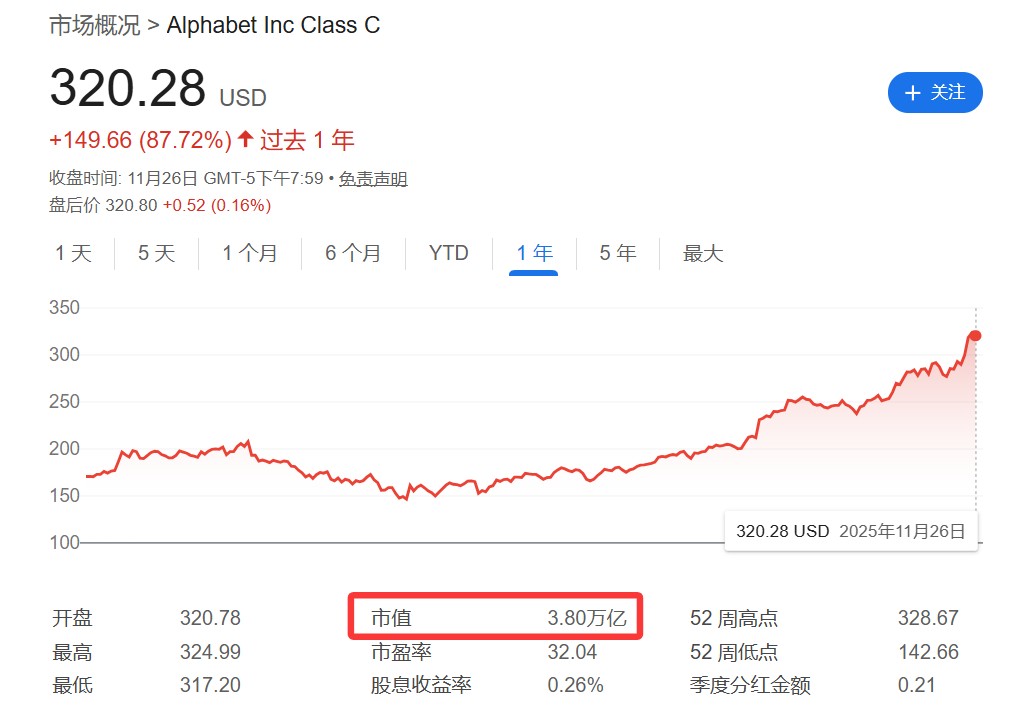
As market expectations for the external sales potential of its self-developed Tensor Processing Units (TPUs) heat up, combined with the successful launch of the Gemini 3 model, Alphabet's stock has recently performed strongly, with its market capitalization approaching the $4 trillion mark, likely reshaping the competitive landscape of the global AI chip market.
Morgan Stanley's Brian Nowak team pointed out in a recent report released on Wednesday that it is not unreasonable to predict that Alphabet will ship 500,000 to 1 million TPUs externally by 2027. This figure is highly significant, indicating that the chips designed by Alphabet will transition from merely meeting internal needs to becoming strategic assets that satisfy external market demand against the backdrop of a global computing power shortage.
According to media reports, Meta is discussing the purchase of Alphabet's dedicated AI chips worth billions of dollars. This potential bulk transaction has sparked widespread speculation in the market that Alphabet may use this opportunity to encroach on Nvidia's market share and significantly boost its earnings expectations. Driven by this report, investor expectations for Alphabet's stock have heated up, directly pushing its market capitalization closer to $4 trillion.
This potential change in revenue streams has a substantial impact on Alphabet's financial model. According to Morgan Stanley's estimates, for every 500,000 TPUs sold externally, Alphabet's cloud business revenue would see an 11% increase, and its earnings per share (EPS) would rise by 3%. The accelerated growth of the cloud business and expansion into the chip market are expected to allow Alphabet's stock to achieve a higher price-to-earnings ratio valuation multiple.
Morgan Stanley Bullish: TPU External Sales May Become a New Growth Engine
Wall Street's current focus is on Alphabet's potential in the AI chip sector. Morgan Stanley noted that although TPUs were initially designed by Alphabet for internal workloads, their success and the global demand for computing power have sparked strong interest from external customers.
Brian Nowak analyzed that Alphabet has invested significant resources in the development of TPUs, particularly by enhancing software capabilities to make them compatible with more systems. This improvement in compatibility is a key technical prerequisite for achieving large-scale external sales. If it can achieve shipments of up to 1 million units by 2027, it will mark Alphabet's formal emergence as a significant player in the AI hardware market.
Challenging Nvidia's Hegemony: Meta May Become a Key Buyer
Currently, the AI chip market is highly concentrated. Third-party industry data shows that Nvidia holds about 90% of the market share, helping it reach a market capitalization peak of $5 trillion less than a month ago. However, as technology giants like Alphabet begin to open up their custom chips to external sales, this monopoly may face loosening Media reports about Meta potentially adopting Alphabet chips are seen as a direct signal of reducing Nvidia's market share. Although Nvidia's stock price has recently corrected, its market capitalization has now fallen to $4.3 trillion, but the narrowing market cap gap with Alphabet indicates that investors are reassessing the relative positions of the two companies in the future AI ecosystem.
In the face of potential competitive threats, Nvidia maintains a confident stance. Nvidia's newsroom posted on social media platform X on Tuesday, stating, "We are pleased with Google's success," while emphasizing that Nvidia is "a generation ahead of the industry" and noting that its platform is the only one capable of running every AI model in any computing environment.
This statement highlights the current technological competition in the market: Nvidia emphasizes its versatility and technological lead, while Alphabet leverages its customized advantages in specific workloads and software ecosystem to break through.
Stock Performance: AI Momentum Drives Market Cap Near $4 Trillion
In addition to excitement in the chip sector, Alphabet's progress in AI model layers has also provided sustained momentum for its stock price. The Gemini 3 model released earlier this month is widely regarded as a significant success, making Alphabet's large language model a strong competitor to OpenAI's ChatGPT.
This is reflected in the secondary market, where Alphabet's stock price has risen 56% over the past three months, with a year-to-date increase of 71%, and despite a slight 1% drop on Wednesday, it remains in the historical high range. In contrast, Nvidia's stock price has fallen 2% over the past three months, although its full-year increase for 2025 still stands at 32%. This divergence in trends shows that market funds are leaning towards the "new AI king" that demonstrates stronger growth margins
