


AI not only "lacks electricity," but also "lacks water"!
Morgan Stanley's report reveals that the water consumption of AI data centers will exceed 100 billion liters by 2028, but the real risk lies in the fact that water resources cannot be allocated across regions like electricity. This threat of "localized drought" is forcing global tech giants to engage in technological self-rescue and elevating water treatment and recycling solutions to a strategic investment level
When all eyes on Wall Street are fixed on NVIDIA's GPU shipments and the gigawatt load of the power grid, a more insidious but equally deadly "gray rhino" is approaching: water.
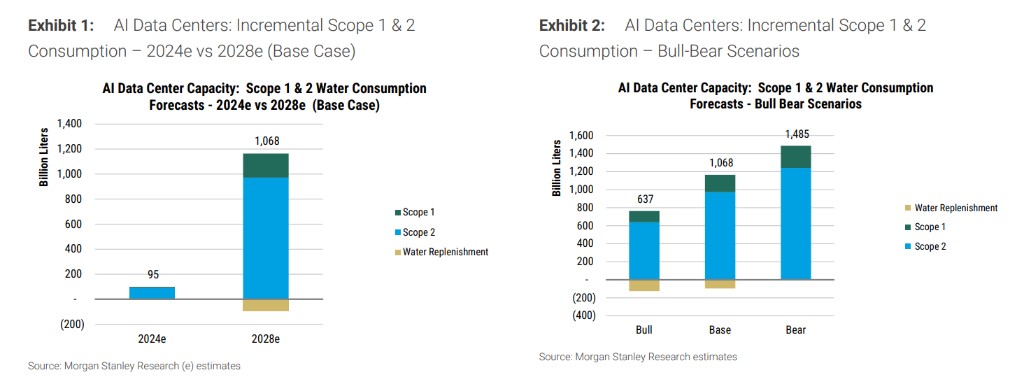
According to the Wind Trading Desk, on November 26, Morgan Stanley's latest research report pointed out that AI is not only a power consumer but also a super "water ghost."
Although energy bottlenecks have long been a common topic, investors are severely underestimating the destructive power of water resource constraints on AI expansion. Data centers are not just about computing power; they are also about how to cool these overheating semiconductors, and in this regard, the global water crisis is evolving into a local project killer.
A Bet of 100 Billion Liters: The Terrifying Increment Behind the Data
Data centers are entities that are extremely dependent on physical resources, and Morgan Stanley's model shows that the "thirst" of AI data centers is growing at an astonishing rate.
- Baseline Forecast: By 2028, the water consumption for direct cooling and power production of AI data centers will reach 10.68 billion liters.
- Bull Market Risk: If AI demand explodes as optimists expect, this number will further swell to 14.85 billion liters. Even in a pessimistic scenario, the consumption will still be 6.37 billion liters.
This means that to maintain the operation of large models, we need to consume an amount of water equivalent to the annual usage of several medium-sized cities.
The Real Bottleneck: It's Not Who Drinks the Most, It's Who Can't Get Water
There exists a huge expectation gap. In terms of total volume, power production consumes the most water (thermal and nuclear power plants require massive cooling water), which usually accounts for the largest share of AI's water footprint.
However, the real bottleneck is not here.
Investor research shows that on-site cooling and chip manufacturing are the fatal wounds. The reason is simple: water resource risks are highly localized.
Electricity can be transmitted across regions via high-voltage lines, but it is difficult to instantly transport water from the Colorado River to the deserts of Arizona. If there is no water locally, data centers cannot be built or are forced to shut down. This is no longer a theoretical deduction but a reality that is happening:
- Amazon's Defeat: In Tucson, Arizona, Amazon's "Project Blue" was directly rejected by local authorities due to its enormous water and power demands.
- UK's Blockade: Anglian Water publicly opposed the plan to build an AI data center in North Lincolnshire, citing that the area's water supply is already under severe strain.
As long as local municipal authorities say "no," even with an abundance of H100 chips, the project must be halted.
Technological Self-Rescue: From "Drinking Tap Water" to "Drinking Seawater"
In order to survive in this increasingly arid world, tech giants are being forced to undergo technological upgrades. Investors are beginning to focus on emerging technologies that can significantly reduce Water Use Efficiency (WUE):
- Microchannel Cold Plates: Directly reduce water consumption through higher thermal performance and less coolant flow.
- Free Natural Cooling Sources: Google's case in Finland is seen as a benchmark—utilizing seawater tunnels to extract cold seawater, cooling through heat exchange modules, thereby minimizing the consumption of drinking water.
The Iron Fist of Regulation
If you think this is just a decoration in ESG reports, you are gravely mistaken. Regulators are sharpening their knives.
Asia-Pacific: Singapore and Malaysia have drawn a red line, aiming to control the WUE of data centers at 2.0 m³/MWh or lower within ten years.
Europe: The EU is expected to propose mandatory minimum performance standards for water use in data centers by the end of 2026.
Who are the Beneficiaries?
In this "water scarcity panic," the direct beneficiaries are not those selling water, but those "managing water."
The market logic is clear: as hyperscale data center operators rush to achieve "positive water resource benefits" by 2030, the demand for desalination and water recycling solutions will experience structural growth.
This is not about who has the best algorithms, but about who can ensure your servers do not overheat while not having their water supply cut off by local residents. In the next phase of AI, companies like Ecolab, Toray Industries, Veolia, and DuPont, which possess core water treatment technologies, may prove to be more certain than some pure tech stocks
