


Nio strives to rush into a new world
Rebirth
Author | Chai Xuchen
Editor | Wang Xiaojun
"Is there a Plan B for profitability? No company has a Plan B, we go all out, accept any possibility, and continue to adjust and improve upon discovering shortcomings."
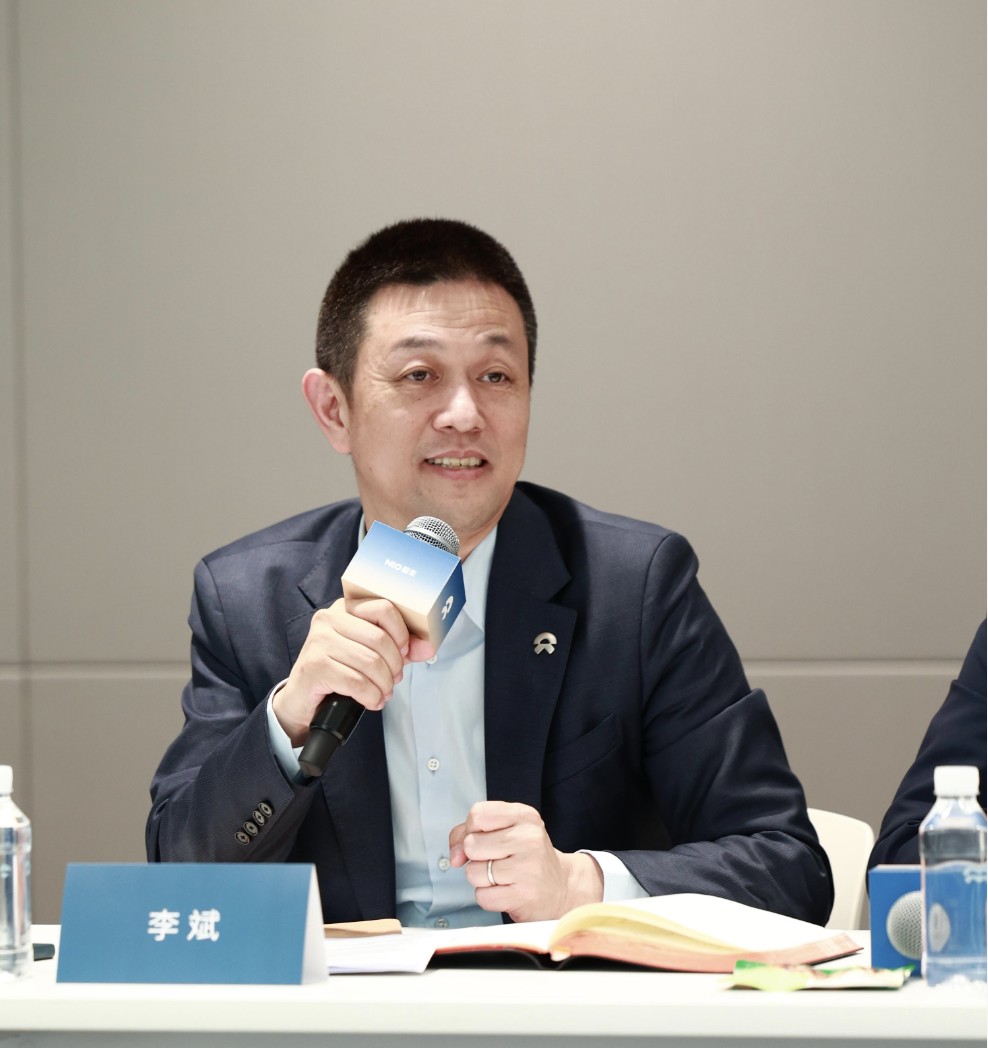
On November 26, at a communication meeting held the day after Nio's third-quarter earnings report was released, Nio founder, chairman, and CEO Li Bin candidly told Wall Street News when asked whether the profitability target for the fourth quarter was secure. This is not Li Bin going back on his word; rather, it reflects a regained confidence, no longer fearing fluctuations.
The market has already had ample expectations for Nio's third-quarter performance. With the rapid ramp-up of deliveries for the flagship L90, Nio's core vehicle sales revenue increased by 20% quarter-on-quarter to 19.2 billion yuan. Although the model structure has shifted downwards, leading to a decrease in the average selling price, it is encouraging that the gross margin has increased instead of decreased.
The financial report shows that Nio's vehicle gross margin rose by 4.4 percentage points quarter-on-quarter to 14.7%, significantly higher than the market expectation of 12.9%. The overall gross margin also rose nearly 4 percentage points to 13.9%, reaching a nearly three-year high.
Clearly, this quarter's performance indicates that Nio's cost reduction and efficiency enhancement strategy has achieved good results. In Li Bin's words, "We at Nio have entered the fast lane."
However, for the fourth quarter, Nio has provided a delivery guidance of 120,000 to 125,000 units, lower than the 150,000 units previously promised by Li Bin. The implied average monthly sales for November and December are 40,000 to 42,000 units, showing basically no increase compared to October; the revenue guidance for the fourth quarter is 32.7 billion to 34 billion yuan.
The market is skeptical about whether the expectation gap lies in the production capacity of the all-new ES8 and whether the subsequent momentum can be maintained.
Li Bin admitted to Wall Street News that ensuring production capacity is indeed a priority, but the ramp-up pace for the all-new ES8 is currently controllable. The biggest "black swan" is not supply, but a significant change on the demand side.
"In the industry, there are not many models like the all-new ES8 with existing orders left. We originally did not expect that the national replacement subsidies would basically shrink, and by mid-October, it would require a lottery or drawing. Everyone did not anticipate this in September or even before the National Day holiday in mid-October. By late October, there was still some hope of inertia, thinking there would be a tail effect in the fourth quarter, but by November, we had to face reality."
"Replacement subsidies are a lot of money; for the all-new ES8, it's 15,000 yuan, and how much can the purchase tax be refunded?" Li Bin said. Cars are not a necessity, and consumers are more cautious. Now the entire industry is seeing a significant decline in new orders, "From the terminal perspective (delivery?), November will definitely be very difficult, and it's hard to predict what December will be like."
Under the "black swan" event, the industry has fallen into a passive state again, and the momentum that Nio has finally ignited seems to be affected again. Li Bin also expects that the fourth quarter may not see the year-end sales peak as in previous years. However, he still expressed confidence in achieving quarterly breakeven in the fourth quarter, as Nio still has plenty of "surplus" on hand According to Nio's estimates, the annual delivery guidance for the ES8 is approximately 40,000 units, with most sales expected to be realized in the fourth quarter. Currently, the waiting period for the ES8 has reached 22-23 weeks, with deliveries scheduled for 2026. It is the "anchor" for Nio's performance in the next two quarters, not only with abundant orders but also a gross margin exceeding 20%.
The strong demand for high-margin products has dispelled concerns about Nio's "price-for-volume" strategy, which is the most reassuring point for Li Bin. "In the third phase, we no longer pursue simple volume growth, but rather high-quality organic growth, placing more emphasis on total gross profit."
Nio co-founder and president Qin Lihong revealed that the gross margin for the ES8 is currently 20%; the gross margin for the ET5/ET5T ranges between 15%-20%; the gross margin for the ES6/EC6 exceeds 20%, and can even reach 25%; the gross margin for the Lado L90 is approximately 15%-20%. This performance even exceeds the initial design expectations.
In other words, Nio has not burned profits to gain market share, but has found a balance between volume and profit. Li Bin stated that with the mass delivery of the new ES8 and the reduction in supply chain costs, the gross margin for vehicles is expected to rise to about 18% in the fourth quarter.
"If we look at the first-generation product cycle (2018-2021) with a 100% growth each year, the growth in the second-generation product cycle (2022-early 2025) has indeed not met expectations, but the third-generation product cycle, starting with the delivery of the L90 this year, has resumed rapid growth," Li Bin said, indicating that the company has entered a harvest period, and Nio's growth engine has regained momentum.
At the same time, the reforms initiated at the beginning of the year are beginning to show results, allowing Nio to operate with a lighter load.
The standalone channel of Lado has merged into the main Nio brand, forming shared channels; in terms of R&D expenses, Nio has completed the foundational R&D work for the NT3.0 platform, and subsequent R&D investments have returned to normal levels.
Thus, Nio has begun to reverse its predicament, with its market value once again surpassing the high point of 130 billion. Looking ahead to the fourth quarter, although the sales guidance is below expectations, the trend of reducing losses remains unchanged.
However, there are concerns about whether Nio can maintain its sales momentum next year amid market and policy fluctuations. Meanwhile, competitors are accelerating in the pure electric era. After finally returning to an upward trajectory, can Nio win another battle? At this moment, Li Bin is undaunted.
He told Wall Street News that today’s market indeed does not have a "one-trick pony," but returning to the basic rules of the industry, the marathon ultimately compares comprehensive capabilities, and there should be no weaknesses. "If we can be one or two points more efficient than others in every aspect, then ultimately you can be three to five points higher than others, and that is the difference between an excellent company and an ordinary company."
Li Bin stated that this is a systemic capability, a fundamental reflection on the essence of this business, "We have sorted out 15 systemic capabilities of the company, plus the CBU full-staff management system and internal mechanisms, if these two things are locked in, we may be able to achieve three to five points more than others."
He used the concept of a hundred million times thinking as an example, "If we are talking about trillions of RMB, that’s three to five hundred billion, so if we start cultivating such capabilities and this management method now, it should take one to two years to take shape and become Nio's own thing." Currently, Li Bin feels positive feedback in innovation, system sorting, and cost control, entering a state of "endless joy."
Li Bin said that this year's finals are just a beginning, and a relatively stable situation may not form until around 2035. "We are very fortunate to be in the finals now. Although we have experienced a low point in the past three years, we have also improved our capabilities. We hope to operate steadily in Nio's second decade and strive to achieve a leading position in this final."
Next, Nio will achieve its full-year profit target under non-GAAP accounting standards by 2026. Li Bin, a veteran entrepreneur with 30 years of experience, seems to finally be seeing the light at the end of the tunnel.
The following is a transcript of the conversation with Nio founder, chairman, and CEO Li Bin, and Nio co-founder and president Qin Lihong:
Q: What is the current situation regarding production capacity?
Li Bin: There are indeed many places that need to ensure supply. The all-new ES8 still mainly needs to maintain production capacity. This year, delivering one more vehicle means earning an additional 15,000. Next year, I will have to ensure subsidies. So in the fourth quarter, we are working very closely with the supply chain, and so far, it can be managed.
However, in my view, supply is always a short-term pressure; the real challenge is demand. In the industry, there are not many existing orders for the all-new ES8 and other models. Originally, we did not expect that the replacement subsidies would shrink nationwide. By mid-October, we would have to rely on lottery and drawing. That’s a lot of money; how much can the purchase tax be refunded?
I believe the industry fundamentally did not anticipate this. In September, even before the National Day holiday in mid-October, there was no expectation. In late October, there was still a lingering hope that there would be a tail effect in the fourth quarter, but by November, we had to face reality. Because cars are not a necessity, consumers are more cautious, and now the entire industry is seeing a significant decline in new orders.
Nio still has some existing orders, so it is doing relatively better. From the terminal perspective, November will definitely be very difficult, and it is hard to predict how December will turn out. Nio's current approach is to maintain price stability because there are still orders for the ES8 in hand in the fourth quarter, which keeps us ahead.
Q: The entire industry was not prepared for the disappearance of the Q4 tail effect. Which Nio models will be affected?
Li Bin: Besides the ES8, the ET9 and Firefly will also be affected. Many Firefly vehicles are new purchases or additional purchases, and there are not many replacements.
Q: Next year, many competitors plan to continuously launch new models to ensure their presence. How will Nio respond to next year's competition?
Li Bin: We will have three models next year. I don't think we need to keep launching new ones. Look at this year; we launched two models, which is quite good. It doesn't have to be so frequent. The team may not be able to handle it. Now we need to make it relatively even. In the past, we would release a generation of cars in a relatively short time, which may not be good. We should still start from the 6P and focus on building these six efficiencies, trying to make the fluctuations relatively stable.
Q: Many manufacturers plan to launch large battery extended-range vehicles next year. What impact will this have on Nio? Li Bin: There are three levels of competition for automotive products: the lowest level is the technical route, the middle level is product planning, and the highest level is product definition.
The technical route is like laying the foundation; the foundation cannot be moved randomly, and the underlying logic must be thought through very clearly. How the entire house is decorated is a matter of product definition. The second-generation ES8 has many explicit values that are insufficient, so we made the third generation; we need to listen to advice. We should learn what we need for product definition, use what we like, and do what is convenient.
When charging and swapping infrastructure is not well developed, a usage ratio of 10%-20% for range extenders is reasonable, but it also comes at a cost, whether in terms of cost, weight, or subsequent maintenance costs. If you can use it a dozen times a year, that's acceptable, but if you only use the fuel tank once or twice a year, carrying around 200 kilograms every day is quite costly. The space, like the front trunk, rear trunk, six wheels, and 12 boxes, makes it impossible to manage 10 boxes. Many high-frequency scenarios and high-value user experiences cannot be accommodated.
I can't say I'm not optimistic; in the end, the market decides. If they win, it's also normal. In the first three quarters of this year, the pure electric vehicle market for passenger cars above 300,000 saw a year-on-year growth rate of 33%, while range extenders saw a negative growth of 10%.
Question: This time, it was found that R&D investment has decreased by about 20%. Next year, several large vehicles are still set to be launched. How does Nio think about this?
Li Bin: It mainly depends on the efficiency of R&D output. We have certainly made adjustments to some R&D projects within resource boundaries, spending less money while maintaining overall competitiveness and achieving the same amount of work. The main benefit of the CBU mechanism is that it allows us to focus resources on high-return, high-priority projects. Therefore, R&D expenses have decreased compared to last year, but R&D output has basically remained stable. In fact, if we allocate expenses to projects with higher ROI, we can do even better in some areas.
When resources are limited, we will think about what is the most important thing, what has the highest priority, and what has the highest return on investment, which can enhance our capabilities. An investment of 2 billion in a quarter is still significant, and we can still maintain competitiveness.
In the past few years, a lot of foundational work, such as chips, operating systems, and 900-volt high voltage, required considerable funding. Once this foundation is laid, there is no need to keep laying it; the focus will be more on upgrading, maintaining, and iterating.
Question: What gives you the confidence to achieve profitability for the whole year by 2026?
Li Bin: After the replacement subsidy declines, how the market will change next year is difficult to predict. I believe the first quarter of next year will be quite challenging to forecast. Generally, the Spring Festival is a low point for car purchases, and the first quarter's volume is about 60% of the previous fourth quarter's three-month volume. However, we have a considerable number of orders on hand, so the situation should still be good.
One thing I am particularly pleased about is that this year the entire company has hardly discussed the issue of exchanging price for volume. The core operational goal for next year is still to achieve profitability for the whole year. Volume is important, but it is just a process; we are more focused on the quality of actual operations. The frontline also needs to look at operational reports to see how much money the company has made.
Question: Recently, the market no longer values companies like XPeng based on traditional manufacturing models like price-to-sales ratios. Do you feel that the capital market has underestimated any variables of Nio? If Q4 profitability is not achieved, is there a Plan B?
Li Bin: First of all, whether there is a Plan B for profitability, no company has a Plan B. We go all out and accept any possibilities.
Valuation must return to the essence of business. After experiencing these events in the past few years, the entire Nio team has increasingly reached a consensus, which is to honestly make products, sell cars, and improve operational efficiency, ultimately achieving profitability that exceeds the industry average.
The reason Toyota is good is that it has a 12% profit margin, 260 billion. Although there are challenges in China today, from a global perspective, it is still growing, and that is because they are doing well. We have no regrets about our investments over the years; we are very clear about where the money is spent. Some expenditures can be more efficient, but we have not laid the foundation haphazardly.
Question: Has Nio become more pragmatic and focused due to survival pressure or a genuine need for change?
Li Bin: I have been an entrepreneur for 30 years. Some people view Nio with a one- or two-year perspective, while I look at it over a longer term. That does not mean I am not a pragmatic person; there are some things I prefer to evaluate over three to five years. The conclusions drawn from assessing something with different time frames can be quite different, and the return on investment varies as well. This is why there is a cognitive dissonance among individuals.
The adjustments over the past two years have two main reasons: one is the realistic pressure of operations, and the other is the reflection of the entire team, which is related to this improvement. I tend to be optimistic, but sometimes I wonder if there is a hidden danger; when I am pessimistic, I become even more proactive.
Question: How does the internal team evaluate the role of celebrities in promoting car sales?
Li Bin: Since the beginning of the year, we have had a battery swap cooperation with Tengger. LeDao L90 invited Sha Yi, Hu Ke, Guo Tao, Xiao Shenyang, and Louis Koo to collaborate, hoping to leverage social media through these celebrity partnerships. LeDao is still a brand new brand, and one of the main challenges is insufficient recognition. In fact, the collaboration has been quite effective.
Question: Before the L90 was released, there were indeed many negative voices about Nio in the market. How did we communicate with the supply chain to ensure delivery?
Li Bin: On one hand, the team, including myself, sometimes has to treat the bosses of our partners to dinner to explain our long-term competitiveness. Some people indeed do not believe it and end amicably, but many partners have great faith in us. Most are probably in a middle state, waiting to see. It is important to keep them informed of the situation; in the end, everyone has their own judgment, as it is definitely easier than in 2019.
In fact, over the years, we have been promoting a transparent supply chain. Now the entire industry association also hopes to promote this model, where everyone discusses matters openly.
For example, when we hope to set cost targets, we need to set their cost and profit targets with supply chain partners. We have a supply chain partner, CBU, helping them calculate their operating statements in cooperation with Nio. It is reasonable for them to make some money, but there should not be excessive profits—just reasonable profits. We work together to eliminate unnecessary investments and collaborations that do not create user value, as well as unnecessary logistics and packaging costs to reduce waste Question: What are the major themes or differentiated points that can be pursued in the competitive direction of vehicles?
Li Bin: It's very difficult to say that a simple trick can work today; it's becoming increasingly challenging. Being a year ahead is already impressive. For example, our fully active suspension system is at most a year and a half ahead. Nio's innovations in this industry have paved the way for many others. Once the supply chain matures, others might have lower R&D costs than us, so the advantages of being a latecomer are still significant. Therefore, it is increasingly difficult today.
However, if we return to the basic laws of this industry, it is a long-term marathon, and in the end, it still comes down to comprehensive capabilities. There should be no weaknesses. If you can be one or two points more efficient than others in every aspect, then ultimately, you can be three to five points ahead of others. This is the difference between an excellent company and an ordinary one.
Why do we emphasize building a solid foundation and making steady progress? It respects this principle. It's easy to say, but the entire company's culture, management system, information system, and internal workflows are not so easy to implement.
For example, we proposed the concept of "million-fold thinking" in the company. A component might cost ten or five yuan, but now we require it to be multiplied by one million, which means five million. If we gradually form an atmosphere, the company's competitiveness will be different. At the Guangzhou Auto Show, it was mentioned that if you come earlier, you can save thirty thousand yuan in overtime fees for the venue. We are slowly starting to achieve this.
This is a systemic capability. Systemic capability is a fundamental reflection on the essence of this business. We have sorted out 15 systemic capabilities within the company, along with the CBU management system and internal mechanisms. If these two aspects are locked down, we might be able to outperform others by three to five points.
What does this mean? If it's one hundred billion, that's three to five billion. If we consider it in terms of one trillion yuan, that's three to five hundred billion. So, if we start cultivating such capabilities now, the entire company will become very competitive. I believe this management method will take one to two years to solidify, and it will belong to Nio.
If we look at it from a five to ten-year perspective, being three to five points better than peers is sufficient.
Question: Is there a possibility for Nio's non-automotive business to scale up?
Li Bin: In fact, we have always been open in this regard. Our charging stations are the most typical example; 85% of the users are from other brands. We welcome everyone to use our chips and operating systems.
Of course, in terms of revenue generation, our chips represent a complete capability from front-end to back-end, with a team of six hundred people who can develop vehicle-end chips according to market needs, and can also develop specialized chips for the field of embodied intelligent robots. The capabilities of chips are universal. The earliest Yang Jian chip, which is used in laser radar, saved a lot of money, and we have some external revenue from this.
There are many similar examples, such as helping others improve battery cell designs, promoting testing services, and maintaining several competitors' charging station systems. In the second and third quarters of this year, some external revenue came from these technical services. If we can do it while doing our own work, why not? It's about monetizing capabilities The non-automotive business essentially operates on the basis of ownership volume. In many aspects, people can still imagine using the cloud services of technology companies, especially for energy-related businesses. Cloud devices initially serve internal needs, and after reaching a certain scale, they begin to open up to external clients. After a relatively long period, they can transform into highly profitable businesses, whether it's Tencent Cloud, Alibaba Cloud, Google Cloud, or Microsoft Cloud; they all follow this pattern.
Therefore, when looking at many of the things Nio is doing, you need to consider the time dimension. Our strategy of long-life batteries combined with charging and battery swapping, especially the battery swapping network, may not seem fully formed today. However, if you place it in the context of a vehicle ownership volume of 10 million, 30 million, or 50 million, the conclusions would be completely different. This is essentially the underlying logic of the non-automotive business.
Q: What has been your biggest personal growth this year?
Li Bin: Personally, I have definitely become more pragmatic. There has been progress in the details of management, but the most important thing for a manager is to understand what to persist in and what to change. This is the most challenging task; you can't just react to every wind and change, but you also can't be overly stubborn or blindly confident.
Q: There are some concerns now; will Nio lose its original warmth in the process of constant calculations?
Li Bin: I don't think these two things are contradictory. Singapore Airlines is one of the best airlines in the world and is also very warm, but it is also one of the most meticulously managed companies. In the past, we sometimes thought that good service and community warmth were important, but not calculating costs is irresponsible. Now, the value of the brand can actually be calculated clearly.
Qin Lihong: Our company has actually gone through three iterations since 2015. The value committee will develop tools for internal promotion. Even the management of values can be quantified and toolized for continuous iteration, so where is the limitation in operational behavior?
Additionally, the opening of the battery swapping route on National Highway 318, with six battery swapping stations invested in by the branding department, is aimed at making people feel that even such poetry and distant places can be reached. Therefore, there is no need to worry about the battery swapping network; this is worth investing in, equivalent to the construction of the energy team. The Chengdu company will operate this process. Otherwise, if our energy team says you finance people talk to me every day about reducing losses, then it becomes meaningless.
Li Bin: If they invest money, they will promote it themselves; if they don't promote it, they will lose money. This is a systematic job.
Q: Competitors are now working on AI hardware. Does Nio have any thoughts or plans in this area?
Li Bin: We have intelligent attributes, and it is understandable to explore some extensions based on that. However, we believe there is still a large growth space for automobiles; our market share is only about 1-2%.
Of course, robots definitely have a future, but that doesn't mean we should start working on them today. Nio is actually looking for companies willing to use our chips; the capabilities of large models on the edge are definitely strong. I also believe that battery swapping for robots is a big business So, we will observe that Nio has made many explorations in the last cycle, such as in the field of nuclear fusion, which has attracted a lot of attention from investors recently. During an internal meeting yesterday, it was mentioned that everyone shouldn't worry about Nio lacking the imagination to innovate; the main concern is that there might be too many ideas for innovation, so it's better to focus on doing solid work
