The impact of Yongmei is hard to replicate, and the bond market is unlikely to recreate the end-of-2020 market conditions

DFZQ believes that this time, due to the relatively small degree of risk diffusion, the pressure from the funding side and the negative feedback in the bond market is not significant. Most importantly, this incident is unlikely to change the market's expectations for the macro environment, and it will not prompt investors to reassess the economic trend and monetary policy direction as in the case of Yongmei, nor will it accelerate the entry of institutions such as banks and insurance into the bond market
Last week, Vanke's extension became the market focus, with some investors comparing it to the Yongmei default event in 2020, raising concerns about a repeat of significant adjustments in the bond market.
In its latest research report, Dongfang Securities conducted an in-depth comparative analysis and concluded that there are essential differences between the current situation and the end of 2020. The extent of Vanke's extension's impact on market fundamentals is limited, making it difficult to trigger systemic risk transmission.
Dongfang Securities believes that this credit event will not significantly change the main trading line of the bond market, and the probability of accelerated entry by banks, insurance, and other allocation accounts is low. The bond market in December may continue to show a weak oscillating pattern.
The Essence of Yongmei's Impact
The market tends to linearly extrapolate, equating Vanke's extension with the Yongmei default in November 2020, but such concerns seem unfounded.
Dongfang Securities stated that the destructive power of the Yongmei event stemmed from the emotional shock following the sudden collapse of "state-owned enterprise faith," along with the subsequent negative feedback from wealth management redemptions. In contrast, the weakening of fundamentals is already a market consensus and is insufficient to trigger systemic redemptions.
Dongfang Securities noted in the report:
The significant impact of the Yongmei default on November 10, 2020, was primarily due to its breaking of the market's "faith" in AAA-rated provincial state-owned enterprises. As the largest coal enterprise in Henan Province, Yongmei had undertaken operations such as divesting loss-making segments and increasing capital before the default, which exceeded market expectations.
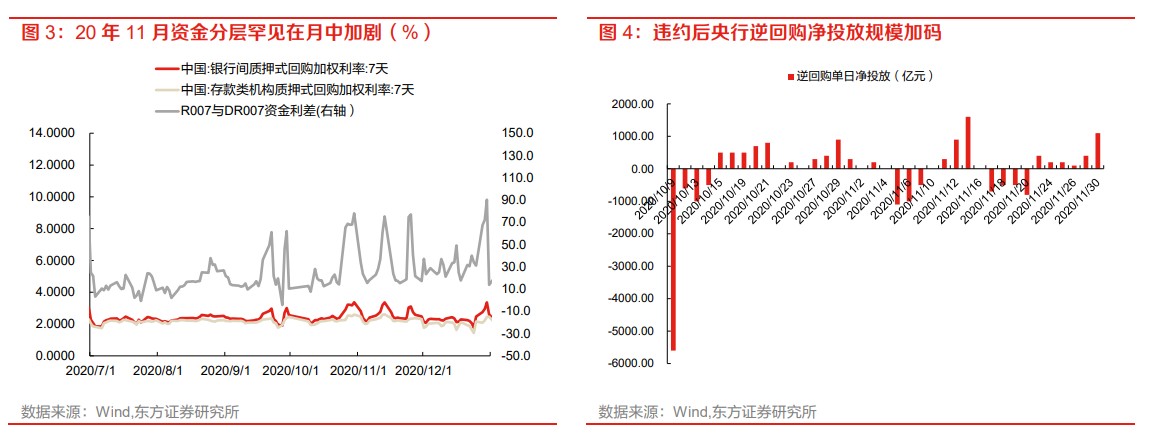
The chain reaction in the credit bond market spread rapidly. In the week of the default, the yields on 1-year AAA and AA+ rated medium-term notes rose by 14.4 and 17.4 basis points, respectively; the highest increase for the entire month of November reached 28 and 54 basis points. The anxiety quickly transmitted from credit bonds to interest rate bonds and the money market, creating shocks: first, fund products faced redemption pressure, forcing them to sell liquid interest rate bonds, forming a negative feedback loop of "selling - net value decline - intensified redemptions." Second, the money market experienced a rare mid-month layering intensification.
It is noteworthy that the central bank responded relatively quickly to the market fluctuations triggered by the Yongmei event, and the calming speed was also rapid. In the week of the default, the central bank began to increase liquidity injections, with net reverse repos turning positive from November 11 to 13, totaling a net injection of 280 billion yuan, and a net injection of 600 billion yuan in MLF on November 16. Funding rates quickly fell from high levels, with DR007 and R007 returning to pre-default levels by November 17. The negative feedback in the bond market gradually calmed down after the Financial Committee's stabilization directive on November 21.

However, the significant decline in the bond market at the end of 2020 was fundamentally due to the Yongmei event changing market expectations regarding the macro environment. This event occurred against the backdrop of a continuously improving economy in the second half of 2020, with market expectations that the central bank would continue to tighten. The exposure of credit risk shattered this expectation, prompting the market to reassess the sustainability of economic recovery and the direction of monetary policy, which was the fundamental reason for the substantial decline in bond yields.
The 2020 Market Trend is Difficult to Replicate
Compared to the current situation, the Vanke extension event is unlikely to produce similar systemic effects. The report emphasizes that the central bank reacted quickly to risk events that year, while this time, due to the limited extent of risk diffusion, "the negative feedback pressure on the funding and bond markets is not significant, so there is no need for the central bank to increase liquidity or make regulatory statements to stabilize and calm the market."
Specifically, Dongfang Securities believes that, first, the trend of weakening fundamentals in the real estate sector has become a consensus in the market. Although the timing of the extension exceeded some investors' expectations, it did not break a certain "belief," and the resulting panic is significantly lower than that of Yongmei. Even if credit spreads widen in the short term, the extent is relatively limited, and the probability of spreading to interest rates and the funding market, causing redemption pressure, is weak.
Secondly, due to the limited extent of credit risk diffusion, the negative feedback pressure on the funding and bond markets is not significant, and there is no need for the central bank to make large-scale liquidity injections or regulatory statements to stabilize the market. The adjustment in the bond market last week was mainly due to instability on the liability side of fixed-income products and ongoing market concerns about new fund regulations, rather than the Vanke event itself. In the latter half of the week, as interest rates adjusted to high levels, long-term bonds led the marginal recovery of cash bonds, with the 10-year government bond and the active bonds of the National Development Bank changing by 1.7 and 2.5 basis points to 1.83% and 1.90%, respectively.
Most importantly, this event is unlikely to change the market's expectations for the macro environment. It will not prompt investors to reassess economic trends and monetary policy directions like Yongmei did, nor will it accelerate the entry of institutions such as banks and insurance companies into the bond market.
December Bond Market: Funding Pressure is Controllable
Looking ahead to December, funding pressure is expected to be controllable. This week, the issuance scale of interest rate bonds fell to 456.7 billion yuan, which is at a moderate level for the same period, and the supply pressure of government bonds is manageable. Moreover, fiscal spending tends to increase at the end of the year, and the funding market may experience seasonal fluctuations, with overall pressure being relatively weak. Last week, the central bank net injected 55.8 billion yuan through open market operations, with funding rates showing differentiated changes. DR007 fluctuated in the range of 1.45%-1.47%, and the end-of-month cross-month was generally stable.
However, Dongfang Securities pointed out that overall trading opportunities in the bond market remain limited. The market's expectation of an upward shift in the long-term interest rate center may have already suppressed market sentiment for the year. Last week, interest rate bonds of all maturities rose, with the 7-year government bond rate rising the most, by 3.8 basis points.
In summary, investors should not simply apply the experiences of the end of 2020, expecting credit risk events to bring significant trading opportunities in the bond market. The current market environment, the nature of the events, and macro expectations are fundamentally different from those at that time, making it more rational to view the trading value of the December bond market with caution