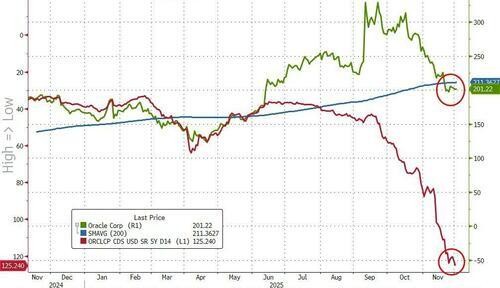
Concerns about AI bubble intensify, Oracle's debt panic indicator hits a new high since 2009

Wallstreetcn
2025.12.03 01:42
portai
I'm PortAI, I can summarize articles.

Oracle's credit default swap (CDS) price closed at an annualized rate of approximately 1.28 percentage points on Tuesday, the highest since March 2009, having more than doubled from a low of 0.36 percentage points in June. As AI giants ramp up bond issuance, the U.S. credit bond market faces supply-demand imbalance pressures, with analysts predicting that the industry's spread will reach a "fundamental range" of 100 to 110 basis points above the benchmark rate next year, up from 75 to 85 basis points in 2025

Concerns about an artificial intelligence bubble triggered by the intensive bond issuance by tech giants are fermenting in the credit market. The cost of default protection for Oracle Corporation's bonds closed on Tuesday at the highest level since the 2009 financial crisis, highlighting deep investor anxiety over the imbalance between massive investments in the AI industry and the prospects for returns.

On Tuesday, according to ICE Data Services, the price of Oracle's credit default swaps (CDS) rose to an annualized rate of approximately 1.28 percentage points at the New York close, the highest since March 2009, up nearly 0.03 percentage points from the previous trading day. This indicator has more than doubled since it fell to 0.36 percentage points in June.

The surge in this risk indicator reflects market concerns about the massive capital expenditures in the AI sector. Oracle has effectively issued hundreds of billions of dollars in bonds through its own projects and supported projects in recent months, and its credit rating is lower than that of other cloud computing giants, making its CDS a key tool for investors to hedge against the risk of an AI collapse.

Morgan Stanley warned at the end of November that the ever-expanding debt scale could push Oracle's CDS close to 2 percentage points, nearing the historical high of 2008.

Debt Scale Expansion Triggers Market Alert

Oracle is the lowest-rated company among major hyperscale cloud service providers. The company issued $18 billion in U.S. investment-grade corporate bonds in September, which are associated with its data centers and the largest AI infrastructure transactions in the market.

As of the end of August, Oracle's total debt (including leases) was approximately $105 billion, of which about $95 billion was dollar bonds included in the Bloomberg U.S. Corporate Bond Index, making it the largest issuer outside of the banking sector in that index.

Investors have recently been aggressively buying hedging tools for this BBB-rated company's debt. According to Barclays credit strategist Jigar Patel, trading data shows that in the seven weeks ending November 14, Oracle's CDS trading volume surged to about $5 billion, compared to just over $200 million in the same period last year.

Oracle's AI ambitions are closely tied to OpenAI, with the company expected to generate hundreds of billions of dollars in revenue from OpenAI over the coming years.

Similarities Between AI Investment Frenzy and Historical Bubbles

The rising cost of default protection reflects investors' anxiety over the gap between massive investments in the AI sector and the timing of productivity improvements and corporate profit growth.

TD Securities strategist Hans Mikkelsen warned that this boom resembles previous market frenzy cycles that pushed asset prices to extremes before retreating. "We have experienced such cycles before," Mikkelsen said in an interview, "I can't prove this one is exactly the same, but it looks like what we saw during the internet bubble."

The spending frenzy to build AI infrastructure and expand power capacity is expected to continue into next year. Mikkelsen predicts that U.S. investment-grade bond issuance will reach a record $2.1 trillion by 2026. According to media compilation data, this year's issuance has already exceeded $1.57 trillion

The Credit Bond Market Faces Supply and Demand Imbalance Pressure

A new round of large-scale bond issuance may overwhelm buyers, meaning companies may need to offer higher yields to attract investors. Mikkelsen predicts that next year the spread will reach a "fundamental range" of 100 to 110 basis points above the benchmark interest rate, higher than the 75 to 85 basis points in 2025.

Citigroup credit strategists Daniel Sorid and Mathew Jacob noted in a report on November 24 that there is a precedent for the industry having a debt frenzy without disastrous consequences—the healthcare industry's years of borrowing in the previous decade provided an example of a sector significantly leveraging up to seize growth opportunities while maintaining spreads below the index.

However, the two strategists stated that corporate bondholders have limited ability to capture upside gains from the AI boom. If companies continue to invest heavily in artificial intelligence to remain competitive, asset managers may see the credit quality of their debt investments deteriorate.

Citigroup strategists wrote that investors are increasingly concerned about how much supply may emerge in the future, and this hesitation has a significant impact on the industry's spreads