


Japan's interest rate hike is imminent, which is favorable for the yen, while the dollar is under pressure as rate cut trades return. The next Federal Reserve chair may be dovish---1203 Macro Dehydration
The Governor of the Bank of Japan has signaled an interest rate hike, causing the USD/JPY to briefly dip before rebounding. The market is focused on the interest rate path for 2026, and the Finance Minister respects the central bank's monetary policy autonomy. The dollar's movement is influenced by employment data and artificial intelligence, with rate cut expectations putting downward pressure on the dollar. The consensus is that the Federal Reserve will cut rates in December, with future policy influenced by economic fundamentals and the next chairperson
- Recently, the Governor of the Bank of Japan has released clear signals for interest rate hikes, leading to a brief drop and subsequent rebound of the USD/JPY. Currently, the market's focus has extended to the interest rate path through 2026. The Finance Minister has stated respect for the central bank's monetary policy autonomy, and the future interaction between monetary policy and exchange rate policy will become a core variable affecting the yen's trend.
- This year, the dollar's performance has been polarized; in the first half, it was significantly impacted by employment data and "reciprocal tariffs," causing the dollar index to decline sharply and triggering market "de-dollarization" trades. In the second half, the dollar entered a consolidation phase. Looking ahead, the suppression of the labor market by artificial intelligence technology and expectations of interest rate cuts will again put downward pressure on the dollar.
- The expectation of a rate cut by the Federal Reserve in December has become a consensus, primarily based on rising unemployment rates and official statements. The subsequent policy path will be influenced by economic fundamentals and the next chairperson. Although the next chairperson may lean towards a more accommodative stance, the committee's consensus decision-making mechanism and data dependence principles will constrain the space for aggressive rate cuts.
I. Japan's Interest Rate Hike Will Benefit the Yen
Japan's Interest Rate Hike Will Benefit the Yen (Nomura)
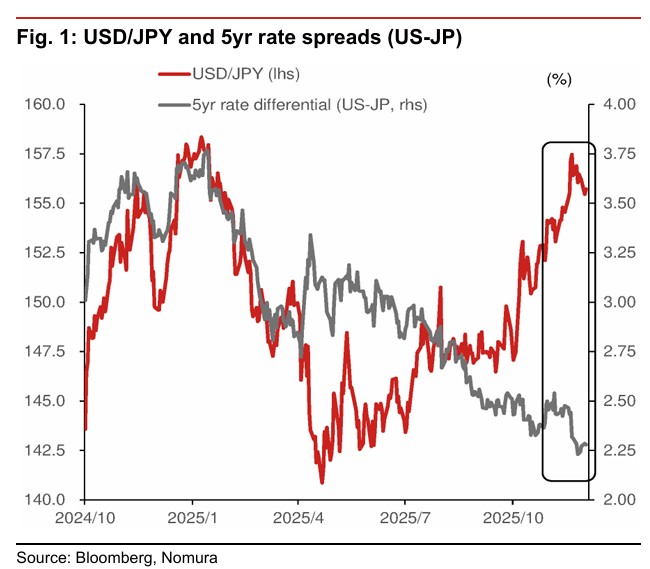
Nomura points out that the recent clear signals for interest rate hikes from the Governor of the Bank of Japan have led to a brief drop and subsequent rebound of the USD/JPY. Currently, the market's focus has extended to the interest rate path through 2026. The Finance Minister has stated respect for the central bank's monetary policy autonomy, and the future interaction between monetary policy and exchange rate policy will become a core variable affecting the yen's trend.
- USD/JPY briefly dropped below 155 before rebounding.
- The Governor of the Bank of Japan, Kazuo Ueda, released signals for interest rate hikes, strengthening the yen, which caused the USD/JPY to briefly drop below 155 but then rebound.
- For the yen to continue strengthening, it is necessary not only to solidify the expectations for a December rate hike but also to lead the market to further anticipate continued rate hikes in 2026, reaching a higher terminal rate.
- Recent movements indicate that even under the administration of Prime Minister Kishida, if the yen is weak, interest rate hikes may still be advanced, and the risk of currency intervention remains.
- The government maintains a non-interference attitude towards the Bank of Japan.
- Japan's Finance Minister, Shunichi Suzuki, pointed out that there is no disagreement between the government and the central bank on economic assessments, and therefore, there are currently no objections to interest rate hikes, emphasizing that the specific implementation of monetary policy is decided autonomously by the central bank.
- She mentioned that "there are fluctuations in the financial markets," and the government and central bank are closely monitoring corporate dynamics, which suggests that in the face of a weak yen and rising bond yields, the government may have increased its tolerance for the central bank's interest rate hikes.
- The potential inflationary upward risk brought about by the depreciation of the yen may drive the Bank of Japan to raise interest rates in December.
- If intervention through monetary policy is not implemented, it will be difficult to gain support from the United States; if the weak yen is addressed through interest rate hikes, the Ministry of Finance will find it easier to provide justification for foreign exchange intervention
- If interest rate hikes are implemented and the yen weakens again, the market needs to remain highly vigilant about the risk of foreign exchange intervention. Currently, the risk of the USD/JPY breaking 160 and rising significantly has decreased.
II. Dollar Under Pressure as Rate Cut Trades Return
Dollar Under Pressure as Rate Cut Trades Return (CICC)
CICC pointed out that the dollar's performance this year has been polarized. In the first half of the year, the dollar index fell sharply due to employment data and "reciprocal tariffs," triggering market "de-dollarization" trades. In the second half, the dollar entered a consolidation phase. Looking ahead, the suppression of the labor market by artificial intelligence technology and expectations of rate cuts put the dollar under renewed downward pressure.
- In the first half of this year, the dollar fell significantly overall.
- In the first quarter, the dollar index began to decline from a high level as a series of policies following Trump's inauguration were weaker than expected.
- In the second quarter, the dollar index fell sharply. On one hand, the softening of U.S. employment data raised expectations for rate cuts; on the other hand, the "reciprocal tariffs" in the U.S. far exceeded market expectations. Concerns about the stability of the U.S. economy and dollar asset returns led to a decline in the dollar's credibility, initiating a round of "de-dollarization" trades. The market reduced holdings of dollar assets to hedge against currency exposure.
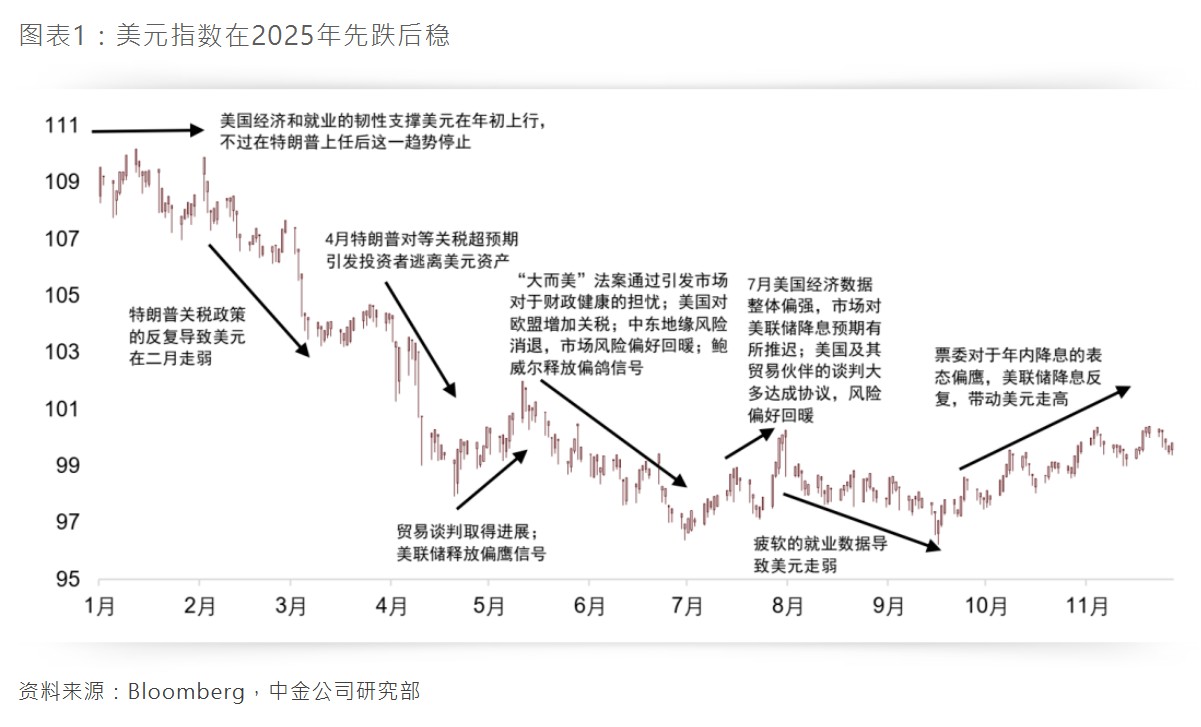
- In the second half of the year, the dollar index entered a consolidation phase.
- After the U.S. reached a tariff agreement with trade partners such as Europe, the UK, and Japan, market concerns about the stability of the U.S. economy and finance eased, slowing the "de-dollarization" process.
- However, with the realization of rate cuts in mid-September and rising political uncertainty in non-U.S. countries, the market temporarily lacked new trading themes.
- A weak labor market and pressure from the U.S. government may lead to the return of rate cut trades.
- Investments related to artificial intelligence are increasingly contributing to U.S. economic growth, which reduces the contribution of labor in production activities, leading to a decline in employment. This affects consumption and inflation, and the market may expect rate cuts to strengthen employment absorption capacity.
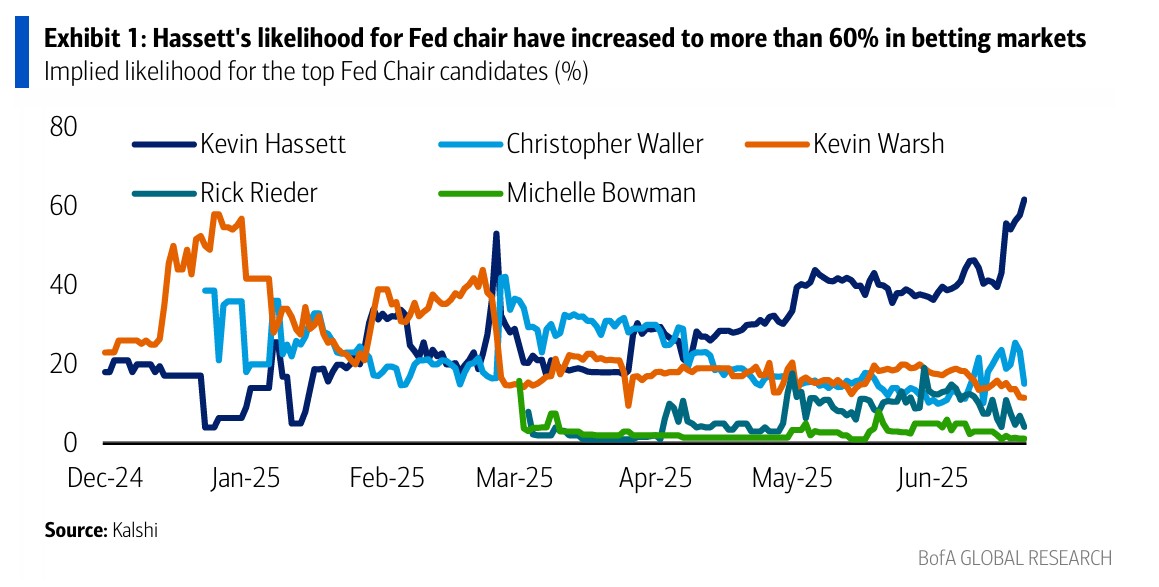
- Kevin Hassett, director of the White House Council of Economic Advisers, is a candidate for the next Federal Reserve chairman, supported by President Trump's advisors and allies. Hassett advocates for lower interest rates, and if the final chairman candidate leans towards him, the market may price in a more aggressive rate cut path, leading to a decline in the dollar.
III. Next Fed Chair May Be Dovish
Next Fed Chair May Be Dovish (BofA)
BofA pointed out that the expectation for the Federal Reserve to cut rates in December has become consensus, mainly based on rising unemployment rates and official statements. The subsequent policy path will be influenced by economic fundamentals and the next chairman. Although the next chairman candidate may lean towards a more accommodative stance, the committee's consensus decision-making mechanism and data dependency principles will constrain the space for aggressive rate cuts.
- It is expected that the Federal Reserve will cut rates by 25 basis points in December, with expectations for two additional 25 basis point cuts next year, and the terminal rate expected to be in the range of 3.0-3.25%, for four reasons:
- The unemployment rate in September has risen to nearly 4.5%; Federal Reserve Vice Chairman Williams has expressed approval for interest rate cuts; ADP data and the Beige Book indicate economic weakness; before the quiet period begins, market pricing reflects over 80% probability of rate cuts, which has not been officially refuted.
- Kevin Hassett is currently the frontrunner for the next chairman.
- If his nomination is confirmed, he may push for larger rate cuts, but as long as the economy remains stable, his proposals may not gain support.
- Unless economic conditions allow, the next Federal Reserve chairman will find it difficult to persuade the Federal Open Market Committee to lower interest rates below 3%.
- If the Federal Reserve cuts rates more than what the economic fundamentals require, it could lead to an increase in long-term Treasury yields, which may have a greater impact on the economy than the policy rate itself.
- Holiday consumption and PMI data will attract market attention.
- The release of U.S. economic data is gradually resuming. This week, the market will focus on ISM manufacturing and services PMI to assess whether economic activity is slowing, inflation is rising, and employment is contracting.
- Driven by "Black Friday" and "Cyber Monday" promotions, holiday consumption is entering a peak phase. Preliminary data shows that holiday consumption has increased compared to the same period last year.
Risk Warning and Disclaimer
The market has risks, and investment requires caution. This article does not constitute personal investment advice and does not take into account individual users' specific investment objectives, financial situations, or needs. Users should consider whether any opinions, views, or conclusions in this article are suitable for their specific circumstances. Investment based on this is at their own risk
