


Under high expectations, revenue growth slows down, and software giant Snowflake's stock price plummets
Snowflake's adjusted operating margin for the third fiscal quarter is expected to be around 7%, lower than the average analyst expectation of 8.5% compiled by Bloomberg, while the company continues to face increasing competitive pressure. The dual challenges of margin pressure and intensified competition test investors' confidence in this cloud data giant, leading to an 8.25% plunge in Snowflake's after-hours stock price
Cloud data management company Snowflake's operating profit margin failed to meet Wall Street expectations, raising concerns in the market about the profitability of its AI tools.
Snowflake's financial report released on Wednesday showed that the adjusted operating profit margin for the third fiscal quarter was approximately 7%, below the average analyst expectation of 8.5% compiled by Bloomberg. Product revenue was about $1.2 billion, exceeding the market expectation of $1.19 billion.
The profit margin falling short of market expectations triggered investor sell-off, causing the stock price to plummet 8.25% in after-hours trading, although it has still risen 72% year-to-date. Despite the company subsequently announcing a $200 million partnership with Anthropic, the stock price has not fully recovered.
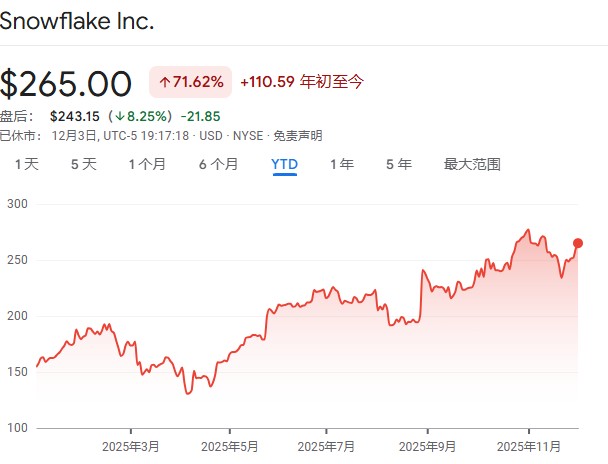
The company's product revenue for the third fiscal quarter grew 29% year-over-year to $1.16 billion, with growth slowing compared to previous periods. Product revenue accounts for about 95% of the company's total revenue, and its slowdown is seen as a signal of weakening business expansion momentum. Although the key metric of remaining performance obligations grew 37% year-over-year to $7.88 billion, exceeding analyst expectations of $7.23 billion, the market is more focused on profitability rather than order backlog.
Profit Margin Raises Market Concerns
The operating profit margin forecast provided by Snowflake became the direct trigger for the stock price decline. The target of a 7% adjusted operating profit margin not only fell short of analyst consensus but also highlighted the cost pressures the company faces during its AI transformation.
Since the appointment of new CEO Sridhar Ramaswamy at the beginning of 2024, the company has completed four acquisitions this year, primarily aimed at strengthening AI-related capabilities. These investments have significantly dragged down profit margins in the short term.
On Wednesday, the company also announced a $200 million partnership with Anthropic to integrate the latter's Claude AI model into the Snowflake platform. Following this announcement, the stock price decline narrowed somewhat, but investor concerns about the return on investment in AI business have not completely dissipated.
Snowflake's product revenue for the third fiscal quarter was $1.16 billion, with an adjusted earnings per share of $0.35, better than the analyst expectation of $0.31 and product revenue of $1.14 billion, but investors are more worried about future growth potential.
Competitive Pressure Continues to Intensify
Market skepticism about Snowflake's valuation partly stems from the deteriorating competitive environment. According to a report by The Information in November, its main competitor, the private company Databricks, is negotiating financing at a valuation exceeding $130 billion, which would significantly surpass Snowflake's public market valuation.
Bernstein analyst Firoz Valliji wrote before the earnings announcement: "In the long term, we are encouraged by the innovation and execution under the new CEO's leadership. However, we remain concerned that competition in its core market is intensifying." Snowflake helps enterprises organize, analyze, and store data in the cloud, but this core business is facing an increasing number of challengers BNP Paribas analyst Stefan Slowinski stated that Snowflake's stock price has risen over 70% this year, far exceeding its peers' performance, and "the bar has been set very high," so the decline in stock price after the earnings report is not surprising. As of Wednesday's close, the company's market capitalization was $89.7 billion.
Despite maintaining a considerable increase for the year, the dual challenges of margin pressure and intensified competition are testing investors' confidence in this cloud data giant
